
Hmmm... that's interesting.

Articles and other literary ticklers.

My Photo
Name: Ariel Atienza
Location: Mandaluyong, Philippines

Sunday, April 30, 2006

17 ways to landscape on the cheap
It's easy to spend thousands cultivating an idyllic lawn and garden. But a little ingenuity and patience will go a long way to keeping some green in your wallet, as well.

By Ann Archer

Traditional thinking says you should expect to pay anywhere from 5% to 15% of your home's value on landscaping. Even at the low end of that range, you're looking at spending $10,500 if you live in the median-value American home worth $213,000.

That's tough to stomach no matter how much you love the outdoors. Thankfully, you can do it right and still spend a fraction of that amount. Here's how.

Get the most visual bang for your buck: First of all, realize that budget gardening can still be beautiful. Let's say you've got less than $1,000 to spend. The first things you should focus on are improving your soil and adding trees, recommends Joanie Clarke, a design consultant for Classic Nursery and Landscape Co. in Redmond, Wash. "You can spend $500 on plants, but they're not going to grow in clay or sand," she says. Clarke advises amending your soil with compost and other ingredients to improve its quality. Buying soil, in comparison, can cost as much as $27 a yard plus delivery.

Take advantage of freebies

• Your city, your friend: Cities often give away free trees, mulch and compost. In Seattle, for example, groups of neighbors can request 10-40 trees from the city in exchange for planting and maintaining them.
• Demolition sites: These are great sources for bricks and stones, but make sure you have permission to remove them.
• Fellow gardeners: See something you like in a neighbor's yard? Offer to trade cuttings. Also, set up seed exchanges with other gardeners or check out existing exchanges online such as those on iVillage's GardenWeb and GardenHere.com.
Avoid costly mistakes: Really think about how you're going to use your outdoor space. If you plan a water feature but are annoyed by the noise of babbling brooks, you’re going to spend more money ripping it out and replacing it with something else later. Take the time to educate yourself and you'll avoid common pitfalls such as planting a tree too close to your house.

Work with what you have: Preserving existing plants and trees can help you save the cost, materials and resources needed to establish a new planting. Educate yourself about plant care and pruning; that 12-foot magnolia in the back yard would likely cost you $65 and five years of growing to replace. (For tips on pruning, check out this page on the U.S. Forest Service site.) Similarly, knowing which areas in your yard are flood-prone and which are always in the sun can help you buy the right plants for the right conditions. Some areas might be better for swing sets or patios.

Hire yourself: The best way to save money in landscaping is to do as much work as possible yourself. A 3-gallon bush may cost $20, but the price skyrockets to $30 or $40 when it's planted by a landscaping professional. A $3-to-$4 perennial will cost about $12 installed.

Know when to hire the pros: There are times when it makes sense to hire a pro. Beverly Katz of Exterior Designs in New Orleans suggests hiring help for jobs that take more muscle or design skill than you have, such as creating hardscapes, while you take on more manageable tasks such as planting small shrubs and perennials. (You can find landscape architects at the American Society of Landscape Architects Web site and certified landscape designers at the Association of Professional Landscape Designers Web site.)

When using pros, try to get a packaged deal: Check out nurseries that offer landscaping services. Many will offer discounts on plant material to their landscaping customers. Classic Nursery and Landscape Company in Redmond, Wash., for example, offers a 20% discount on all plant material for one year to their clients.

Hire a consultant: A full landscape design that includes drawings and a planting plan can cost anywhere from a couple of hundred dollars to more than $1,000, depending on the complexity of the design and the overall budget of the project, according to Katz. A less-expensive route is to draw your own plan and hire a landscape designer to review it. "I charge $100 to $150 an hour to consult. I’ll make notes and add to the plan," said Katz.

Take a phased approach: Divide your plan into phases and pay as you go with funds on hand. You'll save on loan or credit costs and be able to evaluate your progress and adjust plans before moving to the next phase.

Time your purchases: Buy trees, shrubs, perennials, soil and mulch late in the season when retailers want to be rid of them. Depending on your region that could be early fall, a great time for planting because it gives the plant time to develop roots before the summer heat arrives.

Check alternate resources: Look beyond stores for bargains. Arboretums, botanical centers, plant societies and gardening clubs often hold plant sales. You can join The National Arbor Day Foundation for $10 and receive 10 free trees shipped to you at no cost. At Free Trees and Plants, a retail Web site that helps train and employ the disabled, you only pay shipping and processing fees on all your orders.

Buy small: Purchase small-sized plants; five 1-gallon Shasta daisies at $3 apiece cost the same as one 3-gallon plant at $15 at Armstrong Nursery in Carlsbad, Calif. Depending on the species, the smaller plants could double in size in two years, giving you more plant for your money.

Protect foundations: Roots can damage concrete blocks, driveways and sidewalks, so plant large trees at least 30 feet from those areas.

Divide: Look around your yard for any perennials that can be divided and used elsewhere in the landscape. A one-gallon perennial can cost about $9 at a nursery, but you can easily divide the one you planted last year into four plants, saving $27.

Compost: Save money on fertilizers and mulch by composting your own, using yard waste and food scraps. Compost piles can be made of recycled 2 x 4s and chicken wire. All you need is access to the pile and enough space to turn it every now and again. You'll pay as much as $5 per small bag of compost at your local home improvement store.

Think about maintenance: A large lawn is great if you don't mind mowing. But if paying a yard guy $50 a week is part of your plan, make sure that goes into your budget.

Be water smart: According the Environmental Protection Agency, outdoor water use constitutes almost 20% of total home water use. Look for plants that are drought-tolerant to save on your water bill.

Finally, be patient. Plants will not fully mature for a good two to three years, longer for trees and many shrubs. Enjoy the process -- and the money you saved.

Missing soldier dies in hotel ductwork
Body found in air conditioning unit ID’d as Iraq war vet missing for 12 days

The Associated Press

AP
Army Spc. Robert Hornbeck is shown in an undated photo provided by his family.


SAVANNAH, Ga. - A Fort Benning soldier missing 12 days before his body was discovered in a downtown hotel died after he got caught in an industrial-sized air conditioner, officials said Saturday.

A maintenance worker at the DeSoto Hilton hotel found the man’s body Friday in an area accessible through a maintenance door after guests complained of a foul odor in the lobby.

He died after being struck by a large, spinning blower wheel, said Lt. Mike Wilkins, a spokesman for Savannah-Chatham County police.

“At this point, it appears to be an accident,” he said.

‘At least we have closure’
An autopsy Saturday confirmed the identity of Spc. Robert Hornbeck, 23, of Lapeer, Mich., who was last seen outside the hotel April 16 after a late night of bar-hopping with an Army buddy. He answered his cell phone briefly after his father arrived just after 3 a.m. to give him a ride. He said, “Dad, I’m on the stairs,” then the connection went dead.

Family members spent nearly two weeks combing Savannah’s historic district for him. They posted fliers with Hornbeck’s photo in store windows, took out a full-page ad in the local paper and offered a $10,000 reward.

“At least we have closure and we can get him home and do the proper things to honor him,” said Kirk Hornbeck, the soldier’s uncle in Savannah.

Police had not determined how Hornbeck got into the hotel maintenance area or what he was doing there. He was not a guest at the hotel. Blood toxicology tests were also being performed. Hornbeck’s father had previously said he suspects his son was intoxicated.

“I think maybe he’d in fact had too much to drink,” Kirk Hornbeck said. “He might’ve thought he was going out the right door to the outside and got turned around inside the building and ended up in the wrong spot.”

Recently back from Iraq
The soldier had traveled to Savannah to spend Easter weekend with his father and stepmother. He had returned to Fort Benning in January from a yearlong tour in Iraq with the 3rd Infantry Division.

Hornbeck planned to leave the Army at the end of April and return to the University of Michigan, where he studied psychology before joining the Army in 2004. He was scheduled to marry his college sweetheart in July.

Hornbeck’s father was traveling back to Michigan on Saturday, where the family planned to bury Hornbeck with military honors, his uncle said.

While you were sleeping, the paperboy grew up
Readers bemoan loss of community as more adults take over routes

The Associated Press

Julia Malakie / AP
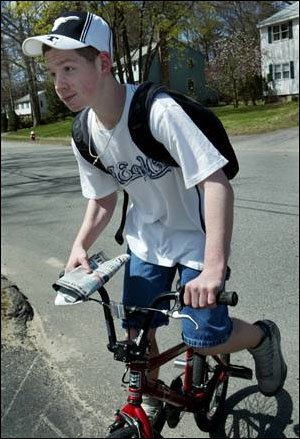
J.J. Polcari, 15, of Wilmington, Mass., delivers copies of the Lowell Sun along his route on Tuesday. Teenage paperboys are a dying breed, as adults now make up 81 percent of the country’s newspaper carriers.


WASHINGTON - A young teen riding his bike at dawn reaches into his shoulder bag, grabs a tightly folded newspaper and deftly throws it to the front steps.

It’s an image as American as apple pie, but the paperboy has gone the way of the milkman.

Today’s papers usually arrive by anonymous drive-and-toss. For reasons including the demise of afternoon papers, a shift to centralized distribution and earlier delivery deadlines, adults in cars now make up 81 percent of the country’s newspaper carriers.

“I don’t know who delivers my papers,” said Stacey Rufe of Glen Allen, Va., lamenting the disconnect she has with her Washington Post carrier. “When I was growing up, our carrier was my friend Mike and his brothers. If you had a problem, you called Mike.”

As recently as 1994, more than half of newspaper carriers — 57 percent — were under 18, often neighborhood kids, according to the Newspaper Association of America.

As the job moved into the hands of grown-up independent contractors, who don’t come to the door for payment anymore, many bemoan the lost sense of community in which the paperboy played a unique role. Also lost is an opportunity that gave children as young as 10 business skills.

Rite of childhood
If you weren’t a paperboy or girl, your sibling, parent or friend was. And if you didn’t do it, you subbed for your brother when he went to scout camp. Parents, more likely than not, helped — either driving on bad weather days or helping stuff inserts into the Sunday papers.

Some former paperboys recall loving the responsibility and sense of pride; others hated the early mornings and collecting from stingy subscribers.

“It was a great first job because I had to manage for myself,” said George Rohling, 41, who delivered The (Spokane, Wash.) Spokesman-Review in the 1970s. Like most paperboys, Rohling was paid according to how many papers he delivered, and he collected payments each week. “I wasn’t standing at a register, asking if they want fries.”

President Truman, actors John Wayne and Bob Hope, and baseball star Willie Mays all had paper routes when they were young. So did TV journalist Tom Brokaw, cartoon great Walt Disney and investment whiz Warren Buffett.

Teens and tweens really started delivering America’s papers in the postwar era, NAA Vice President John Murray said. Boys had hawked newspapers on city street corners, and as customers moved to the suburbs, it was a natural fit.

“They were appealing, tenacious and would work in a small window of time,” Murray said. In return, delivering papers rewarded kids “relatively speaking, handsomely.”

More than a job
In the 1950s, Henry Petroski earned the then-lucrative sum of $20 a week delivering the Long Island Press each afternoon and Sunday morning. The job taught him how to deal with people and money, as well as how to fold a paper.

“It wasn’t that easy; the first few times the paper would open in the air and would fall apart,” said Petroski, now a Duke University professor and author of a memoir, “Paperboy: Confessions of a Future Engineer.”

“By learning what didn’t work, you learn eventually what not to do more than the secret of doing it right.”

Now Petroski receives his Durham Herald-Sun each day from an adult driving a car. It’s not the same, particularly when it rains.

“When I was a paperboy we would what we called ’doorknob,”’ he said. “You would walk up to the door and put the paper in the storm door. Here, it’s just a yellow plastic bag at the bottom of the driveway.”

You missed — whoever you are
Rufe, 34, never knows where to expect her paper, or even what paper she’ll get.

“Today (the paper) was on the bottom of our steps, usually it’s on the driveway, sometimes it’s in the paper box,” said the part-time lawyer. She said she’s received The Financial Times, The New York Times and The Korean Times, many times in lieu of her preferred Post.

Yes, she can call the Post to complain, but “If I knew who my carrier was, I could call him,” she said.

At least one paper is bucking the trend. Since December 2005, The Sun in Lowell, Mass., has shifted about 2,000 papers from adult routes back to youth carriers.

“It’s strengthening everything all the way around,” Circulation Vice President Michael Sheehan said. Routes grow future newspaper readers, he said, while young carriers provide better service and create customer loyalty. Sun paperboy Joseph “JJ” Polcari, 15, is learning about the value of good service. A five-year veteran of delivering Sun papers, he was recently named carrier of the week.

“If you treat people well, they give you good tips,” said Polcari, who earns about $40 a week. Delivering 20 papers takes only 20 minutes each day, he said, thanks to his bike.

And the work is paying off: His mother, Debbie, said J.J. is saving for a car and already has enough for insurance.

Yet this return to youth carriers is an alternative not open to many morning papers. In Bloomington, Ill., The Pantagraph employs about 200 young people in its carrier force of 480. Circulation director Bill Hertter says it’s tough these days to find teens willing to deliver the morning paper by 6 a.m. every day.

“Money is too available,” he said. “Why would they want another five, 10 bucks when they have everything?”

Cute ways to get close
By Maggie Kim

It’s the end of your first date and suddenly, your date’s personal space seems like a no-fly zone. Breaking the physical barrier for the first time can seem daunting, but here are some real people’s creative maneuvers to get touchy-feely—without seeming creepy.

1. Do a practice touch.
Going for a hand-hold or kiss after not having touched a person at all can be anxiety-provoking for both of you. But casually touching the person mid-conversation gets you both used to being close, which makes things easier later. “I’ll often touch people to emphasize a point, show empathy or even to highlight humor, like an affectionate light slap on the arm,” explains John Emch from Seattle, WA. A similar strategy is to make a relatively big move—but then back off. Peter B. from New York, NY, does this by putting his arm around a date and then removing it. “I’ll just throw my arms around a girl’s shoulder like I would a friend’s at the start of a date,” he says. “It lightens the vibe up immediately because it’s just me being friendly.” It also sends the message early on that he’s interested, which lets his date give her own cues freely and without fear of rejection.

2. Rely on chivalry.
Small, gentlemanly gestures are an unthreatening way to make contact. “I hold my hand out to help a date out of a taxi,” says Jeremy Kagan from New York, NY. “It's polite, and it allows my date to be the one to actually reach out.” Put your hand on your date’s lower back as you go through a door, or help your honey out of a car—or into a coat. “My ex-boyfriend used to help me with my coat, then lift my hair out from under the coat for me,” says Ann Lee from Philadelphia, PA. “It was thoughtful and also sensual to have his hands brush against my neck and stroke my hair.” And ladies, there’s no need to wait for the guy to make a move. “If I’m walking with my date, I reach for his arm so we wind up linking arms,” says Megan of Morristown, NJ.

3. Lean in.
When you’re sitting very close together, the space you must cross to touch one another becomes much smaller—and less terrifying. “I took my now-girlfriend to a concert in the park,” says Bryan Dunn from Austin, TX. “It was really crowded, so we had to stand close together... and that kind of closeness often leads to kissing.” You can get the same effect by sitting right next to each other at a tiny café table, too. Even if you’re not in a crowd or sitting right next to each other, try lowering your voice gradually over the course of the date—you’ll find yourselves leaning closer just to talk, with your faces getting nearer to each other than they would be otherwise.

4. Cook something up.
During at-home dates, teaming up in the kitchen lends itself to getting cozy. “As a chef, I know for a fact that asking your date to help in the kitchen is a good way to initiate touching,” says Matthew K. from Portland, ME. “You make contact when your bodies pass by each other in the close quarters or when you show your date how to chop properly.”

5. Sniff it out.
An innocent excuse to zoom in on a person’s touch zone sends the message that you’re interested in more, and you don’t have to be brazen to pull it off. “I was at a bar with a guy who seemed too shy to make a move, so I sniffed the air near him and said, ‘Wow, what’s that smell?’” says Stasia King from Los Angeles, CA. “I sniffed all around and then zeroed in on his neck area and exclaimed, ‘Oh, it’s you!’ Then I leaned in for a long, slow, circular inhale just under the earlobe. He got the picture after that.”

6. Pick a hands-on date activity.
For an easy intro, choose an activity that requires closeness anyway. “I take my dates salsa dancing,” says Johnny F. from Houston, TX. “You have no choice but to touch each other and move together in a pretty sexy way. Even if you’re not good dancers, you can laugh about how you’re missing the steps.” If dancing isn’t your style, try something else physically active (like rock climbing) that requires participants to make contact.

7. Be direct.
What keeps many people from breaking the touch barrier is not knowing whether their dates are interested. Being brave enough to ask makes it obvious that you are looking for contact, and you two will know what to do next. “I’ve really been straightforward,” says Leonard R. from Los Angeles, CA. “I just say, ‘Can I kiss you?’ It’s worked out pretty well!” Tina H. from Miami, FL, puts a fun twist on it. “I’ve said to guys, ‘You want to kiss me, don’t cha?’ They love it because it takes the pressure off them but it’s still light and fun.”

Friday, April 28, 2006

Perdue approves Bible classes, Ten Commandments bills
By Matthew S.L. Cate, Staff Writer
The Chattanooga Times Free Press

Chattanooga, TN - Georgia Gov. Sonny Perdue put his signature on two bills Thursday designed to promote the Bible in the public sphere but likely to face legal challenges over their constitutionality.

Under one new law, public schools can offer elective courses on the Old Testament and New Testament starting in the next school year. The other law gives local governments a blueprint on how to post the Ten Commandments with other historical documents.

"Governor Perdue signed these bills into law today because the Bible is one of the original textbooks in the history of human existence," gubernatorial spokeswoman Heather Hedrick said. "It's an acknowledgment of the importance of these two documents as historical documents."

Supporters have said both bills were drafted to allow communities to recognize the Bible's impact on Western civilization and U.S. democracy. They said the laws have been designed to withstand any constitutional challenges and to provide state-funded legal help to defend local governments.

Opponents said the bills blur the lines that should separate public policy from private religious convictions.

"We don't want the government getting involved in our religious viewpoints," said Maggie Garrett, a staff lawyer with the ACLU of Georgia. "It is troubling when you look at bills like this."

The Ten Commandments bill passed the General Assembly with four dissenting votes out of 236, and the Bible courses bill had nine "no" votes. That's a margin one Northwest Georgia lawmaker said proves the bills' popularity with the general public.

"This is mainstream America," said Sen. Jeff Mullis, R-Chickamauga. "Maybe if we put this back in our society, it will turn out to be a better society."

The laws stipulate that local officials can offer a different Bible course, or none at all, or post the Ten Commandments how they see fit, just as they have in the past. But doing so would forfeit state help in defending their actions.

Ms. Garrett said the ACLU closely will watch how individual schools teach the as-yet undeveloped Bible-based lesson plans. The group could file a lawsuit as soon as someone "comes to us with a case" once the Ten Commandments are posted, she said.

The state Board of Education now must develop curriculum for optional high school classes titled "History and Literature of the Old Testament Era" and "History and Literature of the New Testament Era."

While other materials may be used in the class, the new law stipulates that the primary textbook will be the Old Testament and New Testament. The law forbids teachers from proselytizing.

Northwest Georgia school officials have said they will consider offering the Bible courses, though they must weigh resources and community interest.

"We have to make sure we have enough teachers available to teach the courses required to graduate," said Marissa Chambers, spokeswoman for Catoosa County Public Schools.

The Ten Commandments proposal arose after a federal judge ordered Barrow County, Ga., officials last summer to remove a posting at the county courthouse.

Also last year, the U.S. Supreme Court issued rulings on the matter striking down a Kentucky posting while approving a Ten Commandments display in Texas that was surrounded by other religious and secular monuments.

To get state-funded legal help to display the Ten Commandments, Georgia courthouse displays must include copies of the Mayflower Compact, Declaration of Independence, Magna Carta, lyrics of the national anthem, preamble to the state constitution, the Bill of Rights and an image of Lady Justice.

Georgia Lawmakers Want Bible To Be Standard Textbook In Public Schools
WVTM-TV

Georgia wants to make the Bible a standard textbook in public high schools. Georgia lawmakers overwhelmingly passed the bill; now it goes to the governor's desk.

If signed, the law would become the first of its kind in the country.

Those who oppose the bill said they're ready to fight it, since very few students have expressed interest in religion electives already offered in school.

Clergy group attacks schools’ Bible study course
Watchdog group says class promotes fundamentalist Christian world view

The Associated Press

Dr. Mark Chancey, professor of biblical studies at Southern Methodist University, center, speaks Monday in Austin, Texas, about a report he wrote for Texas Freedom Network examining a Bible study course marketed to public schools. Kathy Miller, the network's president, at left, joined Chancey in denouncing the course.
Thomas Terry / AP


AUSTIN, Texas - A religious watchdog group complained Monday that a Bible study course taught in hundreds of public schools in Texas and across the country promotes a fundamentalist Christian view and violates religious freedom.

The Texas Freedom Network, which includes clergy of several faiths, also said the course offered by the Greensboro, N.C.-based National Council on Bible Curriculum in Public Schools is full of errors and dubious research.

The producers of the Bible class dismissed the Texas Freedom Network as a “far left” organization trying to suppress study of a historical text.

The National Council on Bible Curriculum Web site says its elective course is offered in high schools and junior highs by more than 300 school districts in 37 states.

Texas Freedom Network President Kathy Miller said her group looked at the course after the Odessa school board voted in April to offer the class. It asked Southern Methodist University biblical scholar Mark A. Chancey to review the curriculum.

Chancey’s review found that the course characterizes the Bible as inspired by God, that discussions of science are based on the biblical account of creation, that Jesus is referred to as fulfilling Old Testament prophecy, and that archaeological findings are erroneously used to support claims of the Bible’s historical accuracy.

He said the course also suggests the Bible, instead of the Constitution, be considered the nation’s founding document.

“No public school student should have to have a particular religious belief forced upon them,” the Rev. Ragan Courtney, pastor of The Sanctuary, a Baptist congregation in Austin, said at a news conference held by Texas Freedom Network.

Counter-assertions
Elizabeth Ridenour, president of the Bible class group, accused the Texas Freedom Network of censorship.

“They are actually quite fearful of academic freedom, and of local schools deciding for themselves what elective courses to offer their citizens,” she said in a statement.

According to the Texas Freedom Network, 52 Texas school districts offer the class. In Odessa, more than 6,000 people signed a petition in support before it was approved in April.

Although representatives of the Bible council have attended school board meetings in Odessa, superintendent Wendell Sollis said course materials have not yet been selected.

Miller said the Texas Freedom Network supports study of the Bible as a significant historical text, but not in a way that amounts to religious indoctrination.

See You in Bible Class
Georgia plans to teach the Good Book in schools.

By Sarah Childress
Newsweek

Paul Zoeller / Odessa American-AP
Appeal: Leading a prayer outside school district offices in Odessa, Texas, as officials debate adding the Bible to the curriculum


May 1, 2006 issue - Fresh from a bruising federal court fight over the teaching of evolution, Georgia marched back into the culture wars last week when Gov. Sonny Perdue signed a bill allowing Bible classes in public high schools. An estimated 8 percent of the nation's schools offer some form of Bible study. But the Georgia law is the first to set statewide guidelines and earmark public dollars for a Bible course. Five other states are considering similar measures. Georgia's school board has until February 2007 to decide how the courses should be taught, and forces on both sides of the issue are bracing for a messy battle.

In the past, school Bible lessons were informal. Now two groups with national influence and powerful backers are offering states comprehensive curricula. Last fall the nonprofit Bible Literacy Project published "The Bible and Its Influences," a textbook endorsed by moderate Christian and Jewish groups. So far, 30 schools are teaching the pilot program, and the group says 800 schools have shown interest. Meanwhile, the National Council for Bible Curriculum in Public Schools, backed by a long list of conservative evangelicals, including Pat Robertson, says its curriculum is already taught in 353 school districts. However, if Georgia opts for either program it will be the first time that a state has officially adopted a Bible curriculum. "You can't turn a public-school classroom into a Sunday-school classroom," says Dan Quinn, spokesman for the Texas Freedom Network, a watchdog group that commissioned a report on the council curriculum. The study, written by Mark Chancey of Southern Methodist University, says that the program teaches the Bible from a primarily conservative Protestant view. The council says its approach is constitutional. Just in case, it offers legal aid to districts that teach it. State Sen. Tommie Williams, one of the Georgia bill's authors, used the council's curriculum as a guide when drafting his proposal. "We simply have to teach 'This is what happened—make your own judgments'," he says.

Whatever the Georgia state school board decides, observers predict a flurry of lawsuits. And Georgia teachers will once again find themselves in the cultural cross-fire.

Gimme That Prime-Time Religion
With so many faiths celebrating holy days in the spring, it’s important to remember why we believe what we do.

WEB-EXCLUSIVE COMMENTARY
By Marc Gellman
Newsweek

April 12, 2006 - During this week and in the days ahead, most religious people on earth are preparing for some holy day. A jumble of Jews will be observing Passover. A mass of many Muslims will observe Mawlid al-Nabi, the celebration of the Prophet Muhammad’s birthday. Several Sikhs will observe Baisakhi, which is their spring holiday. A bunch of Buddhists will be preparing for Wesak Day at the full moon of May (Lots of Lamaist Buddhists from Tibet wait one month for Wesak). Wesak is the day the Buddha was born, became enlightened and died. And of course for Christians, this week began with Palm Sunday and ends with Easter.

Springtime is prime time for religion, and luckily for the media conglomerates, it also includes sweeps week and the opening of “The Da Vinci Code.” So, let me take a moment to celebrate the many ways my brothers and sisters of faith welcome this season, and the way the media hunker down to survive it, profit from it and appease the doubting of their secular customers.

The main accusation cynics throw against religion and its defenders is their belief that the foundation stories of religion are not true. The most recent and popular fictional iteration of this antireligious screed is “The Da Vinci Code” and its by now well-known thesis that Jesus was married to Mary Magdalene (the true Holy Grail) and had a child. The knowledge of this fictional truth has supposedly been kept a secret by the Knights Templar, a group of dedicated Christian ninjas, until, of course, it was finally revealed to the world by Dan Brown and the PR department of Random House.

In the world of archeology, the recent surfacing of the Gospel of Judas from its decades-long repose in a safety-deposit box in a bank in Hicksville, Long Island, now casts doubt on the gospel account that Judas betrayed Jesus for 30 pieces of silver. The new version, based on anti-Christian Gnostic texts, is that Judas was a trusted accomplice in the effort to get Jesus crucified so that he could fulfill his mission on earth.

What Christians can say in response to the DaVinci/Judas flap depends upon how seriously one takes Dan Brown as a theological expert and how important the role of Judas was to the role of Jesus as the Messiah sent by God to heal the sins of the world. Brown is a novelist and that, really, is that. As long as Brown claims his book is fiction, it should be treated as such, although it is fair to be highly suspicious of any work of fiction that has as its effect the spreading of unsubstantiated lies about a tradition that has brought faith, hope and charity to millions. As a Jew, I am too often called upon to remind people that the anti-Semitic “Protocols of the Elders of Zion” is also just a fictional creation meant to whip up anti-Jewish sentiments.

It is important, however, to distinguish the details of Jesus’ life and the belief in Jesus' mission. Facts may alter this or that historical verdict on the role of Judas or the life of Jesus, but no historical facts can deflect or damage the belief in Jesus as the Christ, which remains the central claim and enduring promise of Christianity. There is one exception to the invulnerability of Christianity to historical refutation, and that is the resurrection of Jesus. If it could be shown through irrefutable historical and textual evidence that Jesus' followers stole his body from the cave and cooked up the story of his resurrection, then the spiritual project of Christianity would indeed suffer a mortal blow. However, this is highly unlikely, and even if it were possible to prove this, it would still not diminish, for example, the vision of Paul on the road to Damascus nor the heroic martyrdom of Christians for their faith nor generations of Christian saints and scholars who have taught a vision of salvation that sustains and sanctifies one out of every three people on earth. Christianity is primarily built on sacred history and, save the one event of the resurrection, that history is immune to the vicissitudes of history as determined by National Geographic Society, Random House and Columbia Pictures.

Tonight my faith commands me and excites me to remember the going out of Egypt, the plagues there, the splitting of the Red Sea and the burning mountain where Moses received the Torah written in black fire upon white fire. If it were somehow possible to prove that nobody left Egypt, and that the miracles never happened, and that the law was cooked up by a bunch of priests in the time of David, it would insult my faith, but it would not diminish it, because the message of the Passover is a message of freedom, and freedom remains God's gift to all people. This is true not only because historical events from the Exodus to today proves it. It is true because the spiritual legacy of freedom cannot possibly be false.

A proposition can be true, philosophy reminds us, by correspondence or coherence. It can be true because it corresponds to something that happened in the world, or it can be true because it forms a coherent explanation of the way the world works. Religion is the first coherent explanation of why we are here on earth and what we are meant to do and hope and endure and transcend. Everything else is just Nielsen ratings.

Happy Passover, Easter, Baisakhi, Wesak and Mawlid al-Nabi. And to everyone else who just doesn't know what to believe, Happy Springtime!

Voyage Apart in the Same Direction
Everything I have learned about brides and grooms.

WEB EXCLUSIVE
By Marc Gellman
Newsweek

June 2 - Since the author of The Spiritual State in June is overscheduled with weddings, this seems to me an appropriate time to tell you everything I know about brides and grooms. I have watched a parade of them enter my office, enter the holy state of matrimony and enter the world as its newest family. Marrying these people (and naming babies) has made every fractious and interminable committee meeting I have ever attended seem to be merely a minor annoyance.

At first, 33 years ago, I used to ask everything and listen to everything brides and grooms said as they gurgled out their love for each other. Now I ask less and listen and watch more. This is what I have learned. I am sure that other preacher folk have learned the same things from touching other springtime loves. Do they touch and do they laugh? This is the single most important question I ask about people in love who want to get married. They are all I look for now.

Brides and grooms who do not touch each other, hold hands, sneak a kiss, touch the other’s cheek or brush away a stray lock of hair, but instead sit apart as if they were riding on a bus alone, they have no chance. Of course I cannot know this for sure, but I am sure nevertheless. They may stay married for 60 years but they have no chance of ever having even a single day of true passion and true love. I am not looking for physical lust. What I am looking for is the sheer joy of touching the one you love. You can learn this lesson in death as well. We bury our loved one in the ground and put a marker stone on top of the grave so that we can touch the stone that touches the earth that touches the one we love. Touching is the way love begins and it is the way we try to keep it from ending even in the face of death. Once, at a funeral I was told by a couple’s children that they used to walk in on their mom and dad slow dancing together in the living room. I was entranced by that image because I know that in dancing with the one you love, it is never the music that matters, it is always the touching.

I also watch to see if the brides and grooms sitting across from me laugh at anything. I am definitely funny enough to deliver some sure-fire laugh lines, but even in the absence of my own humor, I watch to see if they find certain things about their wedding, or their relationship or the world in general so silly, so amusing, so ironic, so joyous that they just cannot hold back a giggle or a laugh. Unlike touching, which is an obvious consequent of physical passion, laughter is not. Laughter can be caused by many things, love is but one of them. But for me, laughter reveals trust and joyousness, humility and helplessness in the face of love. In older people who have not been Botoxed, I read their wrinkles for signs of laughter. A life of laughter puts laughter wrinkles at the corners of your eyes (crow’s feet be damned--they are laughter wrinkles). Conversely, a life of frowning imprints itself on your face with frown wrinkles between your eyebrows. You can pretend to be an optimist or a cynic, but your wrinkles will always give your real self away. When brides and grooms giggle and laugh it shows me that they are genuinely happy to be with each other, and that they are similar enough to find the same things funny.

I will marry people who do not touch, and I will marry people who do not laugh, but if they don’t touch or laugh I try to talk up the virtues of the other rabbi down the street or I tell them that on the day of their proposed wedding I suddenly realized that I will be in Patagonia herding penguins. If you are in love, or if you are watching your child or grandchild or friend fall in love, take my advice: don’t listen to anything they say about their love for each other. Just watch and listen and ask the only questions I ask: “Do they touch and do they laugh?” It really is all that matters.

One final thing. I always ask brides and grooms what they love about each other, and then I listen to their lists. If the list is filled with qualities that will not fade in time, I know they are OK. If the list is filled with self absorbed or outward attributes, I use the penguin line. And if anyone dares borrow the line from the movie Jerry Maguire, “he completes me,” I threaten them with bodily harm. Mostly, all brides know what they love about their fiancés. Mostly, all grooms know what they love but have no real ability to put it into words. That’s OK with me. Men are limited creatures. Except for David and Dana. When I asked them what they loved about each other, Dana said, “Once we were driving over the Triborough Bridge on a blazing hot summer Sunday. There was a guy at the approach to the toll booths selling newspapers. David bought all the guy’s newspapers and told him to go get out of the sun.” Then David said, “Dana teaches kindergarten, and one morning she was sitting on the bed naked working out some project with little stick-on letters for the kids. She would not go out for breakfast until she finished her lesson for her kids. When she was finally finished, she got out of bed and walked away from me to the bathroom. I saw that a little silver 'A' was stuck to her butt.” They both asked me why I was crying, and I just could not explain that in my line of work you just don’t hear perfect answers that often.

When I marry brides and grooms who have passed the laugh/touch test and who love things about each other that have nothing to do with their abs or boobs, I bless them. Rarely, and only if they are like David and Dana, I will share with them these unpublished words about marriage written by D. H. Lawrence from the Modern Library edition’s introduction to “Lady Chatterly’s Lover”:

So it must be: a voyage apart in the same direction. Grapple the two vessels together, lash them side by side, and the first storm will smash them to pieces. This is marriage, in the bad weather of modern civilization. But leave the two vessels apart, to make their voyage to the same port, each according to its own skill and power, and an unseen life connects them, a magnetism which cannot be forced. And that is marriage as it will be when all this is broken down.
And then, to myself, as they are dashing off to eat the little hot dogs with the crusts around them, I offer a personal prayer, also in Lawrence’s words: “May you have the courage of your tenderness.” That is my prayer now for all the brides and all the grooms who are just beginning their voyage apart in the same direction.

P.S. Please let me know where to send the gift.

Oral Sex at the Synagogue
Uncomfortable or not, it is time for clergy to speak out about how God wants our kids to use their bodies

WEB-EXCLUSIVE COMMENTARY
By Marc Gellman
Newsweek

Nov. 9, 2005 - Last Sunday afternoon I had a nice chat with sixth-grade children and their parents about oral sex. Let me assure you that when I studied to be a rabbi, oral sex was not an elective in my seminary’s curriculum, but now it seems to me of much greater importance than teaching these kids how to bless a challah bread.

I write this week, not only to both of my dedicated readers, but also to the thousands of clergymen and clergywomen who have avoided teaching their congregants and the children of their congregants about sexual promiscuity—and I know why. First of all, it is just unbelievably embarrassing to talk about this stuff. I am a fearless public speaker but my palms were sweating all through the lecture last Sunday. In the follow-up to the lecture, the main question the kids had was, “Do you really have sex?”

There is another obstacle to speaking about things sexual in a house of worship, and that is the ancient and nearly universal religious embarrassment about talking about the urges of the body. Religion simply prefers things soulful to things corporal. This is derived from Aristotle’s preference of form over matter and therefore we are regularly addressed from the pulpit as creatures who are but little lower than the angels, when in fact we are also like my guide-dog-in-training who, as I write these words, is happily humping my leg. Religious leaders today must remember that we are embodied souls, and those bodies are now being seduced by an unprecedented avalanche of sex carried by TV, movies, video games, music, magazines and beer ads. The avalanche’s roar carries a single message: love and sex do not have to be connected in any way at all. Sex can be just hooking up, this message says, and to avoid pregnancy (obviously true) and to avoid AIDS and STDS (utterly false) oral sex is seen by our kids as nothing more than an after-school snack. Many kids now consider it as nothing more than a social convention, a mark of popularity, a sign of sexual liberation and a pleasant way to pass the time in the back of the bus on the way to school.

Houses of worship have not been quite as blind to the threat of drug, alcohol and cigarette abuse because those health dangers are obvious and speaking about them does not cause your palms to sweat. However, it is time for us clergy folk to speak out in a sensitive, not hysterical, non-judgemental, but loving and firm way about how God wants our kids to use their bodies.

What is needed now is a common and loving message to our kids that they don’t have to live this way. That message, grounded in our faith and values and love for our children can and must stretch from liberal to evangelical pulpits. It can be a message offered not imposed, reasoned not dictated and lovingly shared, not bombastically ordered. Even though the religious leaders of America are theologically and politically divided on a host of topics, there ought to be, there must be, universal agreement that the national upsurge of oral sex between minors who do not love each other is not what God wants for them, even if, in a moment of boredom or passion, it is what they want for themselves. Even if such sexual behavior were not illegal or physically harmful or immoral, which it is, it would be profane. If the religious leaders of our country cannot all bring themselves to speak about this intimate and embarrassing but central moral issue in our culture now, then frankly it does not matter much if we give great movie reviews or political diatribes in our next sermon. It does not matter if our kids perfectly know the words to prayers and hymns but have no idea how to preserve their sexual virtue until a time when they are no longer children and when they no longer ride the bus, prowl the malls and play Grand Theft Auto.

I asked the girls I teach and love last Sunday, “When you offer oral sex to a boy who does not love you and may not even like you and who will most probably destroy your reputation by telling his friends what you will do, are you proud of yourself? Do you think you are making your parents proud of you? Do you think this is what God wants you to do with your body? You are better than that. You are much better than that.”

I asked the boys I teach and love last Sunday, “When you ask or beg or plead or coerce or manipulate a young girl who likes you and just wants to be popular to go down on you, are you proud of doing that to her? Do you think you are making your parents proud of you? Do you think this is what God wants you to do with your body? You are better than that. You are much better than that.”

Then I surrendered to my need to explain that this was not just me talking, but our faith talking and so I quoted the Talmud to them: “Be very careful if you make a woman cry, because God counts her tears. The woman came out of a man’s rib: Not from his feet to be walked on. Not from his head to be superior, but from the side to be equal. Under the arm to be protected, and next to the heart to be loved.”

And then I took a deep breath and wiped the sweat off my palms and watched their faces as they thought about something deeply important and difficult. Maybe I changed nothing. I think I started some important conversations at home, and all this happened in my synagogue. Last Sunday I know I did my job, and I did it without teaching anybody how to bless a challah.

The Dying Woman in Room 402
A story for all the people who could use a little encouragement today.

WEB EXCLUSIVE
Rabbi Marc Gellman
Newsweek

May 19 - It was early in my friendship with Tommy Hartman, the priest. My wife, Betty, who freely admits to being the only woman in the world married to both a rabbi and a priest, was in Houston visiting her sister and I called up Tommy and asked him if he wanted to go out for a pizza and beer. He was happy to get out of his priest bunker and go.

When I picked him up and asked were he wanted to go, he said, “North Shore Hospital.” I said, “I don't think their pizza is that good, and I don't think their liquor license came through.” He replied, “I want to go there first because there is a woman in room 402 who is dying of breast cancer. I want to see her and pray for her before she dies.”

I am compassionate plenty during the week—plenty—and I am even compassionate for my congregants late on Tuesday night. But on Saturday night I need time with Betty and friends in order to fuel up for another week of explaining how people should not blame their pain and suffering on The Boss. So it was with some reticence that I agreed to accompany Tommy. What can you do when your best friend is a living saint?

The woman in room 402 was alone and sitting on the edge of her bed staring blankly out the window as if in a daze. Tommy said hello and I hung out by the door. I was thinking, “Mushroom, extra cheese, onions …” OK, I admit it: I need work on the compassion side, but as I said before, it was Saturday night.

Tommy quietly and respectfully sat down on a chair next to the woman, held her hands gently in his hands, and said, just like this, “Dear, you are going to die, but you have nothing to fear because God is going to hold your soul in his hands like a little bird.”

I was stunned. I had never seen such courageous honesty in talking to a dying person. My personal technique up to that evening watching Tommy, was to breeze into the room, smile and say, “Hey how ya doin? You look great! Well I have to be going now.” Tommy just went straight into the truth without hesitation and without fear. It took my breath away.

Then Tommy asked her, “Dear, are you still afraid?” She was crying her eyes out and could barely blurt out the words, “Yes, Father, I am afraid now.” Then Tommy repeated his healing spiel complete with the reference to God and the little bird (which he pantomimed for her by cupping his hands to show her just exactly how God was going to hold her soul in his hands like a little bird). Then Tommy asked her again if she was still afraid and all she could do was nod her head and breathlessly say, “Yes, I am still afraid.” Tommy then asked her, “Why are you still afraid dear? Why are you afraid?”

The woman in room 402 then recovered enough composure to answer my best friend. She sobbed, “I am afraid because I just came into this hospital for a hernia operation! What are you talking about? Why am I going to die? ”

Tommy, without missing a beat, rose and said to her, “Well then, you are not going to die!”

I was on the floor laughing so hard I thought I might die, repeating over and over, “Like a little bird … like a little bird.”

Tommy came over to me and said in an urgent voice, “Marc, I think we have to leave now.”

The woman was pressing the call button like it was a detonator; Tommy pulled me out of the room by my feet. We ran down the hall outracing the security guys; we laid rubber screeching out of the parking lot. Over several beers and no pizza, Tommy looked at me quizzically and said these words which have sustained me personally through many screw-ups. I offer Tommy's words now to everyone everywhere who has done the best job they can, but even so it all just went to hell for some reasons they should have known and for some reasons they could not have known.…

Tommy said, “Maybe the dying woman was in room 502.”

Missing Elderly Man Found Dead
KTSM-TV

89-year- old Cruz Fierro had been missing for four days.

The Fierro family spent countless hours this weekend posting flyers and looking for their father -- Cruz Fierro.
"It's very difficult - he has 10 kids all looking for him - this is not the way you should lose your father - not the way it should be," Irma Fierro said.

But Military Police found Fierro dead on Fort Bliss property Tuesday morning, near a rock wall. His family thinks he was trying to find his way home, just a few miles away. Police say he was discharged from Beaumont on Friday and left before his family arrived -- even though the hospital knew he suffered from dementia.

Police say they started searching the area around Beaumont on Friday, but Fort Bliss officials say police did not ask for permission to search their property until Tuesday morning -- 4 days after Fierro went missing. It wasn't until Tuesday morning's joint search between police and Fort Bliss that Fierro was found dead.

The family says they're disappointed and they're trying not to be angry at anyone because they want to show respect and dignity for their father's memory.

Soldier found dead after MySpace suicide note
20-year-old recruit apparently posted letter the day before taking his life

The Associated Press

TAMPA, Fla. - A 20-year-old soldier was found dead in his barracks the day after an apparent suicide note was posted on his MySpace.com Web page.

The Army has not released the cause of Pvt. Dylan Meyer’s death on Tuesday at Fort Gordon, Ga.

But the last posting on the Tampa man’s Web page seemed to indicate that he had planned to end his life. MySpace.com said there is no way to determine whether Meyer wrote the message himself.

“Jesus, I don’t know if any of you have heard what has happened to me yet, but I just want to remind you not to be sad,” said the note, posted Monday. “Laugh, that’s what lifes about ... When it is all said and done, ... it is the ones you love who you will remember.”

Meyer’s father referred questions Thursday to Army public affairs. Joe Walker, a spokesman for Meyer’s unit, the Army’s Intelligence and Security Command, said the investigation is still going on.

MySpace.com — a social networking hub with more 72 million members — allows users to post searchable profiles that can include photos of themselves and such details as what music they like.

Dustin Triplett, a friend of Meyer’s from high school, told the St. Petersburg Times that many of Meyer’s friends were surprised by his decision to join the Army early last year. Triplett said Meyer told him how much he hated the military and that he was never comfortable.

On his MySpace page, a passage addressed to other soldiers read: “Have fun you simple minded creatures. The army needs drones like you, you are what they call life long enlisted.”

A film and drama fan, Meyer made a movie on April 21 that was added to his MySpace site, a short film about Army life called “Bored As Hell: A Weekend at Ft. Gordon.”

Man killed in Fla. when lightning strikes head
‘It was like somebody had shot him,’ neighbor says after witnessing event

The Associated Press

WEST PALM BEACH, Fla. - A man was fatally struck by lightning while talking to his neighbor about the coming hurricane season.

Harold Bennett, 65, was standing outside his home when he was hit in the head about 6:30 p.m. Wednesday, said neighbor Judy Thompson.

“It was like somebody had shot him,” Thompson said. “The lightning went right through him ... It was horrible.”

It was lightly raining when Bennett was taking the garbage outside and spotted Thompson rearranging furniture.

“He always liked to talk any chance he got, and he asked me if I was moving,” Thompson said. “I said I was just clearing out the back for hurricane season.”

The two were standing about 25 feet apart. Thompson was not hurt.

Trying to Understand Angry Atheists
Why do nonbelievers seem to be threatened by the idea of God?

WEB-EXCLUSIVE COMMENTARY
By Marc Gellman
Newsweek

April 26, 2006 - I think I need to understand atheists better. I bear them no ill will. I don't think they need to be religious to be good, kind and charitable people, and I have no desire to debate or convert them. I do think they are wrong about the biggest question, “Are we alone?” and I will admit to occasionally viewing atheists with the kind of patient sympathy often shown to me by Christians who can't quite understand why the Good News of Jesus' death and resurrection has not reached me or my people. However, there is something I am missing about atheists: what I simply do not understand is why they are often so angry.

So we disagree about God. I'm sometimes at odds with Yankee fans, people who like rap music and people who don't like animals, but I try to be civil. I don't know many religious folk who wake up thinking of new ways to aggravate atheists, but many people who do not believe in God seem to find the religion of their neighbors terribly offensive or oppressive, particularly if the folks next door are evangelical Christians. I just don't get it.

This must sound condescending and a large generalization, and I don't mean it that way, but I am tempted to believe that behind atheist anger there are oftentimes uncomfortable personal histories. Perhaps their atheism was the result of the tragic death of a loved one, or an angry degrading sermon, or an insensitive eulogy, or an unfeeling castigation of lifestyle choices or perhaps something even worse. I would ask for forgiveness from the angry atheists who write to me if I thought it would help. Religion must remain an audacious, daring and, yes, uncomfortable assault on our desires to do what we want when we want to do it. All religions must teach a way to discipline our animal urges, to overcome racism and materialism, selfishness and arrogance and the sinful oppression of the most vulnerable and the most innocent among us.

Some religious leaders obviously betray the teachings of the faith they claim to represent, but their sacred scriptures remain a critique of them and also of every thing we do to betray the better angels of our nature. But our world is better and kinder and more hopeful because of the daily sacrifice and witness of millions of pious people over thousands of years.

To be called to a level of goodness and sacrifice so constantly and so patiently by a loving but demanding God may seem like a naive demand to achieve what is only a remote human possibility. However, such a vision need not be seen as a red flag to those who believe nothing. I can humbly ask whether my atheist brothers and sisters really believe that their lives are better, richer and more hopeful by clinging to Camus's existential despair: “The purpose of life is that it ends." I can agree to make peace with atheists whom I believe ask too little of life here on planet earth if they will agree to make peace with me and with other religious folk who perhaps have asked too much. I believe that the philosopher-rabbi Mordecai Kaplan was right when he said, “It is hell to live without hope, and religion saves people from hell.” I urge my atheist brothers and sisters to see things as Spinoza urged, sub specie aeternitatis—“under the perspective of eternity.”

And to try a little positivity. Last Sunday I took two high-school girls to Cold Spring Labs to meet Dr. James Watson. One of the girls wants to be a research scientist, and the other has no idea yet, but I think she will be a great writer. I think they also both want boyfriends. I want them to stay smart and not dumb down to get a boy. Watson spoke and listened to the girls, and they left, I hope, proud about being smart. I know that Jim believes way more in Darwin than in Deuteronomy, but he also believes that at Cold Spring Labs the most important thing is not whether you are a man or a woman, not whether you believe in God. The most important thing, as he says, is “to get something done.” Now there's an atheist I can believe in.

Text of letter sent to Sago victims’ families
‘I cannot explain why I was spared,’ McCloy wrote

The Associated Press

Below is the letter sent to victims’ families this week by Randal McCloy Jr., the sole survivor of the Sago Mine disaster. The letter mentions several mining terms: a “man-trip” is a vehicle that transports miners, a “rescuer” is an emergency air pack, and a “coal rib” is a mine wall.

To the families and loved ones of my co-workers, victims of the Sago Mine disaster:

The explosion happened soon after the day shift arrived at the mine face on January 2, right after we got out of the man-trip. I do not recall whether I had started work, nor do I have any memory of the blast. I do remember that the mine filled quickly with fumes and thick smoke, and that breathing conditions were nearly unbearable.

The first thing we did was activate our rescuers, as we had been trained. At least four of the rescuers did not function. I shared my rescuer with Jerry Groves, while Junior Toler, Jesse Jones and Tom Anderson sought help from others. There were not enough rescuers to go around.

We then tried to return to the man-trip, yelling to communicate through the thick smoke. The air was so bad that we had to abandon our escape attempt and return to the coal rib, where we hung a curtain to try to protect ourselves. The curtain created an enclosed area of about 35 feet.

We attempted to signal our location to the surface by beating on the mine bolts and plates. We found a sledgehammer, and for a long time, we took turns pounding away. We had to take off the rescuers in order to hammer as hard as we could. This effort caused us to breathe much harder. We never heard a responsive blast or shot from the surface.

We eventually gave out and quit our attempts at signaling, sitting down behind the curtain on the mine floor, or on buckets or cans that some of us found. The air behind the curtain grew worse, so I tried to lie as low as possible and take shallow breaths. While methane does not have an odor like propane and is considered undetectable, I could tell that it was gassy. We all stayed together behind the curtain from that point on, except for one attempt by Junior Toler and Tom Anderson to find a way out. The heavy smoke and fumes caused them to quickly return. There was just so much gas.

We were worried and afraid, but we began to accept our fate. Junior Toler led us all in the Sinners Prayer. We prayed a little longer, then someone suggested that we each write letters to our loved ones. I wrote a letter to Anna and my children. When I finished writing, I put the letter in Jackie Weaver’s lunch box, where I hoped it would be found.

As time went on, I became very dizzy and lightheaded. Some drifted off into what appeared to be a deep sleep, and one person sitting near me collapsed and fell off his bucket, not moving. It was clear that there was nothing I could do to help him. The last person I remember speaking to was Jackie Weaver, who reassured me that if it was our time to go, then God’s will would be fulfilled. As my trapped co-workers lost consciousness one by one, the room grew still and I continued to sit and wait, unable to do much else. I have no idea how much time went by before I also passed out from the gas and smoke, awaiting rescue.

I cannot begin to express my sorrow for my lost friends and my sympathy for those they left behind. I cannot explain why I was spared while the others perished. I hope that my words will offer some solace to the miners’ families and friends who have endured what no one should ever have to endure.

April 26, 2006

Randal McCloy Jr.

Mine survivor: Some air packs didn’t work
Letter to Sago victims’ families includes details of last moments

The Associated Press

• Miner's letter reveals final hours
April 26: New details about the final hours during the Sago Mine disaster in West Virginia are contained in a letter to the miners' families, written by the one survivor. NBC's Ron Allen reports.
Nightly News


BUCKHANNON, W.Va. - Trapped deep below ground by poisonous gases, the Sago miners realized at least four of their air packs did not work and were forced to share the devices as they desperately pounded away with a sledgehammer in hopes of letting rescuers know where to find them.

Finally, resigned to their fate, they recited a “sinner’s prayer,” scrawled farewell notes to their loved ones, and succumbed, one after another, some as if drifting off to sleep.

“As my trapped co-workers lost consciousness one by one, the room grew still and I continued to sit and wait, unable to do much else,” the sole survivor, Randal McCloy Jr., wrote to his co-workers’ families in a letter dated April 26 and obtained this week by The Associated Press.

McCloy’s two-page typed letter offered the most detailed account yet of what happened in the mine after the Jan. 2 explosion, along with criticism that the mine’s operator, International Coal Group Inc., let them down.

The blast killed one miner and spread carbon monoxide that slowly asphyxiated 11 other men 260 feet below ground as they waited in the farthest reaches of the mine to be rescued.

McCloy: Miners shared air packs
The air packs — referred to in the letter as “rescuers” — are intended to give each miner about an hour’s worth of oxygen while they escape or find a pocket of clean air. But at least four of the devices did not function, McCloy said.

“There were not enough rescuers to go around,” McCloy said. He said he shared his air pack with miner Jerry Groves, as co-workers did with the three other men whose devices were not functioning.

In a statement, ICG said that the miners’ air packs, also known as self-contained self-rescue devices, or SCSRs, were tested by federal investigators.

“ICG was informed that the SCSRs found at the barricade were deployed and showed evidence of use,” the mine company said.

“The federal investigators did not note any defective SCSRs and all appeared to be in working order.”

After the blast, the miners returned to their shuttle car in hopes of escaping along the track but had to abandon their efforts because of bad air. They then retreated, hung a curtain to keep out the poisonous gases, and tried to signal their location by beating on the mine bolts and plates.

“We found a sledgehammer, and for a long time, we took turns pounding away,” McCloy wrote. “We had to take off the rescuers in order to hammer as hard as we could. This effort caused us to breathe much harder. We never heard a responsive blast or shot from the surface.”

Martin Junior Toler, 51, and Tom Anderson, 39, made another, last-ditch attempt to find a way out but were quickly turned back by heavy smoke and fumes, McCloy said.

“We were worried and afraid, but we began to accept our fate,” he wrote. “Junior Toler led us all in the Sinners Prayer.”

Last conversation recalled
McCloy said the air behind the curtain grew worse, and he lay as low as possible and tried to take shallow breaths, but became lightheaded.

“Some drifted off into what appeared to be a deep sleep, and one person sitting near me collapsed and fell off his bucket, not moving. It was clear that there was nothing I could do to help him,” McCloy wrote. “The last person I remember speaking to was Jackie Weaver, who reassured me that if it was our time to go, then God’s will would be fulfilled.”

He said he has no idea much time went by before he passed out.

Groves’ family members said Thursday they were grateful to McCloy, both for revealing details of Groves’ final hours and for sharing his air pack.

“If they’d both had one that would work, they might have lasted a little longer,” said Groves’ mother, Wanda, who suffered a stroke on Wednesday while reading McCloy’s letter.

Doctors have been unable to pinpoint why McCloy, 27 was the only who survived the 41 hours it took rescuers to find the crew. He left the mine battered and comatose and is still recovering from brain damage.

“I cannot begin to express my sorrow for my lost friends and my sympathy for those they left behind,” he wrote. “I cannot explain why I was spared while the others perished. I hope that my words will offer some solace to the miners’ families and friends who have endured what no one should ever have to endure.”

McCloy spokeswoman Aly Goodwin Gregg said Thursday that McCloy’s letter was given to the families confidentially, and he would not comment further.

How packs work
The Sago miners were using air packs manufactured by Monroeville, Pa.-based CSE Corp., according to the federal Mine Safety and Health Administration. The packs use a chemical reaction to produce oxygen. The company’s literature says the units have a 10-year shelf life and require no maintenance beyond periodic visual inspections of moisture indicators on the top and bottom covers.

The SCSR contains a small window with a blue dot; if the blue dot is not present, then the SCSR is presumed to be ineffective and is discarded.

A call to CSE was not immediately returned Thursday.

ICG said in a statement that the SCSRs worn by the Sago miners “were all within the manufacturer suggested life,” that the devices are checked every 90 days by a person at the mine, and are also checked by the wearer every day.

Production at the mine resumed March 15, and it was not immediately clear if ICG miners are now relying on the same type of devices.

At least two miners who escaped the blast said they, too, struggled with their air pack. Arnett Roger Perry told state and federal investigators he could not initially activate his.

“They’re not worth a damn,” co-worker Harley Joe Ryan, 60, told investigators. “There’s going to have to be some design changes for them.”

Though state and federal investigators have reached no official conclusions about the cause of the explosion, ICG officials say they believe it was caused by a lightning bolt that ignited a buildup of naturally occurring methane.

The Bush administration is reviewing air packs and other safety equipment used in the nation’s mines after previously scrapping similar initiatives started by the Clinton administration.

Wednesday, April 26, 2006

Hit the road
By Gmeleen Faye B. Tomboc
Inquirer

IF you had one or two days off and a full tank of gas, where would you go? For the wanderlust in you, 2bU! gives a rundown of beaches, historical monuments and natural wonders within driving distance of Manila.

Tagaytay/Taal
There’s a lot more to Tagaytay than Mushroomburger and Breakfast at Antonio’s. A short drive from Tagaytay is Talisay town. Hire a small boat out to the volcano island in the middle of Taal Lake. You can arrange to trek up the volcano crater, or you can charter a horse to save you all that hiking.

If you’d rather stay away from this active volcano, head to the Taal Lake Yacht Club for sailing, hobie racing and windsurfing. Pitch your tent on the ground and have a roaring bonfire in the evening by the lake. On the way back to Manila in the morning, stop by Leslie’s in Tagaytay for bulalo and for a spectacular view of Taal Volcano.

Nasugbu, Matabungkay
If lakes are not your thing, drive another 45 minutes past Tagaytay down the hill to Lian. Turn right after the sugar mill to Nasugbu, or turn left to Matabungkay beach. You can hire a raft for a few hours for around P1,000. For European-style cooking, hie off to the restaurant at Coral Beach Club in Matabungkay. An overnight stay at the more well-known resorts will set you back by P2,000-P4,000 per room.

Laiya, San Juan, Batangas
If you’d rather laze around on a white-sand beach, but don’t want to fly (or drive!) all the way to Boracay, head south to Laiya beach on the South Eastern tip of Batangas. Both economy and upscale resorts abound in this area, so budget shouldn’t be much of a problem.

Bring your own picnic basket and rent an open shed if you just plan to stay for the day. Swim, snorkel and go boating. If you’ve had too much of the sea, trek to the Naambon waterfalls about 3 km from the beach. For culture buffs, hop to the town proper and gawk at the elegant pre-war mansions. Laiya is quite a drive, so check www.camperspoint.com for directions.

Rizal, Laguna
Allot an entire weekend to go around Laguna Lake. Start your trip by taking in the sights at Antipolo. Drive down through Cainta, Taytay, Angono, Binangonan, Morong, Baras, Tanay and Pillila. Most of the churches in these towns were built in the 18th century, so it’s best to drop by each.

From there you’ll reach the town of Mabitac, Laguna. Head to Pangil, and then to Pakil, renowned for its carved toothpicks. Next stop would be Paete, where woodcarvings and taka (papièr mâché) await. Drive on to Lumban, and check out the exquisite embroidery on the town’s famous barong Tagalogs.

Pagsanjan then awaits, its numerous Spanish era stone houses dotting the main road. Stop by Durafe for its pansit, and check out Step-Rite across the street for really cheap shoes. Check in at any of the numerous resorts in Pagsanjan, where you can shoot the rapids up to Pagsanjan Falls the next morning. Once you reach the falls, a raft will bring you to a cave right behind the waterfalls.

Resume your drive through Pila, until you hit the town of Bay. Keep your eye open for Kamayan sa Palaisdaan, where you can eat lunch in any of the huts floating around a pond filled with carp. And of course, don’t drive past Los Baños without some buko pie from Lety’s along the national highway.

You’ll need a lot of food as you might get stuck in traffic in Calamba, but with a little more patience, you’ll be back on South Superhighway and heading home to the city.

Kapampangan cuisine
Just 45 minutes north of Manila is the culinary center of the Philippines—Pampanga. Ivan Henares, heritage activist, recommends a visit to Claude Tayag’s house for bottled buro and taba ng talangka. Then head to Furniture Clay in Mabalacat, Pampanga, where export-quality furniture pieces abound at dirt-cheap factory prices.

For lunch, head to Abe’s Farm Pampanga in Mt. Arayat. Savor delicacies such as sinuteng hinubarang kuhol (escargots sautéed in olive oil with garlic and chilies), balo-balo (fermented rice and shrimp) and crispy tadyang “D Original” (marinated beef ribs deep-fried to a delicious crispiness). Then drop by Betis Church in Guagua, dubbed the Sistine Chapel of the Philippines, to view its wall and ceiling murals.

Don’t forget to take home some ensaymadas from San Fernando, which can be as big as eight inches!

Finally, cap off your day with dinner at the C Italian Restaurant along Fields Avenue, Angeles City for Chris Locher’s unexpected culinary delights. If you have an extra day, arrange for a river cruise along the Rio Grande de Pampanga. Find out why tourists are flocking to the Candaba Bird Sanctuary and to the mangroves in Masantol.

Visit http://ivanhenares.blogspot.com for more on all things Kapampangan, or call the Center for Kapampangan Studies at (045) 888-8691 loc. 1311.

Laguna-Quezon
For a day of arts and crafts, drive down all the way to Calamba, Laguna. Start off your day at the Pettyjohn Pottery Workshop (tel. 049-5451608) with its pieces made of local clay and ash. About 30 minutes away is the City of San Pablo. Head to Kusina Salud (tel. 049-2466878, 7226985), the house of Patis Tesoro in Barangay Sta. Cruz, Putol, San Pablo City, for chef Paul Poblador’s sumptuous lunches.

Just outside San Pablo City is Tiaong, Quezon. Ugu Bigyan’s Potter’s Garden awaits at 490 Alvarez Village, Barangay Lucasan, Tiaong. If you have time, drop by Villa Escudero or check out any of San Pablo City’s seven lakes on your way back. At 104 hectares, Sampalok Lake is the biggest and is conveniently located in the city proper.

Take the Alaminos-Sto. Tomas, Batangas route on your way back to the South Superhighway so you can enjoy an early dinner at Rose and Grace along the highway. Warning, though, this is not your ordinary air-conditioned turo-turo. A small plate of vegetables will set you back by about P190. Stick to their specialty, the bulalo, to make the visit worthwhile.

Whether it’s a weekend on the beach or a day of checking out historical sites, there’s a lot awaiting the weary city dweller outside the metropolis.

Bring lots of drinking water, check if your car air-conditioner is working fine and take along friends who share your adventurous streak.

Buy a road map so that you can plot out your own road trips to out-of-the-way destinations. Just be sure to gas up so you can always drive your way back when you get lost. With a little creativity, a lot of daring and a tank of gas, the next two months might just be your most traveled summer yet.

Tuesday, April 25, 2006

New Ideas: Ordinary Objects That Inspire Design
by Doug Wilson

With just one day and a limited budget, how does Trading Spaces designer Doug Wilson turn boring spaces into showplaces? Here the celebrity stylist takes you step by step through his creative process and shows you how one ordinary object (what Wilson calls a "kick start") can inspire an extraordinary design scheme.

Vacation Memories

Bring back more than just souvenirs from your travels -- use the memory of a vacation destination to create distinctive looking decor. For instance, a trip to the sun-soaked sandstone rock formations of Colorado Springs' Garden of the Gods influenced the choice of vibrant earth tones in a southwestern living room. Quarry tile in a scarlet shade mimics the park's geology and provides cool flooring during intense summer heat. The walls, color washed in three shades of orange that includes terra cotta, fruit punch and agate, seem bathed in late-afternoon sunlight. Fabrics for pillows and curtains, which include a shimmery orange faux silk and a more formal yellow-and-red pattern, pull their energetic colors from the wall treatments. A solid, cowboy-brown leather sofa grounds all the orange shades, while kilim pillow covers in nubby wool add textural contrast. Soothing natural elements, like an arrangement of gerbera daisies in eye-popping yellow and a rustic vase constructed of windblown wood, look as if they were casually collected on a day-long mountain trek.

Box of Chocolates

Commercial design and packaging can be a great source of inspiration. A dedicated chocoholic gave me a chic purple hatbox, which originally contained an addict's stash of high-end chocolates. It immediately made me think of a teenage girl's bedroom. An assortment of bedding and curtain fabrics -- shimmery lilac satin, trippy purple linen, subtly sophisticated stripes, funky faux ivory leather -- matches the hatbox's sassy color scheme, and a light lavender and purple wall paint ties the various shades together. Since the hatbox's mod shape is reminiscent of the swinging Sixties, opt for furniture and accessories with a groovy bent: a purple throw pillow with psychedelic sequins, a table lamp as stylish as a pair of go-go boots and nesting tables in futuristic plastic that can be fanned out when friends drop over to chill and "study." Of course, practicality is also a consideration. A low, linear bed made from white-lacquered wood veneer will fit into the room's retro theme -- and any parent's budget.

Aroma of Chai Tea

Not all kick starts have to be tangible, visual cues; smells can be incredibly evocative. A steaming cup of chai tea, spiced with sweet cinnamon, sharp ginger and pungent clove, conjures up India's fertile Assam valley, with its hundreds of tea plantations on the banks of the Brahmaputra River. If that aroma were a living room pillow, it would be a fanciful tangerine number, delicately embroidered with green threads and studded with tiny mirrors. Pulling the paint color from the pillow yielded a soft shade of pine, which plays off a rough-textured seagrass rug. Shapely, low-to-the-ground rattan loungers also provide texture and capture the relaxed casualness of a coffeehouse. Cinnamon-colored copper, whether hammered onto an end table or molded into a wall sculpture, reinforces that sense of unwinding in a hip java joint filled with gleaming espresso makers. Smooth, gray slate flooring adds some unexpected contrast, while a lidded, acorn-topped wood cachepot is a handy spot for storing loose tea.

Striped Handbag

How can a living room resemble a handbag? When you translate a pocketbook's quirky combo of youthful and sophisticated notes -- saucy stripes plus a classic shape -- into a decor that's part modern and part traditional (much like its owner). The purse's proper brown leather trim translates into a practical chocolate carpet, while the bag's rakish leather-purple stripe yielded the fresh-looking wall color. A matching chair and ottoman in ivory microsuede, plus an overhead fixture with a repeating pattern of glass squares, captures the bag's clean lines. A mottled cashmere yarn, for creating open stitching on a pillow, keeps the look nicely off-kilter by bringing some handmade coziness to all the modernity. Shiny fabrics in light crimson, pumpkin and golden saffron brighten and exaggerate the colors in the yarn, and add some zest to the room when they're sewn into curtains.

Saturday, April 22, 2006

Bonding With Lazenby
Was an Australian underwear model the best Bond ever?

By Dan Oko

"This never happened to the other fellow." Those were the first words out of George Lazenby's mouth as Bond, James Bond, when he took over the role from Sean Connery in 1969 for On Her Majesty's Secret Service. In the film's opening scenes, he's beaten senseless by goons on a Portuguese beach after saving a suicidal countess, who thanks him by racing away without looking back. A new DVD of the film, counted as a lost classic by many faithful Ian Fleming fans, was released last month. Finally, Lazenby, arguably the best Bond ever, will receive the respect he deserves.

As a child of the '70s, I was a latecomer to this view. Raised on the vapid Roger Moore as Bond, I preferred Indiana Jones. My discovery of OHMSS came shortly after watching GoldenEye, the 1995 picture that featured Pierce Brosnan in his first turn as Bond. Few remember the controversy that embroiled Brosnan, fresh off the set of Mrs. Doubtfire and still best known for his lead role in television's Remington Steele. As a TV star with Irish roots, Brosnan was viewed as a lightweight. Die-hard fans wanted a macho basher closer to the Connery-Lazenby mold to retake the role. Adding to Brosnan's woes, the traditionalists were not happy to see spymaster M played by a woman, Judi Dench.

As the actor Daniel Craig prepares to take over the Bond mantle—and his license to kill—in Casino Royale, he has emerged as a target for insufferable Bond purists. At Craignotbond.com, a site that hopes to spark a boycott of the upcoming film, the petulant attacks run down not just the actor's ability ("My suspicion is that he is just not a very good actor. …") and looks ("Everyone I know thinks he is stone ugly. …"), but even his manhood ("Very fey."). On the other side, CraigisBond.net offers this assessment of the British up-and-comer: "Everybody who's seen Craig's performance in Steven Spielberg's Munich has witnessed that Craig is the right man to do the job."

Craig might be comforted to know that even the Adonis-like Lazenby had to live down a range of pointed, physical criticism. "He's tall, dark, handsome and has a dimpled chin," wrote New York Times film critic AH Weiler in 1969. "But Mr. Lazenby, if not a spurious Bond, is merely a casual, pleasant, satisfactory replacement." Yet, I stand with the crowd that believes that if Connery had not returned to her majesty's service with Diamonds Are Forever in 1971 (having failed to spark his career with roles other than 007), Lazenby would have continued playing the part for many years to come.

The producers of On Her Majesty's Secret Service were concerned about having a virtual unknown carry the film—prior to winning the role, Lazenby was a top-earning underwear model and former combat trainer with the Australian armed forces. Seeking box-office ballast, they brought in the leggy Diana Rigg from The Avengers to play the countess, and a relatively youthful Telly "Who Loves You, Baby?" Savalas to play Bond's nemesis Blofeld (complete with fluffy white cat). Lazenby outclasses his peers. With his swimmer's build and model's insouciance, the actor cuts a supremely confident figure amid dangerous car chases, superb ski scenes set in the Swiss Alps, and, notably, when he infiltrates Blofeld's mountaintop hideout disguised as a kilt-wearing expert in genealogy and winds up entertaining a bevy of international beauties while uncovering a plot to poison the world. But there's more to Lazenby as Bond than simply repeating the formula that earned United Artists more than $82 million during Connery's early tenure playing the part.

While it's not fair to call the Connery movies a corruption of Fleming's novels—in fact, with Connery's early success, the author even acknowledged the actor by giving Bond a Scottish birthright—the films, like the stories, had started to grow increasingly cartoonish by the time of Fleming's death in 1964 (several years before Lazenby's arrival.) With a new actor on deck for On Her Majesty's Secret Service, the first-time director Peter Hunt took a chance to re-establish Bond as the brutish agent described in Fleming's early novels. The director also slowed the action down enough to allow this characterization to take hold. While Connery remains the prohibitive favorite for many fans, it took just this one movie for Lazenby to make the character his own. He turns away from the sly, self-conscious wit that made his predecessor a box-office draw and allows the wear and stress of being a secret agent to show through. Plus, given Lazenby's training as a martial artist, his fight scenes remain a high point for the franchise.

To the great pleasure of Ian Fleming readers, the film likewise hews closely to the 1963 novel. The audience is treated to Bond's professional doubts (he threatens to resign, and ultimately is forced to team up with villainous Draco to defeat Blofeld), and we witness Bond falling in love and getting married—for the first, and I imagine, the last time. OHMSS closes with Lazenby cradling the corpse of his bride, and the look of resignation on his face shows an emotional unraveling that the other fellows who played the role never came close to touching.

Despite his tremendous screen debut, Lazenby did not go on to have a successful acting career. When Connery came back to the franchise, the Australian didn't make another big-time movie until the 1977 spoof Kentucky Fried Movie. A scan of the Lazenby page in the Internet Movie Database turns up bit parts in forgettable TV series and a few international films, although nothing on par with his first professional coup. It's a slide that Daniel Craig is more than likely aware of. A more encouraging predecessor is Pierce Brosnan, now the most successful ex-Bond, who appears to be aging gracefully and gaining recognition for his talent. That's a far better fate than Timothy Dalton, whose brief tenure as Bond is rightly forgotten today.

Oregon man survives 12 nails to the head
33-year-old meth user attempted suicide using nail gun, doctors say

The Associated Press

The nails were not visible when doctors first examined the man an Oregon emergency room, so doctors were surprised when X-rays revealed six nails clustered between his right eye and ear, two below his right ear and four on the left side of his head.
MSNBC-TV


PORTLAND, Ore. - An Oregon man who went to a hospital complaining of a headache was found to have 12 nails embedded in his skull from a suicide attempt with a nail gun, doctors say.

Surgeons removed the nails with needle-nosed pliers and a drill, and the man survived with no serious lasting effects, according to a report on the medical oddity in the current issue of the Journal of Neurosurgery.

The unidentified 33-year-old man was suicidal and high on methamphetamine last year when he fired the nails — up to 2 inches in length — into his head one by one.

The nails were not visible when doctors first examined the man in the emergency room of an unidentified Oregon hospital a day later. Doctors were surprised when X-rays revealed six nails clustered between his right eye and ear, two below his right ear and four on the left side of his head.

The study did not say how long the nails were, and a hospital spokeswoman refused to release that information. A photo published in the study suggests the nails range from 1½ to 2 inches long.

No one before is known to have survived after intentionally firing so many foreign objects into the head, according to the report, written by Dr. G. Alexander West, the neurosurgeon who oversaw the treatment of the patient.

The man at first told doctors he had had a nail gun accident, but later admitted it was a suicide attempt.

The nails came close to major blood vessels and the brain stem but did not pierce them. The patient was in remarkably good condition when he was transferred to Oregon Health & Science University in Portland, where the nails were removed.

The patient was later transferred to psychiatric care and stayed under court order for nearly a month before leaving against doctors’ orders.

Army suicides hit highest level since 1993
83 soldiers killed themselves in 2005, up from 67 the previous year
The Associated Press

U.S. soldiers from the 1st Armored Division search for weapons caches along the banks of the Euphrates River near the Iraqi town of Hit on April 18.
Ho / Reuters


WASHINGTON - The number of U.S. Army soldiers who took their own lives increased last year to the highest total since 1993, despite a growing effort by the Army to detect and prevent suicides.

In 2005, a total of 83 soldiers committed suicide, compared with 67 in 2004, and 60 in 2003 — the year U.S.-led forces invaded Iraq. Four other deaths in 2005 are being investigated as possible suicides but have not yet been confirmed. The totals include active duty Army soldiers and deployed National Guard and Reserve troops.

“Although we are not alarmed by the slight increase, we do take suicide prevention very seriously,” said Army spokesman Col. Joseph Curtin.

“We have increased the number of combat stress teams, increased suicide prevention and training, and we are working very aggressively to change the culture so that soldiers feel comfortable coming forward with their personal problems in a culture where historically admitting mental health issues was frowned upon,” Curtin said.

Many served in Iraq
Of the confirmed suicides last year, 25 were soldiers deployed to the Iraq and Afghanistan wars — which amounts to 40 percent of the 64 suicides by Army soldiers in Iraq since the conflict began in March 2003.

The suicide rate for the Army has fluctuated over the past 25 years, from a high of 15.8 per 100,000 in 1985 to a low of 9.1 per 100,000 in 2001. Last year it was nearly 13 per 100,000.

The Army recorded 90 suicides in 1993, with a suicide rate of 14.2 per 100,000.

The Army rate is higher than the civilian suicide rate for 2003, which was 10.8 per 100,000, according to the National Centers for Disease Control and Prevention. But the Army number tracked closely with the rate for civilians aged 18-34, which was 12.19 per 100,000 in 2003.

When suicides among soldiers in Iraq spiked in the summer of 2003, the Army put together a mental health assessment team that met with troops. Investigators found common threads in the circumstances of the soldiers who committed suicide — including personal financial problems, failed personal relationships and legal problems.

Army increase prevention efforts
Since then, the Army has increased the number of mental health professionals and placed combat stress teams with units. According to the Army, there are more than 230 mental health practitioners working in Iraq and Afghanistan, compared with “about a handful” when the war began, Curtin said.

Soldiers also get cards and booklets that outline suicide warning signs and how to get help.

But at least one veterans group says it’s not enough.

“These numbers should be a wake-up call on the mental health impact of this war,” said Paul Rieckhoff, executive director of the Iraq and Afghanistan Veterans of America. “One in three soldiers will come back with post traumatic stress disorder or comparable mental health issues, or depression and severe anxiety.”

Rieckhoff, who was a platoon leader in Iraq, said solders there face increased stress because they are often deployed to the warfront several times, they are fighting urban combat and their enemy blends in with the population, making it more difficult to tell friend from foe.

“You don’t get much time to rest and with the increased insurgency, your chances of getting killed or wounded are growing,” he said. “The Army is trying harder, but they’ve got an incredibly long way to go.”

He added that while there are more psychiatrists, the soldiers are still in a war zone, “so you’re just putting your finger in the dam.”

TV presenter backs out of crucifixion ordeal
Manchester Evening News

TEARS: Diamond and the cross.A BRITISH journalist and presenter today broke down in tears after backing out of being crucified as part of a journey to rediscover his faith.

Dominik Diamond had travelled to the Philippines to join a ritual where committed Christians mark Easter by re-enacting the Passion of Christ.

The Scot was among a number of pilgrims who carried crosses in the ceremony at San Fernando city, about 45 miles north of the capital Manila.

Advertisement your story continues below
But Diamond, 36, backed out when the time came for the nails to pierce his flesh, weeping as he pressed his head to the cross and prayed.

Hundreds of people watched as at least seven Filipino devotees were nailed to crosses at the ritual in San Pedro Cutud village.

Daily Star columnist Diamond had been due to undergo the ordeal as part of a struggle to find his spiritual identity.

His personal journey is being filmed by Ginger TV for a documentary, titled Crucify Me, that will air on Five later this year.

Questioning

Diamond, a Roman Catholic from Arbroath, Angus, who travelled to the Philippines from Scotland via Italy, recently told the Press Gazette world events and personal incidents had left him questioning his faith.

He said: "My religion was central to my life until five years ago, when a combination of public and private events made me question my beliefs.

"I'm hopeful that this journey will help resolve my crisis of faith.

"I've been making a living in the media now for 15 years, I'm in my mid-thirties and I've got three kids.

"It's about time I did something that didn't involve cheap gags.

"So if you're going to make the first serious programme you've ever done, you might as well aim high. So I thought I'd try to find God."

As part of the journey, Diamond visited the Vatican and an austere Jesuit retreat in Italy to decide whether his faith was restored enough to undertake the crucifixion ritual in the Philippines.

Diamond began his journalistic career writing for Smash Hits magazine in the early 1990s.

He has since had shows on BBC Radio Five Live and presented Pick of the Week on Radio 4.

Diamond currently presents the breakfast show on Scotland's Xfm and will present the What The Papers Say awards this year.

Briton chickens out of crucifixion ritual in the Philippines
Yahoo! News
Friday April 14, 05:45 PM

SAN FERNANDO, Philippines (AFP) - A crucifixion ritual in the Philippines proved too much for a would-be British participant who chickened out to the jeers of almost 10,000 spectators.

Seven Filipinos had themselves crucified in the bloody imitation of the Passion of Jesus Christ in the town of San Fernando, an annual tradition that has become a macabre tourist attraction.

The seven "Kristos" trooped to a hill under the burning sun carrying huge wooden crosses. Once there, they were briefly nailed to the crosses, hanging above the crowd for a few minutes before being taken down.

They were flanked during their march by scores of hooded, half-naked flagellants, who whipped their backs into a crimson mass with bamboo and rope flails, in repentence for their sins.

All seven were able to walk away unaided after their ordeals although one had to seek medical treatment afterwards.

Briton Dominic Diamond joined the Filipinos in carrying a cross to the hill in the town north of Manila, but when it was his time to be nailed up, he merely knelt down and prayed for 10 minutes.

He later spoke briefly to the leading Kristo, Filipino Ruben Enaje, 45, to explain his actions and then left the scene in an ambulance to the jeers of the watching Filipinos.

Some of the Filipinos angrily banged on the windows of the ambulance as Diamond was taken away.

Enaje later said Diamond apologized tearfully explaining that "he grew scared when he saw the others being crucified."

Conrado Diamse, a local resident and former participant in the bloody ritual, sneered at Diamond, a British newspaper columnist and a former TV presenter.

"He is not sincere. He is just after publicity," he said.

Diamond was not available for comment and local officials said he would only talk to a British TV station that had exclusive rights to his story.

The crucifixions every Good Friday in the small village of Cutud at the edge of San Fernando were originally a form of penance by devotees wanting to thank God for answering their prayers or to seek help.

One participant, Dionisio Dencil, said he had been crucified three times before but had almost backed out this year due to fear.

The 30-year-old said he had rediscovered his resolve after a dream in which Jesus told him he would receive a blessing every time he perfomed the ritual.

He said he was carrying out the bizarre ritual to thank God for answering his prayers and allowing him to recover from a brutal stabbing and beating years earlier.

Enaje, said he fell from the third story of a building and vowed to subject himself to the crucifixion every year if he survived.

"I will do this for as long as I can, even if I reach the age of 85," said Enaje.

The event, which is not endorsed by the Church, has developed over the years into a major tourist attraction and pulls in thousands of fascinated onlookers.

Local vendors took advantage of the situation, peddling cold drinks, straw hats, fans and even souvenir replicas of the bamboo and rope whips that the flagellants use.

Lucas Czarnecki, 25, a tourist from Poland expressed disappointment, saying "I didn't expect it to be a showbiz act. Somebody is going to make a lot of money here."

Fifty-one-year old storeowner Angelita Ocampo, conceded she was earning more due to the spectacle.

"It has become more for the sake of tourism. But for some, the real essence remains," she remarked.

'God made me cancel my own crucifixion'
By Nico Hines

BRITISH broadcaster who travelled to the Philippines to be crucified on Good Friday for a television programme pulled out of the stunt in tears yesterday — and blamed God for his decision.
Dominik Diamond broke down and wept after watching nine Filipinos take their turn to be whipped and nailed on crosses and realising that his turn was next. “God wanted me only to pray at the foot of my cross,” he sobbed, sinking to his knees and praying as local people and tourists started to boo.

Five, the television channel, denied it was disappointed that Diamond, a radio and TV presenter and outspoken Daily Star columnist, had decided against being crucified. No date has been set for the broadcast of the programme. If shown, it may have to change its original working title, Crucify Me.

Diamond was set to join an elite group of radical Roman Catholics who mark each Easter by re-enacting the Crucifixion. Thousands of people gather to watch the volunteers nailed to crosses with metal spikes the size of pencils.

Negotiations had taken place to bestow on Diamond the privilege of becoming only the second Westerner to take part in the event, known as Karabrio. The ceremony is held in the village of Cutud, 50 miles (80km) north of Manila. Men dress in white robes and flagellate themselves with glass-tipped paddles and bamboo whips, in penitence for their sins.

Diamond, who said that he had had a crisis in his faith, decided to go on a pilgrimage taking in the Vatican and a Jesuit retreat in Italy, and culminating in the crucifixion to restore his faith in God. Despite his failure to go through with the exploit, producers insist that the documentary would still be aired.

After pulling out of the challenge, Diamond said: “At no point was it ever conveyed that I would definitely be crucified. At all times in this journey I have been guided by my God in ways I could never have predicted. Having experienced the humility of bearing my own cross through the streets, I felt my God wanted me only to pray at the foot of my cross.”

Sebastian Horsley, an oil painter, was the first Westerner to take part in the Karabrio. He felt that it would be valuable for him to experience that level of pain, for artistic rather than religious reasons.

Horsley was pleased with Diamond’s refusal to go through with the ordeal. “I’m glad he bottled it. I mean, going over there with a Channel Five crew is not right. It got leaked to the press when I did it but I wouldn’t allow any film crews to come with me.

“This is very special to these people. It is something they do to get closer to God, not something that should be cheapened,” he said “I tell you, it really hurts having nails driven through your hands. Your arms are strapped up and they put alcohol on them and then bang in the nail.”

Five denied that the television channel was disappointed with Diamond’s decision: “It’s not a surprise. He always said from Day 1 he would make a decision when he got there and it was absolutely up to him.”

Ruben Enaje, a Filipino carpenter who takes part in the festival every year, became Diamond’s mentor as the presenter tried to summon the willpower to be crucified. Mr Enaje has had himself nailed to a cross every year since 1988 to show his gratitude to God for saving him when he fell out of a window. Guided by him, Diamond made his own cross and carried it for two miles through the streets of Cutud.

Ed Stobbart, the executive producer, said: “I've been talking to Dominik for about a year about the idea. He used to be practically the face of Celtic (football club) up in Glasgow and he would get into all kinds of problems there with people who had an issue with him being Roman Catholic. He thought, ‘Hold on, I’m not even that into the religion’. He ended up leaving Scotland with his family.

“His insomnia was a major problem. He used to lie in bed all night praying for God to let him sleep and He never answered so he began to think there was no God.”

Mr Stobbart conceded that the programme’s name, Crucify Me, may no longer be appropriate. “Let’s just say the title is subject to discussion. Read between the lines,” he said.

Dual citizenship
By Isagani Cruz
Inquirer

NATIONALITY is the tie that binds an individual to his country, from which he can claim protection and whose laws he is obliged to obey. It is the status through which he may be represented by his state in its dealings with other states in the family of nations.

The term is often used interchangeably with citizenship, which, however, is more internal than international in its application. It has a limited scope and may apply to certain members of the state and not to the rest of the people who owe it allegiance. Thus, during the American regime in this country, Filipinos and Americans were both considered nationals of the United States vis-a-vis other states, but Filipinos were not entitled to certain rights of American citizens like the right to vote or run for public office in their country.

We were then covered by a different set of laws that, unless otherwise provided, were not also applicable to American citizens or their other colonies. The same relationship was true of the subject, the monarchial equivalent of the democratic citizen, like the Malayans and the South Africans when they were under the sovereignty of the British Empire. They were governed under their respective municipal laws and not the municipal law of England.

Nationality may be acquired by birth or by naturalization. An individual acquires the nationality of the place where he is born (“jure soli”) or the nationality of his parents (“jure sanguinis”). Naturalization, on the other hand, is a formal process by which a foreigner acquires, voluntarily or by operation of law, the nationality of another state.

A person usually has only one nationality but there are times when he may find himself owing allegiance to more than one country because of the concurrent application to him of their separate citizenship laws. For example, a child born to a Filipino parent in the United States would be a citizen of the Philippines under the “jus sanguinis” and at the same time a citizen of the United States under the “jus soli.” There is also the doctrine of indelible allegiance, under which a person naturalized in another country without the consent of his original state is still considered a citizen of that state.

The person with more than one nationality will usually not change that exceptional status and prefer instead to enjoy the best of both worlds, the one usually for emotional reasons and the other for convenience.

According to former Vice President Teofisto Guingona, there are close to 8 million Filipinos who, having acquired a new nationality abroad, are still devoted to the land they have abandoned. But although they still pine for their former country, they nevertheless are reluctant to leave their adopted country to which they have also become attached. They long, in short, to become Filipinos again while still remaining foreigners.

Affected by their sentimentality, Congress now allows dual citizenship and permits natural-born Filipinos to enjoy the rights they used to have in this country before they acquired a new citizenship abroad. Under Republic Act 9225, which became effective in 2003, such former Filipinos may reacquire their Philippine citizenship by simply taking the prescribed oath of allegiance to the Philippines. Natural-born Filipinos who are naturalized in other countries after the effectivity of the law shall retain their Philippine citizenship, subject to the same conditions prescribed for its re-acquisition. The unmarried minor children of those who reacquire Philippine citizenship will also be considered citizens of the Philippines.

Significantly, the required oath of allegiance does not contain the usual renunciation of allegiance to any and all other states, thereby impliedly allowing continued allegiance to the adopted state. The usual absolute renunciation is, however, required from those seeking public elective office or appointed to public office in the Philippines, which would make them citizens exclusively of this country again. Exercise of the right of suffrage or to practice a profession is subject to the usual statutory requirements.

Enjoyment of the privileges offered by the law is contingent on the adopted state permitting its beneficiaries to remain its citizens notwithstanding their reacquisition or retention of Philippine citizenship. If the foreign state considers their taking advantage of Republic Act No. 9225 as cause for the forfeiture of their naturalized citizenship, their status as dual citizens will end.

Former Filipinos who have been or will be naturalized in another country will have no problem if such country will not mind sharing their affection with the Philippines. By its Republic Act No. 9225, our country has manifested its broadmindedness on the matter, but other countries may feel otherwise and demand total devotion from its citizens, including the naturalized foreigner. The naturalized Filipino must then make a crucial choice between the country he has left but still loves and the greener pastures of his adopted land.

Students heckle Arroyo in Cavite graduation
By Gil C. Cabacungan Jr., Marlon Ramos
Inquirer

INDANG, Cavite—President Macapagal-Arroyo was heckled here yesterday by a Mass Communication graduate of the Cavite State University, turning the afternoon commencement exercise into a nightmare of protests against her.

Just a few minutes into the President's speech, the student, Maria Theresa Pangilinan, shouted "Patalsikin si (Oust) Gloria" while holding up a red banner with the words "No to Chacha." A member of the Presidential Security Group and two security guards of the university immediately went to where Pangilinan was sitting and confiscated the banner.

The President was visibly stunned but kept her poise and resumed her speech.

A few minutes later, a group of protesters from the left-leaning Bagong Alyansang Makabayan (Bayan) and the Solidarity of Cavite Workers (SCW) also raised red streamers calling on Ms Arroyo to step down.

The protesters were positioned at the row of chairs meant for the parents and relatives of the graduating students.

As the group was escorted out of the school grounds by policemen and PSG members, they continued chanting "Pahirap sa masa, patalsikin si Gloria (A burden to the masses, oust Gloria)."

"May karapatan kaming magpahayag ng aming hinaing. Huwag ninyo kaming saktan(We have a right to express our views. Do not hurt us)," said Marlyn Gutierrez, SCW president.

"Huwag kayong mambastos (Do not be crude)," Supt. Roberto Soriano, the operations chief of the Cavite police, retorted.

The group was later brought to the police station.

Frisked on way to stage

The commotion halted the President's speech midway for about a minute.

She gave the hecklers a blank stare, clasped her hands but remained calm. She resumed her speech but this time, her voice had a higher pitch, which betrayed her irritation.

Ms Arroyo was then addressing the graduating class about the importance of mastering the English language in landing better-paying jobs inside the economic zones in Cavite.

She wrapped up her speech without any more incident and stayed on to hand out diplomas to half of the 1,159 graduates, who were frisked by police and PSG on their way to the stage.

"This is really a forgettable event," said one of the graduates.

Tough graduate

Pangilinan was allowed to march to the stage, but at least four police and PSG personnel tried to prevent her from getting her diploma to avoid further incident.

When it was her turn, Pangilinan shook hands with the President but both purposely looked away from each other. On her way down, Pangilinan was heckled by some of the graduates who did not like her actions which they claimed ruined their graduation.

A school official said that there was nothing to prevent Pangilinan from marching on stage because she had completed all the requirements and what she did was only a misdemeanor.

The Inquirer later learned that Pangilinan was the president of the Central Student Government of the university. Students interviewed by the Inquirer said she was also a staff writer of Gazette, the official publication of CvSU.

Another streamer

Halfway through the conferring of diplomas, another student, identified as Apolinario Dayang-dayang, an agriculture engineering graduate, was also arrested as he was about to raise a streamer at around 6 p.m.

At this juncture, the President left the grandstand and boarded the presidential car.

Cavite Gov. Ireneo Maliksi, who had a front row view of the entire incident, said he was embarrassed that the President was heckled.

"She was our guest of honor, we should have treated her properly. I really feel bad for the student for doing that in the graduation ceremony," said Maliksi, who has ordered an immediate investigation of the incident.

At the same time, he complemented Ms Arroyo for remaining unfazed throughout the incident and staying longer than expected (the President was supposed to hand out only a dozen diplomas).

"She showed that she was a true statesman," Maliksi said.

Security breached

PSG and police personnel had reportedly confiscated several red banners during security search hours before the President's arrival.

PSG head Brig. Gen. Delfin Bangit refused to comment when asked how the protesters-who pretended to be parents of some of the graduates-breached the security line. The huge open field was cordoned off with only students and their parents and relatives allowed within the main venue.

PNP Gen. Prospero Noble said the security for the event was the sole responsibility of the school and that the police was only there to help keep the peace. "The student's actions reflected badly on her school not us," said Noble.

Tit for tat

Senior Supt. Benjardi Mantele, Cavite police director, said the protesters were taken to the Indang police station.

Asked if the arrested persons would be charged, he replied: "We'll see. They are still under investigation."

The incident elicited several reactions from the crowd. "While I agree with what they (the students) were saying, they should have chosen another place and another event. The graduation rites should be solemn," one parent said.

Another said: "Tama lang yun. Binastos din naman ni GMA ang boto ng mga Pilipino (What they did was right. GMA also did not respect the vote of the Filipino)."

Thursday, April 20, 2006

Poll: Pinoy proficiency in English declining
By Sandy Araneta and Michael Punongbayan
The Philippine Star

Filipinos’ self-assessed proficiency in the English language has declined over the past 12 years, pollster Social Weather Stations (SWS) reported yesterday with the release of its March 2006 survey.

Survey results showed there was a decline in all aspects of English proficiency, most notably in the ability to speak English, as compared to results of similar surveys conducted in December 1993 and September 2000.

The latest survey showed that only 65 percent of Filipino adults said they understand spoken English as compared to 74 percent in December 1993 and 77 percent in September 2000.

The percentage of those who read English are also down to 65 percent from 73 percent in 1993 and 76 percent in 2000. Meanwhile, only 48 percent now say they write in English as compared to the 59 percent who said they wrote in English in 1993 and 61 percent in 2000.

But perhaps the greatest decline is in the ability to speak English. Only 32 percent of respondents in the March 2006 survey said they could speak in English compared to 56 percent in 1993 and 54 percent in 2000.

Those who said they are not competent in any way in the use of the English language also rose to 14 percent from only seven percent in 1993 and 2000.

Personal usage of the English language is greater in Metro Manila and in the Visayas and in other urban areas, especially among the upper classes, the young and the educated.

In the latest survey, the SWS said a majority agreed that developing good English communication skills opens door to better job opportunities. Net agreement was higher in Metro Manila and the rest of Luzon.

The March 2006 was conducted from March 8 to 14 and used face-to-face interviews of 1,200 adults, divided into random samples of 300 each in Metro Manila, the rest of Luzon, Visayas and Mindanao. It has sampling error margins of plus or minus 3 percent for national percentages and plus or minus 6 percent for area percentages.

The survey results were presented by Gerry Sandoval, SWS deputy manager for projects and training, during the launching of the English proficiency campaign dubbed "English Is Cool."

The campaign is being spearheaded by the European Chamber of Commerce of the Philippines (ECCP) and EON The Stakeholder Relations Firm and is supported by the Department of Education (DepEd) and other government and non-government agencies nationwide.

English proficiency is perceived as one of the Philippines’ key competitive advantages in the global market. The organizers believe that there is an urgent need to convince the youth to be proud of being bilingual.

"In a globalized economy, English is a ‘ticket’ to the future. Loving, learning and enjoying the language will open doors to improving their chances in life," the report said.

The advocacy campaign’s mission is to reverse the decline in national English proficiency by re-popularizing the English language, primarily among the youth.

The DepEd pointed to the use of "Taglish," or the mixture of Tagalog and English, in schools, particularly during class hours as having contributed to the decline in English proficiency among Filipinos.

DepEd officer-in-charge Undersecretary Fe Hidalgo said during the launch of the "English is Cool" campaign that even teachers have been monitored using Taglish during class sessions.

Dr. Lydia Balatbat-Echauz, president of the Far Eastern University (FEU), likewise cited Taglish as one of the causes of declining English proficiency.

Hidalgo, however, clarified that the DepEd is not trying to make Filipino a second-class language.

"If I speak English it does not mean that I love my country less. But it’s a language of need. We all realize that when we look at information communication technology, it’s all in English. We need it as a global language now. But our own language is also very important," Hidalgo said.

Earlier, the DepEd was given P581 million to train teachers in English proficiency. But Hidalgo said that there are half a million teachers requiring training.

"We have reported that we can only reach 37,000 teachers across the country. We cannot do it alone. Our teacher training institutions are not enough for our half a million teachers... (The budget) is never enough. The ideal thing is to have trainers for the 186 school divisions that we have so we can be assured of a network of trainers," she said.

The "English is Cool" campaign is also co-sponsored by members of the Joint Foreign Chambers of Commerce, namely, AmCham, Australian-New Zealand Chamber of Commerce, Canadian Chamber of Commerce, ECCP, Japanese Chamber of Commerce and Industry, and the Philippine Association of Multinational Companies and Regional Headquarters Inc.

The quarterly SWS Surveys are supported by subscribers, who have no proprietary rights over the data.

Tuesday, April 18, 2006

10 Memory Tricks for Elementary Students
Article provided by Sylvan Learning Center

It's not just parents who could use a memory boost; children can brush up on their recollection skills, as well. From kindergarten through third grade, your child can use memory techniques to remember lists and simple grammatical rules. Below are ten memory tips that will help your child excel in school and in life.

The alphabet system. Help your child associate images that are represented by the letters of the alphabet. This is a great method for remembering long lists of items in a specific order, and a useful tool for your child to practice alphabet order. For example, "A is for apple, B is for boy."

The link/story method. Help your child invent bizarre or funny stories to link items he needs to remember. For instance, if he needs to learn primary colors, have him develop a story such as: "The yellow bird grabbed its red parachute and flew into the blue sky."

Acronyms. Have your child make a word out of the first letters of the item to be recalled. For instance, the letters that spell HOMES represent each of the Great Lakes: Huron, Ontario, Michigan, Erie, and Superior.

The journey system. This system uses landmarks on a journey. To remember the first four presidents of the United States, take this journey: On our way to Washington, we saw our friend Adam, who wanted to go to Jeff's house to play a new video game called Mad (Washington, Adams, Jefferson, Madison).

Movement learning. Songs that include movement help children remember the song's vocabulary. "Heads, shoulders, knees, and toes" is very effective.

Excitement and sound. When reading a book aloud, adding inflection and excitement to the story will help your child remember it. "Fee, fi, fo, fum," boomed the giant in "Jack and the Beanstalk." Children will pick up the emotion of the story through the words that you act, and their increased interest will help them retain more of the information.

Rhyme and rhythm. This is an effective tool for remembering dates or simple grammatical rules. Example: "In 1492, Columbus sailed the ocean blue." Or: "I before e, except after c."

The number/shape mnemonic. With this system, your child builds imaginary pictures and uses numbers to represent the shape of the object. The number seven could be a boomerang, for instance.

Color code. The use of color is linked strongly to memory. If your child needs to remember the original 13 colonies, have them color-code a United States map.

Acrostics. In a poem that is an acrostic, the first or last letter of each line combine to spell out a word or phrase. Here's an example:

Reduce, reuse, and recycle.
Earth needs us to do our best to keep things clean.
Caring for the planet is everyone's job.
You can do your part to save the environment.
Collect metal, paper, and plastic for recycling.
Litter free is how it has to be.
Everybody should work together to keep the planet clean.

Don't blame Big Gulp for America's obesity
Food companies push high-calorie fare, but we're all a part of it

The Associated Press

James Tillotson, a business and food policy professor at Tufts' Friedman School of Nutrition, says that most efforts to assign blame fail to account for how overwhelmingly complex an issue obesity is.
Elise Amendola / AP


It’s tempting to blame big food companies for America’s big obesity problem.

After all, they’re the folks who Supersized our fries, family-portioned our potato chips and Big Gulped our sodas. There’s also the billions they’ve spent keeping their products ever on our minds and in our mouths.

Likened by some to the way tobacco companies seduced smokers, such practices have made the food industry the target of lawsuits and legislation seeking to yank junk food from schools and curb advertising to children.

But some experts say neither the problem nor the solution is nearly so simple.

“You don’t have the collusion or the cover-up you had in smoking,” says James Tillotson, a business and food policy professor at Tufts’ Friedman School of Nutrition. “We want to blame somebody, but the thing is, we’re all a part of it.”

Sure, companies set the stage with cheap, calorie-dense foods.

But government also has propped up agribusiness, the medical community was slow to take on obesity and good nutrition, and consumers seem determined to move less and eat more, says Tillotson, a former food industry executive.

How much of that burden of blame belongs to the food industry can be difficult to answer.

Personal responsibility
The food industry emerged at a time when malnutrition was the nation’s chief dietary concern. But at some point food became too plentiful, a change that altered the culture of the American diet.

Yale obesity expert Dr. David Katz says that’s because companies aggressively peddle food to people who don’t need it.

Food industry officials prefer to call it consumer choice.

“We don’t think the food industry has done anything particularly wrong in this regard,” says Robert Earl of the Food Products Association, a lobbying group that prefers to indict sedentary lifestyles and poor choices.

Companies have tried to help people make better choices, he says, offering healthier products and more nutrition data. But people can’t be forced to make the right choice and consumer disinterest doomed many of those products.

He’s right. Consumers bear much responsibility for their weight and the fact that two-thirds of Americans are overweight or obese. It’s not the industry’s fault that people don’t get exercise, or that schools have cut physical education, or that people prefer the taste of Twinkies (500 million sold a year) to tofu (much less).

But critics call Earl’s assessment disingenuous. Personal responsibility has limits in the face of a multibillion-dollar marketing whirlwind pushing countless high-calorie treats.

“They (food companies) are putting $36 billion into directing those choices,” says Marion Nestle, a nutrition professor at New York University and critic of the food industry. “And their methods are very effective.”

Meanwhile, efforts to market the healthier products Earl spoke of historically have been lackluster, acknowledges Brock Leach, an executive for new products at PepsiCo Inc.

As for nutrition data, it isn’t always helpful. And attempts to standardize or clarify labeling still meet resistance.

Personal responsibility also falters when it comes to children, who are bombarded by junk food ads that undermine parents.

Larry Crowe / AP
Ellen Van Gelder, 41, has been dealing with weight issues her whole life. Though Van Gelder disapproves of many of the food industry's marketing methods and wishes food companies would make it easier to eat healthier, ultimate responsibility for her weight is her own.


Everything from child-friendly merchandizing of sugary cereals to cartoon ads is designed to give companies more sway over what children eat, says Dr. Susan Lynch, a child obesity doctor and wife of New Hampshire Gov. John Lynch.

Such tactics make it tougher to teach good eating habits to kids who equate food with entertainment, she said.
“It becomes a marketing thing, a fashion thing,” says Lynch. “You want to buy the food with the cartoons on the box or the toy.”

The industry should have done more to direct the child obesity debate, agrees Pepsi’s Leach. Much of the focus has been on getting junk food out of school vending machines, but Leach argues that’s just a tiny part of the solution.

He says food companies — including his own, one of the biggest losers in the vending machine fight — should have offered healthier vending options long ago, then redirected attention to other critical issues, such as getting physical education back in schools.

Science lag
In many ways the food industry is chasing a moving target. For years, food production was a better understood science than nutrition. And so whole grains were abandoned and hydrogenated fats embraced.

The medical community takes much of the blame, says Dr. George Blackburn of Harvard Medical School’s nutrition division.

“We didn’t even put nutrition in the medical curriculum except in the last 30 or 40 years,” he says. “As soon as we got drugs, to hell with nutrition. We’re just now getting it to be a professional responsibility to be sensitive to people’s healthy eating.”

Today, the food industry suffers from nutrition research overload, with tidal waves of new and sometimes contradictory health findings that strain its ability to produce appealing foods that are in sync with the latest science.

Even when companies succeed, they still are susceptible to scientific surprises that can break a business.

When saturated fat was the enemy, companies reformulated their products, says Grocery Manufacturers Association spokeswoman Stephanie Childs. Only later did they learn that the trans fats they had replaced them with were even worse.

But the science lag can’t explain the growing ubiquity of food or the ballooning portions of it, from bigger buckets of movie popcorn to McDonald’s much vilified — and now defunct — Supersized burgers.

The industry again points to the consumer, saying that starting in the 1970s people demanded convenience and bargains. Smart companies launched family sizes and sold food everywhere from office supply chains to hardware stores.

“It’s a tremendous way of getting people to buy more at lower cost to the producer,” says Nestle, who notes research has shown that the more food people have, the more they eat. “There’s no question that that’s an incentive to buy. Everybody loves a bargain.”

This has changed how Americans eat. So-called portion distortion has contributed enormously to obesity.

And overeating becomes even easier when food is everywhere, Nestle says. Meal time is all the time when everything from cars to backpacks to grocery carts are redesigned with snack food holders to accommodate constant munching.

But Nestle acknowledges it becomes a chicken-or-egg question. Lifestyles have changed and Americans want to eat big and on the run. Did that lead food companies to change, or did new products change Americans?

Engineering obesity?
Despite his criticism of the industry’s practices, Yale’s Katz acknowledges companies are in a difficult position. Ultimately, they sell food, and staying in business means selling the foods people want. Public health is secondary.

But what if those companies engineered their foods to make you eat more of them? Though he acknowledges that evidence is scarce, Katz believes companies do just that, much the way tobacco companies were accused of tinkering with nicotine.

Research shows that people eat more when faced with a variety of foods, or even a variety of flavors within a single food. For example, you are less likely to overeat plain baked potatoes than those drenched in butter, salt, sour cream and chives.

Sugary cereals, Katz notes, have more salt in them than many potato and corn chips. Katz believes that’s one way to make a cereal’s flavor more complex and appealing to get people to eat more of it.

Industry officials dispute Katz’s theory. Earl, of the Food Products Association, says he knows of no company that has knowingly manipulated ingredients as Katz suggests.

Whatever the food industry’s share of the blame, Tillotson, the Tufts professor, thinks obesity lawsuits are inappropriate and Congress is considering a measure to bar them. Food companies were asked to feed a hungry nation; suing now penalizes them for doing so, he believes.

Industry officials contend lawsuits divert resources from efforts to educate consumers and to produce healthier foods. Market demand and a sense of social responsibility are better catalysts for change, they say.

And some companies deserve real credit for living up to that.
General Mills Inc., the nation’s No. 2 cereal maker, now makes all its cereals from whole-grain flour.

Kraft Foods Inc., the nation’s biggest food manufacturer, says it’s curbing snack food ads to children and will redesign packaging to flag its healthier products. The company also recently cut the fat in hundreds of products and stopped marketing snacks at schools.

PepsiCo Inc., which credits healthier products with two-thirds of its revenue growth, has launched various healthy eating education efforts and even has tied executive bonus programs to the development and marketing of healthier items.

The Coca-Cola Co. now labels some of its sodas with nutrition data for the entire bottle, not just one serving.
But while critics applaud the changes, they say industry goodwill and consumer demand aren’t reliable enough. The realities of competition can push goodwill aside and consumers can’t be counted on to want what’s good for them.

Leach acknowledges it’s true that industry will follow consumer demand, and that includes high-fat, high-sugar foods.

That’s why Richard Daynard, director of the obesity and law project at Northeastern University School of Law in Boston, says lawsuits — some are pending, some were dismissed or settled — still are needed as part of a larger assessment of the obesity epidemic.

“You can’t get to a solution until you get a diagnosis. If you don’t see the role of the junk food industry in causing the problem and in continuing to maintain the problem, you’ve missed a big part of the diagnosis,” says Daynard, who is leading a soda industry lawsuit.

“Things that dramatically assign blame, like a lawsuit, help people make a diagnosis.”

Ellen Van Gelder, an obese 41-year-old health care worker from Concord, N.H., doesn’t need a lawsuit to make her diagnosis.

Though she disapproves of many of the food industry’s marketing methods and wishes food companies would make it easier to eat healthier, ultimate responsibility for her weight is her own, she says.

“I would love to blame somebody else. The reality is it’s each person’s responsibility,” says Van Gelder, who has battled her weight her entire life. “You put the food on your plate. You choose whether to eat it.”

U.S. obesity epidemic may be leveling off
More men, kids still getting fat, but weight gain among women holds steady


Campers at Camp Merrowvista in Tuftonboro, N.H., pile their lunch plates from the salad bar. Although rates of obesity are still climbing among young people and men, weight gain among women is leveling off, suggesting the U.S. obesity epidemic may be reaching a turning point.
Jim Cole / AP file


ATLANTA - More U.S. children are getting fat, with more than one-third now overweight. More of their dads are getting heavy, too.

But the percentage of women who are overweight seems to have peaked, leading some experts to wonder if the U.S. obesity epidemic may soon be leveling off.

Overall, larger proportions of the U.S. public are overweight than ever before, according to the government's most accurate recent check of the nation's girth. But women — who as a group are more obese — seem to be holding steady.

The study didn't examine why more men and children are getting fatter and women aren't. But some experts think the leveling off in women could signal a turning point in the nation's obesity epidemic.

"Women have always been more responsible about health than the general population," said Dr. William Dietz, of the U.S. Centers for Disease Control and Prevention, which reported the new data.

"I'd like to think this shows women are leading the way in recognizing obesity as a health threat," said Dietz, director of the CDC's Division of Nutrition and Physical Activity.

Another piece of research also suggests a turn. The NPD Group, a New York-based market research firm, found the percentage of overweight adults has held steady from 2002 to 2005.

"I would say it has leveled off. The bad news is we haven't found a way to lose weight," said Harry Balzer, vice president of NPD, which each year tracks what thousands of people eat and their self-reported height and weight.

The CDC report is being published in this week's Journal of the American Medical Association.

The findings come from the CDC's National Health and Nutrition Examination Survey, which collects data on a sample of about 5,000 people each year. The researchers clustered years together, presenting calculations for 1999-2000, 2001-2002 and 2003-2004.

The survey is considered the gold standard for obesity data — it's done through in-person examinations that include actual height and weight measurements.

That beats telephone surveys, in which men tend to overstate their height and heavy people underestimate weight, throwing off obesity calculations, said Cynthia Ogden, the study's lead author.

Expanding waistlines among men, kids
The study found the percentage of men who are overweight rose to 71 percent in 2003-2004, from 67 percent in 1999-2000. The obese percentage rose to 31 percent, from 27.5 percent.

For women, both the overweight and obese percentages held steady, at about 62 percent and 33 percent, respectively.

Why women held steady is not clear, but Balzer said it may have to do with a leveling of employment rates for women since the late 1990s. He also noted a leveling of the percentage of Americans who eat meals at home — home portions are considered healthier than what is eaten in restaurants.

For children, the percentage of boys, ages 2 to 19, who were seriously overweight, or obese, rose to more than 18 percent in 2003-2004, from 14 percent four years earlier. For girls, the percentage rose to 16 percent, from about 14 percent.

The CDC study also offered data on the percentage of kids who were heavier than 85 percent of children the same age and sex, as recorded in an earlier growth chart benchmark. Those children are customarily referred to as overweight, though the CDC does not use that term.

The percentage of kids in that category shot up to almost 34 percent in 2003-2004, compared to 28 percent in 1999-2000.

"I think the bad news about children far outweighs the good news about women," said Kelly Brownell, director of Yale University's Center for Eating and Weight Disorders.

A leveling off of obesity in women isn't such great news, either, if 1 out of 3 women still are obese, he added.

"I would hate for people to feel complacent — like we're somehow winning this battle — because you have a problem leveling off at a terrible point," Brownell said.

Everyone's fat but me, Americans say in poll
Survey finds most underestimate their weight, overestimate height

Reuters

WASHINGTON - Ninety percent of Americans know that most of their compatriots are overweight, but just 40 percent believe themselves to be too fat, according to a study published Tuesday.

Government statistics show that more than 60 percent of the U.S. population is overweight, and half is obese, meaning they are at serious risk of health effects from their weight.

But the Pew Research Center telephone survey of more than 2,000 adults found that many people overestimate how tall they are and underestimate how much they weigh — and thus do not rate themselves as overweight, even when they are.

"The survey finds that most Americans, including those who say they are overweight, agree that personal behavior — rather than genetic disposition or marketing by food companies — is the main reason people are overweight," Pew says in the report, published on the Internet.

"In particular, the public says that a failure to get enough exercise is the most important reason, followed by a lack of willpower about what to eat. About half the public also says that the kinds of foods marketed at restaurants and grocery stores are a very important cause, and roughly a third say the same about the effect of genetics and heredity."

"One in four respondents in our survey say they are currently dieting, and roughly half (52 percent) say they have dieted at some point in their lives. In a poll taken 15 years ago, the percentage of adults who reported having ever dieted was slightly higher — 57 percent," the report reads.

The adults polled were asked how tall they are and how much they weigh. Doctors and researchers around the world use a ration of height to weight called body mass index to calculate if someone is obese or overweight.

The women reported they weighed a median of 150 pounds and had a median height of 5 feet five inches, which would put them just barely on the borderline of being overweight.

But national statistics indicate that U.S. women in fact have a median weight of 155 pounds and are only 5 feet 4 inches tall, which puts them squarely into the overweight column.

"As for men, well, they give themselves even more phantom height than women do — two extra inches," the report reads. "The self-reported median height of men in the Pew survey is 5 feet 11 inches, compared with 5 feet 9 inches in the government survey."

Those surveyed agreed that maintaining a healthy weight is important.

"Virtually everyone agrees that a person's weight has an impact on the chances for a long and healthy life," the report reads.

"More than nine-in-ten (91 percent) believe that weight has an impact on attractiveness, either a little (35 percent) or a lot (56 percent)."

Obesity products help Americans live large
From baby seats to bridal gowns, and in the end, coffins, getting bigger


Michael Conroy / AP
Keith Davis of Goliath Casket poses with the company's largest stock size of casket, 52 inches wide, at the company's shop in Lynn, Ind. Caskets are normally about 27 inches wide. The company has produced caskets up to 7-feet square.


NEW YORK - From the cradle to the grave and most points between, obesity has found its niche in American marketing. Make that a wide berth.

Baby seats, doorways and caskets are but a few examples from a long list of life's accouterments that are getting much bigger to accommodate much bigger people. There are also vacation resorts for those embarrassed to be seen in a bathing suit.

At Freedom Paradise on Mexico's Yucatan peninsula, the chairs are wider and without arms, to prevent getting stuck; the beds are king-sized and reinforced, to prevent collapsing; and the beach is private and secluded, to prevent gawking and staring.

"You should not be embarrassed by how big you are," said William Fabrey, whose online business "Amplestuff" offers larger versions of everyday things from umbrellas to footstools. "You can't just yell at someone and tell them to lose weight. You're already dealing with people who think they have no worth.

"They still have to sit down on a chair that doesn't collapse," he said.

Like others in this small but growing group of businesses, Fabrey started his company after discussions with an overweight friend. "She was a big woman, and she said, 'There's got to be an easier way to get through the day.' "

Sponges on a stick
To make living large a little easier, Fabrey sells lotion applicators and sponges attached to handles — enabling the user to reach all parts of the body; handbooks on hygiene with tips on dealing with odor problems, chafing and irritations caused by skin folds. His business also provides links to physicians and medical services.

"We don't take any position on whether someone should lose weight," Fabrey said. "That's up to the person."

Seemingly every day, another study appears that shows the United States is becoming a country of fat people. According to the Centers for Disease Control and Prevention, more than 71 percent of men weigh too much, along with about 61 percent of women and 33 percent of children.

As Americans grow in weight, their life expectancy becomes shorter — by as much as five years, according to the latest national statistics — more than the impacts of heart disease and cancer. Obesity is fast approaching tobacco as the No. 1 cause of preventable death.

The price tag to taxpayers, according to the CDC, is a whopping $117 billion a year, a figure that some health experts dispute, claiming the government numbers are based on faulty data. Not disputed, according to obesity specialists, is the amount Americans spend trying to get thinner — $33 billion a year.

U.S. Surgeon General Richard Carmona sounded a dire warning last month, telling university students in South Carolina "obesity is the terror within," and that unless people start getting thinner, "the magnitude of the dilemma will dwarf 9-11 or any other terrorist attempt."

Such pronouncements help fuel criticism that catering to bigger people really means throwing wide the door to death by overeating.

But for those who are overweight, who know full well how it feels to be sneered at, laughed at, pitied and scorned, having a simple tool such as a sponge on a stick, or a sturdy footstool that can bear up to 500 pounds, makes one feel a little more human. And a little less demonized.

Joan Borgos weighed 350 pounds for 28 years, until she had gastric bypass surgery and lost 200 pounds. She began putting out LargeDirectory.com because there was nothing available "that didn't look like a muu muu from Lane Bryant's," she said.

Among men, 71 percent are overweight, including 31 percent who are obese. Among women, 62 percent are overweight, including 33 percent who qualify as obese.

Plus-sized dating, driving and dying
From her home in Massachusetts, she lists clothing catalogs, bridal shops (for gowns up to size 32), plus-size dating services, counseling services, seat belt extenders and lingerie. She recently added listings for teens, after desperate mothers told her they couldn't find stylish clothes for their overweight adolescents.

Even toddlers have joined the overweight ranks, with car seat manufacturers offering the "Husky," which is 10 pounds heavier and four inches wider than the standard size.

"There are all kinds of theories that abound about why people are getting heavier," said Borgos. "People are more sedentary, people eat more junk food and get less exercise. I don't know what it is.

"But it's a constant level of stress to live as an overweight person. You're always scoping out the environment, looking if you're going to be able to fit. "

Kelly Bliss, a self-described "chubby chick" in suburban Philadelphia offers "plus-size fitness and lifestyle coaching."

Which means, she says, encouraging overweight clients to exercise as best they can, to eat healthily and to not focus on losing pounds.

"People cannot just stop being fat," she says. "It's prejudice when you say a fat person does not need things to make them comfortable," she says. "People crumble when you given them even more pressure on top of a life that's already not working."

To make caring for the overweight ill easier, and to make patients more comfortable, there also are specialized medical products for an ever-growing clientele.

Treating the obese is called bariatric care, from Greek root meaning weight. Providing it means hospitals are paying for wider beds, wider wheelchairs, wider doorways, longer needles and bigger CT scan machines. As well as larger gowns and extra-sized slippers.

And for the end of life's road, coffin makers have introduced new lines with higher-gauge steel and widths of up to 28 inches, from the standard 24.

In Indiana, the Batesville Casket Co. calls it "a little extra room for life's final journey."

Monday, April 17, 2006

Paralyzed girl confronts man who shot her
Appearing in courtroom, 5-year-old tells shooter she forgives him

The Associated Press

BOSTON - Five-year-old Kai Leigh Harriott sat in the front of the courtroom in her wheelchair and looked directly at the man who had just pleaded guilty to firing the shot that paralyzed her.

At first, she broke down, crying harder than she ever had since the night nearly three years ago when Anthony Warren fired three rounds at the house where she was sitting on a porch.

After a sip of water and some consoling from her mother, Kai spoke.

"What you done to me was wrong," she said to the man seated just 10 feet away. "But I still forgive him."

Warren, 29, of Boston, had been scheduled to go to trial on six assault and weapons charges last month. He instead pleaded guilty to all charges Thursday.

Prosecutors say Warren, his brother and others had an argument with people who lived on the first floor of the three-family house where Kai lived with her family. They left, then Warren returned around 11 p.m. on July 1, 2003, and fired three rounds at the house.

One of the bullets hit Kai _ then 3 years old _ as she sat on a third-floor porch with an older sister. The bullet shattered her spine, permanently paralyzing her from the chest down.

After his guilty plea, the girl, her mother and two sisters gave emotional statements to Judge Margot Botsford, who then sentenced Warren to 13 to 15 years in prison and five years' probation.

Sunday, April 16, 2006

Life, love and joy
LOVE LUCY
By Lucy Gomez

The Philippine STAR

Children are the happiest people.

They are the funniest and sweetest ones, too. They get excited over the simplest things, everything they receive is like a birthday gift to them, and all their little treasures are gifts they are willing to give away in a heartbeat. They are the best teachers on how life should be lived, how every moment should be savored, how every tomorrow should be eagerly awaited.

For my young girl, buying her first ballet outfit was a major event. When we got back home, she clutched the shopping bag to her chest, carried it wherever she went (from the bedroom, to the kitchen, to the bathroom, and back), and even at bedtime continued to tenderly peek into her little package.

Right before I fell asleep that night, I saw her gingerly remove the shiny pink tights from its packaging. I got up at dawn to the sound of the dogs barking (they were chasing a stray cat as usual) and did a double take when I saw my chubby bundle of joy. She was sound asleep, yes, but her legs glistened like pearls. I thought she played again with her baby oil and slathered it all over her body. Only when I approached her did I realize that she had tried on her tights – and I surmised she must have executed a lot of mock ballet moves until she finally fell asleep in exhaustion, half of her costume on and all.

My heart went out to her. I just knew she could not wait for tomorrow to come, and she probably thought she could speed it up by pretending it was already there. She woke up with runs on her brand new tights, but that did not dampen her mood. Nope, a costume malfunction did not ruin her agenda for the day. After lunch, off she excitedly went with her best friend to their first ballet class, hair combed neatly into a bun, little feet cocooned in soft ballet shoes – two figures in pink raring to dance, no apprehensions, only delightful expectations. Of course, one of them had two huge holes and runs on one tight-clad leg, but then, what did it matter? There was a whole hour of dancing for them to enjoy – pointing toes, lifting arms and hands, walking and turning like little pink fairies. The day was all theirs for the taking.

* * *

We all have people that are difficult to buy presents for, not because they are hard to please, but because they already seem to have everything. What we fail to realize is that anything we give, no matter how simple, can and will be appreciated for as long as it is clad in thoughtfulness.

Once, Juliana chanced upon me surfing the Net, looking at photos of gorgeous shoes. Somehow, the ones I really, really wanted also happened to be really, really expensive (Is that not always the case for us shoe fiends?) and I kept on ooh-ing and ah-ing over three particular pairs. Buy it na lang, Mommy, the daughter who also loves shoes told her mommy. I cannot, I explained to her. I had promised myself I would not be impulsive about my purchases, and besides I did not want to buy anything that was way too expensive, especially during a time like this when a lot of people are going hungry. "Ask na lang daddy to buy it, Mommy, because ’di ba he works so he can buy us food and shoes and dresses?" How do you explain to a five-year-old that the shoes mommy wanted were not really a necessity? Something else finally caught her attention and she left me to continue whatever it was she was doing, gooey eyed still, tirelessly going through photos of shoes.

That night, I saw a small beribboned package that was obviously put together by little hands. I opened it to find Juliana’s favorite purse, a transparent little plastic thing the size of my palm that had pink and blue flowers all over it. Inside the purse, she had stuffed the change she found on my desk. It was so full just one more coin would make it fall apart.

Juliana always leaves little surprises like that for me, so I thought this was just another one of them (usually it is a flower from the garden, a drawing, or an "I love you" note). When I thanked her and asked her why she had chosen a purse filled with coins this time around, she matter-of-factly said, "So you can buy your shoes." I smothered her with hugs and kisses and blessed her little heart, until she had to push me away because I was tickling her too much.

I keep that little purse always within easy reach on my work desk. When there is someone I want to give a present to, I only have to look at it to be reminded that always, it is the thought that counts. And the little story behind it, which oddly enough started with shoes, will never fail to make my heart soar. It just is so wonderful to love and be loved.

* * *

Because I am almost always the last one to sleep, I often find myself kissing my sleeping child and husband, telling them I love them even if I know they are deep in dreamland. It does not matter if they hear me at that moment or not, it is enough that I am able to say it to them. What is it about love? It cannot be bottled up inside. It has to be expressed, ripped at the seams, poured out on a recipient.

I like to think that is also the way things are with God. He loves us so much He will explode if He does not let us know. Never mind if we do not always tell Him we love Him back. All He wants is for us to simply know. Look around you. Everywhere are signs of God’s love. That is something even the blind can see.

* * *

In Mother Teresa’s book The Joy in Loving, she says:

"Do not imagine that love to be true must be extraordinary. No, what we need in our love is the continuity to love the One we love. See how a lamp burns, by the continual consumption of little drops of oil. If there are no more of these drops in the lamp, there will be no light.

"What are these drops of oil in our lamps? They are the little things of everyday life: fidelity, little words of kindness, just a little thought for others, those little acts of silence, of look and thought, of word and deed."

What America now means to us
HINDSIGHT
By F. Sionil Jose
The Philippine STAR

The rape charge in Subic against four American Marines is yet another wrinkle in Philippine-American relations. In spite of noises to the contrary, we continue to be dependent on the United States. This patron-client relation is accepted by most Filipinos – if the movement which will make the Philippines the 51st state of the American union is legitimized, it will surely be approved by most Filipinos. How then will the rape charge be resolved? In all probability, it will be relegated to the dust bin – one more price we have to pay for this lopsided relationship. The Americans know all this – for which reason they take us for granted.

It is also said that the best thing that has happened to the United States and us is the Pacific Ocean. But even with this vast chasm, for most of us, America is our second country. More than four million Filipinos live there as immigrants or illegals. Our emotional ties with America have not deteriorated. This in spite of the shrill anti-Americanism of a small minority influenced by the communists and an unrealistic inward-looking nationalism. A re-elected American president and an insecure Malacañang occupant now share some common problems.

How do we explain the tenacity of this attachment to an America far away, so often insensitive to our aspirations? How else but with history that starts with America’s first exercise in globalization, the manifest destiny ambition of American imperialists for a foothold in Asia and the huge Chinese market. There was the decaying Spanish empire and its last colony, the Philippines, up for grabs, and so Dewey sailed into Manila Bay in 1898 "to assist" the Philippine revolution. The "little brown brothers" swallowed the bait.

It didn’t happen that way, but the Americans sweetened their perfidy with a public school system, universal suffrage, public works and public health, and the open door to the "land of milk and honey" to pensionados, the stoop laborers in the cane fields in Hawaii, the orange orchards and vegetable farms in California. And so we were soon shaped in the American image with large dream doses from Hollywood. Our own intellectuals imbibed American accents and education. The cultural conquest was complete – a conquest which we must now emerge from if we are to shape a nation defined only by us and survive a world dominated by Coca Cola.

This is easier said than done, for aside from having to shake off America’s cultural chains, we must strengthen ourselves economically so that our women need not go abroad to work as housemaids and prostitutes.

But now American investments may diminish as the climate becomes less favorable; they will probably relocate to Vietnam or China.

Our exports in services may continue to rise as more and more Filipinos are determined to flee from government-induced difficulties. US visa requirements, however, have stiffened, making it more difficult, particularly for our nurses and other professionals to enter the United States.

Our sugar exports in the past were favored by the United States sugar quota. Sugar and coconut have been replaced in value by garments and electronic products, but the value added to these exports is not as high as our agricultural exports. The opening of the mining industry to foreigners as decided by the recent Supreme Court decision has bright possibilities.

American economic interests in the Philippines all through the colonial period were primarily in mining and agriculture. We were supposed to benefit from free trade and shortly after World War II, when we were granted independence in 1946, we also gave them equal rights (parity) in the exploitation of our natural resources, a condition that we opposed stringently.

But our nationalism avoided the agrarian problem which the United States was willing to help resolve. It also blinded the eyes of our elites to the opportunities offered by the American market, opportunities which the Koreans, the Taiwanese and the Japanese exploited so well; within a generation after World War II, they achieved miraculous economic recovery.

And we were left behind.

In the brutal world of realpolitik where might is right, we matter little to the United States now. In fact, we have disappeared from the American screen, except when there is some disaster in our country, or when a Filipino in the United States commits a front page crime.

The Americans are not as sentimental as we when we process decisions through the sieve of our own psychological makeup. So the new American ambassador has a relative who survived the Death March; except for a few like her, forgotten is the Filipino American partnership in World War II – those who have actual memories of this are too old to have any influence in American policy making. If Americans have such grateful memories, all those Filipino veterans in the United States who were promised pensions would not be destitute today.

In the strategic American overview, we may be considered now an unreliable ally after Gloria withdrew the minuscule Filipino contingent in Iraq.

The real flashpoints in Asia are the following:

North Korean recalcitrance, its nuclear program that is a direct threat to Japan, a major American ally.

Closer to us is Taiwan and its desire to reject its "province" of Mainland China status as advanced by China and, ironically, by the Chiang Kai-shek regime which fled to Taiwan in 1949. This desire rankles China and every so often, it makes all those threatening noises that are soon quieted down by either the presence of the United States 7th Fleet in the Taiwan Straits or appeasing gestures by the Taiwanese government with tacit American approval.

In Japan, however, looms a growing apprehension of the military threat which an economically powerful China has become. The latest rot in Japan-China relations came about last year when a Chinese nuclear submarine was spotted in Japanese territorial waters.

From the Chinese, no apology; rather, a continuous rise of anti-Japanese sentiment, obviously fanned by government and fueled by bitter memories of Japanese atrocities during the Sino-Japanese war. This has prompted Japanese Premier Koizumi to increase military spending.

America is well aware of China’s rise now equaling Japan’s No. 2 economic position, as well its scientific advance and its resolve to build a strong military in the fashion of Meiji Japan. Don’t forget: China has the atom bomb and has already sent a man to space.

America is also well aware of China’s hegemonic aspirations in southeast Asia, in the Spratleys about which the Philippines can do nothing. Note how America was excluded in the recent Asian summit in Kuala Lumpur, this at China’s behest.

The American military bases in Clark and Subic, once the biggest military bases outside the continental United States, were granted by the Philippines in 1946. When parity rights ended and the bases were thrown out, we lost a bargaining leverage. Without the US bases, our claim to the Spratleys is in jeopardy.

9/11 had a profound impact not only on the Americans but on us. There are parallels between what is happening in the Middle East and our ongoing communist and Moro rebellions. The communist uprising is rooted in our agrarian disparities since the Spanish regime on to our revolution in 1896, through the Hukbalahap peasant uprising in 1949-53. The Moro rebellion has a slightly different origin. But both could have been avoided by an oligarchic Filipino elite which controls government all through the American regime to this very day.

As our history has amply illustrated, American leaders are used to "waltzing" with dictators, with Ferdinand Marcos in particular in pursuit of America’s "national interest" – oil in the Middle East, and until they were closed in 1991, military bases here. These American "interests" do not always coincide with ours. From where did Ferdinand Marcos get his largest support but from Ronald Reagan? All those years that Senator Ninoy Aquino was in exile in America, the White House considered him a pariah; he was seen as a destabilizer of the cozy relationship between Reagan and Marcos.

The withdrawal of the tiny Filipino military contingent in Iraq two years ago, forced by the kidnapping of a Filipino truck driver, illustrated how our "national interest" differs from that of the United States. About a million Filipinos work in the Middle East. They send to an inefficient and bankrupt government about $10 billion every year. President Arroyo may have acted for her political survival by acceding to the demands of the kidnappers but many Filipinos approved her action.

The Moro rebellion which erupted in the late Sixties during the presidency of Ferdinand Marcos has its roots in the negligence of government to our Moro minority, poverty, and the flood of land hungry settlers in the under populated areas of Mindanao. It was not a military problem then but failure to recognize it early enough has now militarized it. Is it the same with Iraq? And Al Queda?

The Middle East Connection

Many of the Moro rebel leaders were educated in the Middle East; some were trained by the Taliban in Afghanistan. Al Queda’s ties with the terrorist Moro group, the Abu Sayyaf, are well established; such ties date back to the Eighties, perhaps even earlier, when many Arab teachers came ostensibly to open Islamic schools. 9/11 was plotted in the Philippines where the terrorists learned how to fly – how to take off but never how to land. Philippine intelligence services forwarded such information to Washington but, perhaps the information was not given credence.

Many similarities exist between our Moro datus and sultans with the Saudi princes and Middle Eastern sheiks. The datus inhibit the mobility of young, able Moros in the same way that the Saudi princes amassed wealth and power without spreading much to the Saudi populace.

The Filipino’s perception of national security is often inchoate, all too often the so-called national interest is defined by the power holders, the upper classes. The rest of the population outside their golden ghettoes have little recourse to justice. The corruption of the justice system, of the bureaucracy in general, has imbued many Filipinos with a sense of futility if not desperation. It is so easy for us as it is for many in the Arab world to embrace radicalism and seek salvation in organizations like Al Queda and/or in jihad.

And finally, for the Arabs, there is Israel.

For all its many shortcomings, we need America. It has provided security for us the southeast Asian region; in fact, America provides stability for the world.

But for us, this security should not be the security of the grave. If only to enhance this security, we need to do the following:

1. Renegotiate the Visiting Forces Agreement to satisfy our craving for sovereignty and to make the American military presence in the Philippines more meaningful in the light of heightened security requirements in the region.

Our defense capability is minimal compared to the capabilities of our neighbors. We depend so much on American military assistance. This military presence should be bolstered not only by visiting American forces, but by the positioning of a base in the South, preferably in the island of Basilan or in Sulu. Note that Japan pays for the American bases in Japan.

2. Negotiate for better trade access to the United States.

3. Assist the Filipinos in the United States in their organization for lobbying in America for our interest and theirs. The Filipino communities in the United States are strong in terms of numbers, but the communities are riven. Organized Filipino communities can also be helpful in channeling assistance to the Philippine communities where they come from. Filipinos coming home to do good often do on their own. Such assistance can be focused and also be better organized. It must be remembered that when the Chinese revolutionary leader Sun Yat Sen mounted his revolution in the Twenties, it was the Chinese in the United States which gave him the most assistance.

As a young nation, America should be forgiven for having little memory. In the first place, who created the Taliban? Who built up Saddam Hussein?

Americans will do well to remember that in 1898, in fulfillment of manifest destiny, many veterans of their Indian wars fought the Filipinos. They suffered thousands of casualties and more than 250 thousand Filipinos – mostly civilians – were killed. That bitter conflict should have been embedded deep in the American psyche; if it was, then they would never have gone to Vietnam, and now Iraq. As in Vietnam, the Americans confronted for the second time that indomitable force, Asian nationalism. Now it is Arab nationalism.

Meanwhile, religion was never really the motive behind our Moro rebellion and is also not the basic impulse of the Iraqi insurgency. In Iraq, the two major factions, the Sunnis and the Shiites, are at odds with one another. When President Bush claims that God is on the American side, he is precisely exacerbating the religious issue and fanning even stronger the religious nature of the conflict. For the Arabs, the equal righteousness of jihad is invoked.

The roots of the conflict transcend religion, although religion now gives the conflict an indelible color. Arab anger – like that of the Moro’s – is also directed at their own sense of hopelessness, their being unable to resist exploitation by a "heathen America" coveting their oil, the loss of their ethnicity more than nationality. And it is with their leaders that a rapacious America is often allied. Whoever the Americans place in power (as in Iraq) is therefore perceived as an American toady.

The stringent security measures set up by the United States already cost billions. Such drastic measures have engendered a fortress psychology that is now strangling the United States as well. By creating such, Al Queda has already achieved its destabilization of the United States. America’s moral high ground is also diminished.

Tyrants are washed away by time or by an empowered people, like we did in 1986 when we drove Marcos out.

Liberty – and justice which goes with liberty – is humanity’s inalienable destiny. This liberty taken for granted in America is not an abstraction to us. Filipinos, like peoples everywhere, defined it according to their deepest aspirations. They suffered and died for it. The conflicts then and now are not between civilizations, between East and West, between tradition and modernity, least of all between the old and the new.

The conflicts have always been between the oppressor and the oppressed, between the rich and powerful colonialists, global and domestic who covet liberty for themselves alone, and the poor to whom this liberty is denied.

America’s role as the world’s richest and most powerful nation should be to help the many who are poor, who want to be free, without having to shed the blood of its youth. And this role is perhaps best summed up by one of America’s founding fathers, Thomas Paine, when he said, "Where there is oppression and injustice, that is my country."

Jesus Christ is still Superstar
By Wilson Lee Flores
The Philippine STAR

I know men and I tell you that Jesus Christ is no mere man. Between Him and every other person in the world there is no possible term of comparison. Alexander, Caesar, Charlemagne, and I have founded empires. But on what did we rest the creation of our genius? Upon force. Jesus Christ founded His empire upon love; and at this hour millions of men would die for Him. – Napoleon Bonaparte

Before the era of Britney Spears, Eminem, Jessica Simpson, Shakira or Alicia Keys, and before I was born, Britain’s The Evening Standard newspaper on March 6, 1966 published an interview with John Lennon of the Beatles in which he arrogantly stated that his then No. 1 pop music band was "more popular than Jesus." While touring reporter Maureen Cleave in his mansion, Lennon said in the interview: "Christianity will go. It will vanish and shrink. ...We’re more popular than Jesus now; I don’t know which will go first – rock ‘n’ roll or Christianity. Jesus was all right but his disciples were thick and ordinary. It’s them twisting it that ruins it for me." Lennon and the Beatles are now gone, but not surprisingly, two thousand years after his life, passion, death and miraculous resurrection, Jesus Christ is still the undisputed superstar of world history.

I’m not a very religious person, but I am humbled whenever I pause and reflect on the incomparable life of Jesus Christ. As a writer, I have had the opportunity to know, interview or meet up close some of the world’s most powerful, famous, successful or wealthiest political leaders, celebrities, tycoons and other newsmakers. However, nobody past or present, living or dead, can compare. Jesus Christ is the most remarkable person in history whom I would wish to have an exclusive interview with for the Philippine STAR.

Some questions I would like to ask Jesus include: What does He think of our world, which has grown wealthier and technologically advanced, but also more cynical, hedonistic and morally confused? Can He comment on the wild claims made by the fictional Da Vinci Code novel and its forthcoming movie adaptation which have shaken the faith of not a few believers? Why is there so much evil on earth, with false prophets and bad leaders even sacrilegiously name-dropping His name? Why has He allowed so much man-made disasters on places like the Philippines and why excessively corrupt politicians have not yet been struck with lightning to cleanse this world of scum? When will his Second Coming happen? What is it like to live forever in heaven?

Jesus Christ was born in a stinking manger of an obscure place, yet His birth is now celebrated every year as the most joyous of all holidays in every corner of the globe. He labored in a carpenter’s shop until He was 30 years old and preached for only three years, but His teachings have the most profound impact on mankind compared to all other philosophers or teachers. He was called "Master" though he never owned slaves like the pharaohs of Egypt or the ancient feudal lords did. He was respected as teacher though He never went to college. He was sought after as a healer though He had no medical training. He was called high priest though He was vocal in His criticisms of many hypocrite and sanctimonious clerics in the temples.

Corrupt political leaders feared and charged Him with sedition though He commanded no armies and never plotted political subversion. He authored no book, yet the Bible chronicling His life and gospel has become the No. 1 bestseller of all time. He never traveled 200 miles from his birthplace, yet His teachings have gone to inspire and change the lives of people from all cultures and continents. He never sought public office or held political authority, yet He exerted the most power. He was not a politician, but He was a fearless social reformer who upheld truth, justice and morality. He was the all-mighty Son of God, yet He was not power-hungry or arrogant, but humbly and voluntarily relinquished power in order to save mankind from sin. He violated no laws yet they arrested Him, held an unfair trial and crucified Him beside two thieves. He died and was later buried in a borrowed tomb, yet today He lives on forever!

What will you say to God if you get the chance to meet him?
WORDS WORTH
By Mons Romulo- Tantoco

The Philippine STAR

Easter is a time when we are confronted with thoughts about death, resurrection and eternal life – and also questions about our readiness to face Our Lord Jesus Christ. We should be grateful each day that we wake up and are able to embrace, talk or text our loved ones. Each morning that’s given to us is a chance to redeem ourselves. We should live our lives with the awareness that anytime we are called to join our Creator, we are ready to face Him. Death may be a scary topic but knowing that we will finally meet Him is enough reason for us not to fear it.

MANNY PACQUIAO, World Boxing Council (WBC) International super featherweight champion: When I see the Lord face to face, the first thing I will say is "Lord, thank You for all the blessings You have given me!" I will also ask the Lord to forgive me for all my faults and sins.

SAM MILBY, actor: Thanks for sending Your only Son, for the eternal life, and for the forgiveness of my sins.

CLAUDINE BARRETTO, actress: Lord, I love you. Thank You for dying on the cross for all my sins. I acknowledge that apart from You, I am nothing. Who am I that You’re mindful of me? May Your will be done in my life.

NANCY IRLANDIA-TANJUATCO, media practitioner/consultant: I would thank Him for our daughter, Nadine, who is now three months old. She is the personification of an answered prayer. Parents are supposed to teach their children, but in truth, Nadine continues to teach me the greatest lessons in life, and to keep my vision fixed on what is truly important. I would thank Him for the joy of my wonderful husband, Dino, and for the selfless love of a mother who has always been the wind beneath my wings. In short, I would give Him my thanks for family and for everything and everyone that has brought me to the good place in which I find myself today. And God, I know today we drink the wine, and tomorrow we pick the grapes – please let me handle both with equal strength and wisdom.

JOSEPHINE KNOX, socialite: I will thank Him for being in His presence and for the life, family, friends, and experiences during my journey on earth!

ANGELA M. ARROYO: I would like to just tell Him thank you for everything He has given me – a beautiful family, a wonderful childhood, and the experiences I have been through that make me appreciate the simple things in life that truly make me happy. I would also ask God to make me a channel of His peace.

RAFAEL G. HECHANOVA, retired businessman/civic leader: I pray to God for many things, but I always try to include a prayer to have peace in our hearts, peace in the family, peace in our community, peace in our country, and peace in the world.

JUN DE LEON, photographer: I would be too overwhelmed to say anything to Him.

MARISSABUENAVENTURA, owner, Meet My Feet Footwear: Since I talk to God all the time, I would actually use the opportunity to listen to what He has to tell me.

Her Mother's Glory
By Samantha Echavez
People Asia Magazine

Right from the start, Miss Universe 1969 Gloria Diaz understood that when celebrity-hood and genes go together, public hype heightens, usually to the disadvantage of the kids. Questions like "What is it like to follow in the footsteps of your famous parents?" pop up everywhere they go. Unless it is a passion, the children usually get lost in the labyrinthine world of late-night tapings and pictorials.

When her daughter, Isabelle Diaz Daza, was still a baby, people already saw the star potential - Junior Miss Universe would sell, of course! There were temptations popping up every now and then, but Gloria said no and remained firm in teaching the importance of education to Isabelle and her two other siblings, Raf and Ava.

But some roads are meant to be taken. Gloria's friendship with Ben Chan sparked an interesting turn of events: Isabelle, now 17, is the newest endorser of Human. "Ben asked through other people. We didn't even talk about the money because there were better offers. I just want her to try, to see how hard it is, but I'm getting afraid because she seems to like it," Gloria coyly admits.

Even Gloria cannot stop Isabelle's fast-rising stature in the modeling industry. With fascination, people pinpoint the ways Isabelle has taken after her mother: elegance in her movement, royalty in her gait, defined Filipina features, slender body and soft bronzed skin. Despite the growing interest in this young lady whose bloodline has always been associated with fame and glamour, she still remains unruffled and humbled, sizing everything up with a child's eye.

Isabelle recalls the first time she saw her billboard. "It's weird. I remember the first time. I was with my cousin Georgina [Wilson]. She called me and said, 'Belle, we'll go billboard hopping!' and I was like 'What?' So we drove to Quirino near La Salle, then I saw it and I was 'Oh my God! It's me. . .' You know, it was such a huge photo of me and I was really thrilled to have it. And of course, scared of what people would say. Is that me? I stared at it for the longest time then Georgina said, `Let's take your picture.' So I had this picture of me pointing at me. Yeah it's me! It was cool.

"This is such a flattering offer for me," Isabelle quickly adds.

Her modeling stint is an exciting addition to her list of interests. Isabelle plays for the De La Salle varsity soccer team, which is busily clinching championships left and right. "After soccer, after I get home from school, I'll rest, then I'll always eat. That's my joy," she grins. She even stresses that she got her love for food from her dad, businessman Bong Daza, whose marriage to Gloria has been annulled. "My dad's great and hip. I remember before he bought an iPod when no one had it yet. He didn't know how to use it so he gave it to me," she beams. Lately she's been listening to classic songs by Elvis Presley, the Beach Boys and the Beatles. Her dad also bought her a drum set and taught her how to use it. She even makes music videos with her cousins.

She also paints, just like her famous auntie, Isabel Diaz, and uncle, Ramon Diaz. On top of these is her main priority: her studies. She is currently majoring in Early Childhood Education at De La Salle University.

"But my mom is persuading me to go into Child Psychology," she amusingly shares. "She thinks I'm a great psychologist because every time she has a problem, she'll ask me and I'll analyze and I'll give her advice. And she always tells me `You know, you'll be good as a psychologist.' For example, she'll have a problem and she'll ask me for advice. Even if she has to endorse something. She'll ask me about clothing, what's baduy. If she has problem with anything, she'll ask me."

Such is the closeness of the two. "My mom supports me. She always supports me in everything I do. Even soccer. She knows it's a tough sport - she wants me to move to tennis. Because she plays tennis. That's our bonding. If I don't have soccer; we play tennis."

But nothing can be more demonstrative of the mother-daughter's tight relationship than the time Gloria sat her daughter down for a talk days after graduation. "After all my hard work, preparing your baon, it paid off when I saw you march. It was all worth it," Gloria told Isabelle days after she graduated from high school at the Assumption Convent San Lorenzo. "I was like, `Wow.' I was inspired," Isabelle recounts with fondness.

Isabelle also takes care of the household, just like her mom. "I appointed myself as in charge of the house. So me, I'm always the one telling everyone to turn off the lights because growing up, it was always like that. My mom was like, 'Are you are all mad at Meralco? Ba't lahat ng ilaw bukas? [Why are all the lights on?]' So it was always drilled into me to turn off the lights. Turn off everything that's not moving. Clean up after yourself. When I'm at home I tell my siblings or cousins to turn off this or that and they're like, 'Okay, Gloria, calm down,' and I'm like, `I'm turning into my mom'!" she exclaims with a laugh.

Indeed, Isabelle and Gloria's personalities almost overlap, unveiling more endearing similarities and keeping them close together. Gloria sees herself in her daughter, especially every time the latter interacts with other people. "She can adjust to a lot of situations. She's comfortable with kids, gays, straight, poor or rich. She's also poised even when she's very excited."

While Isabelle got a kick out of being an extra in some of her mother's shows when she was a kid, she does not intend to go into showbiz. She has her eyes set on a college diploma, master's degree and a teaching job in the future. "That's why I'm taking up Early Childhood Education. I just want to teach what I have been taught. In Assumption, our teachers always talk about teaching and helping the country."

For the mother, everything boils down to Isabelle's happiness. "More than anything, I want her to be happy. I want her to know that she can make a big contribution to society, be a decent person and be happy. It's hard if a child is not happy with the work she does. Dapat enjoy siya [She should enjoy it]."

From the girl who was used to being introduced as "the daughter of Gloria Diaz," completely leaving out her name, Isabelle now emerges as her own person who takes her newfound fame in stride. "I don't feel it's all about me or something," she smiles. "I just try to work in everything I do." At such young age, she is already equipped with a discipline that sets her off to a good start. Imagine how far that discipline will take her a few years from now. Certainly, the name Isabelle Diaz Daza invites stellar imagery parading all the passions of her life - from modeling to teaching. No need for Gloria to wish for Isabelle to make a big contribution to society. She already has.

Pampanga crucifixion crowd jeers as Scotsman chickens out
By Ding Cervantes
The Philippine Star

SAN FERNANDO CITY, Pampanga — Where’s Braveheart when you need him?

A would-be Scottish "Kristo" backed out of a crucifixion ritual on Good Friday, drawing jeers from disappointed local folk and thousands of tourists.

"I can’t do it, I can’t do it," Dominik Diamond, a 36-year-old man from Glasgow, Scotland, was heard crying out before being comforted by organizers and led to a waiting ambulance.

The sight of seven Filipinos agonizing after nails were used to secure them to wooden crosses apparently made the Scotsman change his mind about undergoing the bloody ritual himself.

The traditional true-to-life crucifixions in Barangay San Pedro Cutud here often draw foreigners who sometimes sign up for the ceremony.

The crowd at the makeshift Golgotha in this barangay was notably larger than in past years, apparently in anticipation of the second Caucasian to volunteer for crucifixion together with seven Filipinos, led by the seasoned "Kristo" Ben Enaje.

"Diamond was expected to steal the show from Enaje who has been the main Kristo over the past years," said tabloid journalist Jess Malabanan.

In a yearly ritual that has taken on the trappings of a sporting event more than the solemn occasion it is supposed to recreate, people flock to small towns, purchase snacks and drinks from vendors and jostle for prime viewing positions. From there, they see self-flagellants preparing metal-tipped whips and penitents spread on wooden crosses in preparation for the iron spikes.

Organizers of the traditional crucifixions in San Pedro Cutud — which has been staging the ritual for 50 years now — realized that the announcement of Diamond’s crucifixion would attract more visitors to their barangay and scheduled him for the finale.

But Diamond apparently had second thoughts.

From a local chapel, Diamond emerged wearing a white robe and barefooted to carry his cross the distance of some two kilometers to the crucifixion site.

By about 1:30 p.m., Enaje and six other local "Kristos" had been crucified on three separate crosses. However, when the time came, Diamond ran to the foot of his empty cross, knelt down, and cried.

Last year, a Japanese national who also expressed a desire to be crucified changed his mind and did not show up for the Good Friday ceremony. So far, the only foreigner to endure crucifixion in San Pedro Cutud was a Belgian woman in 1995.

Organizers said that Diamond has been a television journalist for 15 years in Glasgow where he hosts a morning show. He arrived with a television crew to document the crucifixion attempt.

Blasting Judas

Meanwhile, in the nearby town of Sto. Tomas, people are also anticipating that the effigy of Judas will be blasted even louder than last year’s as they commemorate Easter Sunday today. A louder blast, they believe, would presage more bountiful farm harvests.

"People of Sto. Tomas are said to anticipate only three events in their lives each year — Christmas, rainy season flooding, and the blasting of Judas," said resident Bong Lacson, the provincial government’s Outstanding Kapampangan awardee last year and author of books on local events.

Lacson recalled that in the 1970s, a priest attempted to stop the tradition which some have described as "vindictive." He said, however, that the priest relented after his convent was pelted with stones by angry local folk.

At about noon today, homes in all seven barangays empty out as local residents, including some from abroad who return just to witness this generations-old Easter tradition, line up for the blasting of a papier-mâché effigy of Judas held aloft between two poles.

"Blasting the effigy is a dramatic process," Lacson said.

Four papier-mâché black ravens, positioned on the ground near the poles, are the first to be ignited. The ravens are then propelled towards Judas’ posts to ignite the fireworks that explode the Judas effigy.

According to Lacson, fireworks technicians make sure that Judas’ effigy does not explode too soon. "It has to turn several times between the posts and its tongue has to stick out before the fireworks explodes starting from the feet. The loudest explosion should be in the head.’

Many local folk believe that a dramatically loud detonation of Judas’ head will mean bountiful harvests for their farmlands and fishing grounds. "Otherwise, people get disappointed," Lacson noted.

Wednesday, April 12, 2006

God, the Bushes and Billy Graham
The 41st president of the United States pays homage to the world's most influential Protestant evangelist. Graham's largely unifying legacy is worth considering at a time when faith seems ever more divisive.

By Jon Meacham
Newsweek

AP-Bryan College Station Eagle

April 11, 2006 - Barbara Bush’s timing was perfect. At a ceremony honoring the Rev. Billy Graham on the campus of Texas A & M University in College Station, Texas, on Monday afternoon, the former First Lady said a few words about Ruth Graham, the evangelist’s beloved wife who could not make the trip from Montreat, North Carolina. An interviewer, Mrs. Bush said, once asked Ruth whether, as a Christian, she had ever considered divorce.

“‘Divorce? No,’” Mrs. Graham had replied. “‘Murder, yes.’” A tide of laughter rose in the huge room, but Mrs. Bush was not done. She waited a beat, then added: “I can understand that.”

Her own husband, George H. W. Bush, seated a few yards away next to Graham, joined in the cheers. (The crowd was a predictably eclectic Bush gathering, with guests ranging from actor Chuck Norris to AOL founder Steve Case.) When the former president’s turn came to present Graham with the George Bush Award for Excellence in Public Service, Bush frankly admitted he was too choked up to say much. The white-maned Graham, at 87, sat quietly as Bush said: “What he has meant to me and to my family is too personal, too emotional.” A few moments later, Graham made his way to the podium. Setting his walker to his left, Graham summoned the old strength once more. Backstage beforehand, Graham’s voice was barely more than a whisper; now, in the moment, he rose to the occasion, and spoke boldly. Ruth, he said, loves Barbara Bush “like a sister,” and, addressing the former president, Graham said: “Your friendship and your warmth over the years have meant more to Ruth and me than I can possibly express, and you have made us feel almost like members of your family. I thank you and Barbara for what you have meant to our nation, and our world, and to my family.”

From the wit to the evident warmth, the occasion did in fact have the feel of a family affair, and, given Graham’s age and health, it may mark one of the last times the world’s most influential Protestant evangelist and the 41st president of the United States can publicly pay homage to each other. (In the holding room before the ceremony, Graham asked someone to speak up. “I’m so sorry, but I’m nearly deaf,” he said. “Aren’t we all?” cracked Mrs. Bush, putting her guest at ease.) Beyond the personal, though, the Graham-Bush relationship also sheds light on the sometimes complex connection between faith and politics in American life. For six decades—since Eisenhower, really—Graham has been what Bush called “the nation’s pastor,” a seemingly ubiquitous figure at the highest levels. From pressing Ike to enter the 1952 presidential campaign to golfing with Kennedy to helping save George W. from a life of drift and drink, Graham has managed, with only a few missteps, to be more unifying than divisive as a Christian evangelist in the public square, which is no small feat in a country founded on religious freedom and wary of sectarian religious allusions. He belongs to a particular tradition of what Benjamin Franklin called “public religion” in America, and as he fades away, ever so slowly and with great grace, it is worth considering his legacy as the nation prepares, as it ultimately must, for a post-Billy Graham era.

Rarely very strident or fundamentalist-Graham dropped out of Bob Jones College, a forerunner of South Carolina’s hard-line Bob Jones University-Graham nevertheless spoke out on political and cultural issues for many years, and his association with presidents, including, obviously, the Bushes, had worldly implications. From Eisenhower forward, politicians who were seen with Graham were invested with a kind of religious aura. It is easy—too easy—to be cynical about Graham, to consign him to the role of preacher to the powerful. His decades of ministry, however, show him to have been at once a maker and a mirror of the nation’s public religion, from Cold War millennialism to the suburban sunniness of the conservative counterculture in the 1960s and ’70s.

Eloquent and driven—like George H. W. Bush, as Mrs. Bush pointed out, he was addicted to travel—Graham was not only a gifted preacher but possesses even now the capacity to bring calm to the most turbulent of personal moments. “When my soul was troubled,” Bush said in College Station, “it was Billy I reached out to, for advice, for comfort, for prayer.”

There is no question Graham’s pastoral touch played an essential role through the years. He was with the Bushes on the night Desert Storm began, and on the evening before they surrendered the White House to the Clintons. He was at the prayer service at Washington National Cathedral on the Friday after the attacks of September 11, sitting near the Bushes and the other former first families—implacable and reassuring, his strength drawn from his role as a symbol of much of the nation’s faith, a faith above politics.

In ‘American Gospel,’ Meacham explores faith, history and freedom

For many years, though, Graham tried to have things both ways, dabbling in direct political involvement while feeling he should, as a minister, avoid partisan entanglements. His friendship with Richard Nixon proved to be a turning point, moving Graham further from the temporal realm and back toward the spiritual. He and Nixon were, Graham, thought, very close, but when the White House tapes emerged-which, among so many other things, captured Nixon’s propensity for profanity-Graham was confused and hurt. In one 1972 conversation, Graham found himself agreeing with an anti-Semitic Nixon about alleged Jewish control of the media. “A lot of the Jews are great friends of mine,” Graham said. “They swarm around me and are friendly to me because they know that I’m friendly with Israel. But they don’t know how I really feel about what they are doing to this country.”

When the conversations were released in 2002, Graham said he could not recall the episode and sought forgiveness and reconciliation: “Racial prejudice, anti-Semitism, or hatred of anyone with different beliefs has no place in the human mind or heart,” he said. Jewish leaders, many of whom appreciated his support of Israel and his refusal to join other evangelicals in calling for the conversion of the Jews, accepted his apology. “Much of my life has been a pilgrimage—constantly learning, changing, growing, and maturing,” Graham said. “I have come to see in deeper ways some of the implications of my faith and message, not the least of which is in the area of human rights and racial and ethnic understanding.”

The significance of Graham’s journey from flirting with partisanship to a more pastoral role is that the more distance he put between himself and the strife of the political arena, the more able he became to serve as a source of unity. “It is true that we are a pluralistic nation,” he said in 1985. “We have a Constitution which guarantees to all of us human freedoms, of which religious freedom is foremost. In America any and all religions have the right to exist and to propagate what they stand for. We enjoy the separation of church and state, and no sectarian religion has ever been—and we pray God, ever will be—imposed upon us.” For Graham, then, politics became “hot-button issues” to be avoided. “At my age,” he said last summer in New York, “I have one message:” the Gospel. Younger evangelists do not always see what Graham has: that politics is of the kingdom of this world, subject to change and chance. His voice, when it is stilled, will be difficult to replace.

In College Station, Graham reflected a bit on the connection between his ministry and his role in the country’s public life. “To be honest,” Graham said to Bush, “when you first contacted me about this award I was very reluctant to accept it. After all, the words “public service” usually bring to mind someone who has been active in government or politics, or perhaps a business leader or philanthropist. But that has not been my calling. My calling has been to proclaim the Gospel, and urging people to commit their lives to Christ. My calling has been to help people look beyond this world and its problems to the world to come-to help us understand that we weren’t created for this life alone, but we were created for eternity and for fellowship with God. And yet over the years I have realized that my commitment to Christ makes me more concerned about this world. God loves us, and Christ commanded us to have compassion for others and to be concerned about human suffering and injustice wherever they occur.”

Whatever our faith, whatever our doubts, the sentiment and spirit of Graham’s words—that we are to live lives of service to others—is perhaps the most fitting benediction for his public life. For Christians Graham will always be a powerful messenger of God, but in a nation built on the idea and the reality that all men are created equal and have the right to believe or not to believe as they wish, his closing words are useful for us all. “Freedom and public service go hand in hand,” Graham said, “and this is one reason why America has always been a nation of opportunity and progress.”

When he was done, he grasped his walker and moved, slowly but steadily, off stage. Outside, in the Texas afternoon, he put on his sunglasses, was helped in to a car, and driven away to a well-deserved rest. The enormous crowd drifted away, with President Bush’s words of farewell—so consummately Bushian, hollered with both arms in the air—ringing in the air. “Go in peace,” he cried with a grin, “thank you!”

A Friend in Need
The proud Afghan risked all to save a Navy SEAL. Now, feeling abandoned, he is facing death threats.

By Ron Moreau and Sami Yousafzai
Newsweek

Zalmai for Newsweek
Gulab says he 'sacrificed everything' to save the American


April 17, 2006 issue - Even with all the troubles that followed, Mohammad Gulab says he's still glad he saved the U.S. Navy SEAL. "I have no regrets for what I did," the 32-year-old Afghan told NEWSWEEK recently. "I'm proud of my action." Nevertheless, he says, "I never imagined I would pay such a price." Last June, foraging for edible plants in the forest near his home in the Kunar-province village of Sabray, Gulab discovered a wounded commando, the lone survivor of a four-man squad that had been caught in a Taliban ambush. Communicating by hand signs, Gulab brought the injured stranger home, fed and sheltered him for two days and helped contact a U.S. rescue team to airlift him out.

Gulab has been paying for his kindness ever since. Al Qaeda and the Taliban dominate much of Kunar's mountainous backcountry. Death threats soon forced Gulab to abandon his home, his possessions and even his pickup truck. Insurgents burned down his little lumber business in Sabray. He and his wife and their six children moved in with his brother-in-law near the U.S. base at Asadabad, the provincial capital. Three months ago Gulab and his brother-in-law tried going back to Sabray. Insurgents ambushed them. Gulab was unhurt, but his brother-in-law was shot in the chest and nearly died. The threats persist. "You are close to death," a letter warned recently. "You are counting your last days and nights."

Gulab's story says a lot about how Al Qaeda and its allies have been able to defy four and a half years of U.S. efforts to clear them out of Afghanistan. The key is the power they wield over villagers in strongholds like Kunar, on the Pakistani frontier. For years the province has been high on the list of suspected Osama bin Laden hideouts. "If the enemy didn't have local support, they couldn't survive here," says the deputy governor, Noor Mohammed. Since the Soviet occupation in the 1980s, jihadists have been amassing influence through scare tactics, tribal loyalties and cash. A little money can purchase big leverage in an area where entire villages sometimes subsist on a few thousand dollars a year, and many foreign jihadists have insinuated themselves into the Pashtun social fabric by marrying into local families. "The enemy knows the culture and exploits it," says Col. John Nicholson, who commands U.S. forces along several hundred miles of saw-toothed borderland.

Al Qaeda effectively owns much of Kunar. "There is little or no government control over most of the mountain villages," says an Afghan intelligence officer in Asadabad, asking not to be named because of the nature of his work. Many local Afghan officials are afraid to visit their home villages. Fighters entering Kunar from Pakistan have grown increasingly brazen in their movements. "This year they are so bold, they are coming in broad daylight," says the Afghan intelligence officer. Around Gulab's home village, even the natives stay out of certain areas that have been staked off by the jihadists.

Fear wasn't enough to keep Gulab from helping the commando he found in the woods last June. The Afghan says he had heard about the previous day's ambush and knew that local insurgents were hunting an American who had escaped, but Gulab believed he had to do the right thing. Under the mountain tribes' code of honor—Pashtunwali, they call it—there's a sacred duty to give shelter and assistance to anyone in need. Using gestures, Gulab indicated that he meant no harm. The injured stranger signed back that he understood and lowered his automatic rifle.

Word spread fast among Gulab's neighbors that he had taken an American into the village's protection. The jihadists soon heard the same thing. Their commander, an Afghan named Qari Muhammad Ismail, sent the villagers a written demand for the fugitive. Gulab and other village men answered with a message of their own: "If you want him, you will have to kill us all." Sabray has roughly 300 households altogether. "The Arabs and Taliban didn't want to fight the village," says Gulab.

The next night, Gulab and his neighbors took their guest to a nearby cave. For two days they took turns standing guard with his weapon while a village elder traveled to the Americans in Asadabad, carrying a letter the SEAL had written and a piece of his uniform. Four days after the ambush, a U.S. military team finally arrived to secure the village. That night a helicopter carried the wounded man and Gulab to the U.S. base.

There, Gulab says, the SEAL thanked him and promised to send him $200,000 as a reward. The Afghan also claims that U.S. officers, knowing that he and his family would be in danger because of his heroism, promised to relocate them to America within two months. (The military denies such an offer was made.) All he has now is a $250-a-month job at the base as a construction laborer. "I sacrificed everything," he says. "Now no one cares."

After several requests for comment on Gulab's story, NEWSWEEK got an e-mail from Col. Jim Yonts, a public-affairs officer in Kabul. "The U.S. military undertook many positive actions toward this individual and the other Afghans of the area to show our national gratitude and respect," he wrote. "I can not discuss the issue of the U.S. Navy SEAL promising money, but I can tell you that there was never an expectation to arrange relocation for this individual or his family." The military has no authority to make such an offer, he explained. The SEAL, who remains on active duty, declined to comment via his attorney, Alan Schwartz, an "entertainment lawyer" in Santa Monica, Calif. Gulab only shakes his head: "Why would anyone else want to cooperate with the U.S. now?"

Grim 9/11 evidence shown to Moussaoui jurors
Defendant shouts in court as jury hears wrenching testimony

Associated Press


April 11: Jurors in the Zacarias Moussaoui death penalty trial are hearing more heart-wrenching testimony from September 11th survivors and victims' families. NBCs Pete Williams reports.


ALEXANDRIA, Va. - Prosecutors seeking Zacarias Moussaoui’s execution introduced gruesome evidence of the horrors of terrorism Tuesday showing pictures of burned and blackened bodies from the Sept. 11, 2001, attack on the Pentagon.

Over the objections of defense attorneys and despite warnings by a federal judge that such a strategy could backfire, government lawyers displayed for jurors the most gut-wrenching evidence yet in a sentencing trial studded with one horrific image after another.

The photos were of the attack at the Defense Department, very near where the jurors are sitting. Each picture was displayed for just a few seconds each. They showed mostly intact bodies with facial features still discernible. One torso, covered with white ash, looked more like an ancient statue.

“Burn all Pentagon next time!,” a defiant Moussaoui shouted as he was led out of the courtroom for a lunch break.

The photos were introduced as prosecutors completed their presentation of victim-impact testimony specifically about the about the Sept. 11 deaths at the World Trade Center in New York.

A husband's pleas
Earlier, a Sept. 11 widow wrung out for jurors the emotional residue of terrorism for terrorism’s survivors, telling about her husband’s final pleas for life and describing difficulties their children have had since his death.

Wendy Cosgrove, 48, of Long Island, N.Y., testified about the impact of her husband Kevin’s death when he was trapped on the 105th floor of the North Tower of the World Trade Center.

Cosgrove said the couple’s oldest son, who was 12 on Sept. 11, has become angry and self destructive and had some scrapes with the law. “He’s very angry and often that anger is directed toward me,” she said.

The couple’s middle child, who was 9 on Sept. 11, has been mutilating herself and is undergoing therapy, she said.

On Monday, jurors heard a 911 tape of Kevin Cosgrove as he told the dispatcher, “I’m not ready to die.”

Much of the tape was muffled and nearly inaudible except at the very end when he screamed “Oh God, no!” and the call went dead.

Judge urges restraint
U.S. District Judge Leonie Brinkema has urged prosecutors to show restraint, but it has proved difficult to blunt the emotional impact as families of 9/11 victims tell their stories to jurors in Moussaoui death-penalty trial.

Moussaoui is the only person charged in this country in connection with the Sept. 11 attacks. The jury deciding his fate has already declared him eligible for the death penalty by determining that his actions caused at least one death on 9/11.

The jury also heard from 43-year-old Juan Rivero, a retired Port Authority of New York and New Jersey policeman, who described his rescue efforts at the World Trade Center.

At one point, as the second tower collapsed, he testified he was running from the Trade Center complex toward the Hudson River when the debris cloud engulfed him.

Death by ‘broken heart’
The jury has heard painful testimony from more than 20 witnesses already, but that has done little to inoculate jurors against the emotional impact of each new story that has its own cruel twist on the familiar story of loss.

One man told how his wife and brother by rotten coincidence found themselves in the Windows on the World restaurant at the top of the World Trade Center on Sept. 11, 2001; both were killed. He also described how he can’t bear to see his wife’s identical twin because of the memories that come flooding back.

Elaine Hughes of Long Island, who lost a son on 9/11, testified that her husband wants his tombstone to read “that he died of a broken heart” from his son’s death.

Jurors struggling
Some jurors have struggled to maintain composure. One asked for a drink of water toward the end of Monday’s testimony after a day in which his face frequently showed the strain of hearing families’ accounts.

Even though he was in jail in Minnesota at the time of the attacks, the jury in the first phase of Moussaoui’s trial ruled that lies he told to federal agents a month before the attacks kept the authorities from identifying and stopping some of the hijackers.

Now they must decide whether Moussaoui deserves execution or life in prison.

Defense lawyers say the jury should spare Moussaoui’s life because of his limited role in the attacks, evidence that he is mentally ill and because his execution would only play into his dream of martyrdom.

Subpoena for Reid
Late Monday, the defense issued a subpoena for would-be shoe bomber Richard Reid, who is serving a life sentence in Colorado after a failed try to blow up an American Airlines flight in 2001.

Moussaoui testified previously that he and Reid were going to hijack a fifth plane on Sept. 11 and fly it into the White House. The defense lawyers, who have tried to discredit their client’s credibility on the witness stand, has said Moussaoui is exaggerating his role in Sept. 11 to inflate his role in history.

Amorous eagle gets stuck in crotch ... of tree
Male bumbles into maple while apparently concentrating on courtship ritual

Associated Press

JEFFERSON, Wis. - A bald eagle tussling in flight with another eagle — likely in a springtime courtship ritual — had to be rescued when it got wedged in the crotch of a maple tree.

Ryan Ellifson, a warden with the state Department of Natural Resources, said the birds may have flown too low during courting maneuvers when the accident happened Sunday afternoon. He noted that the other eagle kept circling overhead after the male got stuck.

Local residents called police after seeing the eagle pinned in the tree.

"A resident saw them and they appeared to be fighting in the sky when one knocked the other one down and he got wedged in the tree and couldn't get out," Police Chief Gary Bleeker said.

A utility truck with a hoist was called in, and Ellifson went up to free the bird, an adult male with the characteristic white head. He said the eagle had one wing stuck in one set of branches and another wing in other branches.

Ellifson held the eagle's talons and feet while freeing the wings.

"I used a towel to put over his head to calm him down and he came out of there pretty easily," he said. "He was agitated, and rightfully so."

The eagle was taken to Wildlife in Need, an animal rehabilitation center in nearby Oconomowoc.

Lisa Beck of Wildlife in Need said the eagle was examined Monday and found to have no broken bones, although it didn't immediately try to fly when placed in the center's flight barn. She said that could be due to muscle strain from struggling to free itself.

Plans called for releasing the eagle in the same area where he was found.

If the other bird was its mate, the two should be able to join up again and move on together, Ellifson said.

Bald eagle tends to nest as single dad near D.C.
Mate was injured in battle with rival female bird in suburban Maryland

Associated Press

WASHINGTON - Within earshot of traffic roaring along the Capital Beltway, a suddenly single dad is waging a quiet struggle to save his offspring, a nest of bald eagle eggs on the verge of hatching.

The eagle, nicknamed George by workers building a new Beltway bridge, lost his mate, Martha, when she was attacked by another female eagle Wednesday. The aggressor may have been trying to take over George and Martha's nest in suburban Maryland, which is valuable real estate for the area's booming bald eagle population.

After watching Martha fall in a dramatic midair battle, construction workers sought help from Stephanie R. Spears, an environmental specialist working with the Woodrow Wilson Bridge project.

Spears rushed the bleeding mother eagle to a veterinary hospital in Newark, Del., where she was being treated for puncture wounds and a damaged beak that may need weeks of rehabilitation.

George was left alone to guard the nest and at least two eggs, difficult because he needs to hunt for food twice a day, and the attacking female remains a threat. Spears said she and federal wildlife officials were considering whether to move the eggs, or chicks, into a surrogate nest where they might have a better chance at survival.

Think your phone bill is high? Try $218 trillion
Malaysian man hit with gigantic bill, ordered to pay up or face prosecution

Associated Press

KUALA LUMPUR, Malaysia - A Malaysian man said he nearly fainted when he received a U.S. $218 trillion phone bill and was ordered to pay up within 10 days or face prosecution, a newspaper reported Monday.

Yahaya Wahab said he disconnected his late father's phone line in January after he died and settled the 84-ringgit (U.S. $23) bill, the New Straits Times reported.

But Telekom Malaysia later sent him a 806,400,000,000,000.01-ringgit (U.S. $218 trillion) bill for recent telephone calls along with orders to settle within 10 days or face legal proceedings, the newspaper reported.

It wasn't clear whether the bill was a mistake, or if Yahaya's father's phone line was used illegally after his death.

"If the company wants to seek legal action as mentioned in the letter, I'm ready to face it," the paper quoted Yahaya as saying. "In fact, I can't wait to face it," he said.

Yahaya, from northern Kedah state, received a notice from the company's debt-collection agency in early April, the paper said. Yahaya said he nearly fainted when he saw the new bill.

Government-linked Telekom Malaysia Bhd. is the country's largest telecommunications company.

A company official, who declined to be identified as she was not authorized to speak to the media, said Telekom Malaysia was aware of Yahaya's case and would address it. She did not provide further details.

Utah town is threatened with a boycott over traditional-family resolution
By ASSOCIATED PRESS

SALT LAKE CITY - The little Utah tourist town of Kanab is a gateway to some of the biggest views in Red Rock country. Nearby are Zion and Bryce Canyon national parks as well as other stunning landscapes that formed the backdrop for TV's "Gunsmoke" and "The Lone Ranger." "Our slogan has been 'Come and play in our backyard,'" Kane County's tourism director Ted Hallisey says.

But some tourists may be passing up Kanab this year.

In January, the City Council in the overwhelmingly Mormon community of 3,600 unanimously passed a resolution in favor of the "natural family" consisting of a working husband, a stay-at-home wife and a "full quiver of children."

The resolution struck some as homophobic and sexist, and stirred talk of a Kanab tourism boycott, which won the endorsement of syndicated travel columnist Arthur Frommer.

"I think they know perfectly well this is a smokescreen for discriminating against gays," the New York City travel guru and guidebook author said Wednesday in a telephone interview.

The six-member City Council in Kanab is the only Utah governmental entity to pass the resolution, which was sent to cities all over Utah by the Salt Lake City-based Sutherland Institute, a conservative think tank. Sutherland President Paul Mero said that studies show community problems such as crime, violence and poverty increase when family structures break down.

Frommer mentioned the resolution and the rumblings of a boycott in his March 2 travel column. "If you value freedom, you may want to take a similar step, because voting with your money does deliver results," he told readers.

Kanab's business owners are taking note.

"It's not a theoretical. This affects my business, and it's hard to make a living in Kane County," said Victor Cooper, owner of the Rocking V Cafe, some 300 miles south of Salt Lake City.

Kane County's tourism bureau has been flooded with more than 300 letters, calls and e-mails from individuals who say they plan to either cancel visits to Kanab or will avoid spending their money in Kanab on visits to the region.

"We're not panicking, but we're probably monitoring it as close as anybody," Hallisey said.

He said the county gets about a quarter-million visitors a year -- with the tourism season running from May to October -- and collected nearly $350,000 in hotel room tax revenue in 2005, a 15 percent increase from the year before.

Mayor Pro Tem Terril Honey, the owner of Honey's Jubilee Foods grocery store, said the council never expected people to see the resolution as discriminatory.

"The resolution is saying that the best way to raise a child is in a family with a mother and a father. I think the intent is a good intent," he said.

Councilwoman Carol Sullivan said she now regrets her vote and proposed a repeal on last month, but go no support.

Some residents are pressuring the council to change its mind and have started an Internet petition drive. A group of business owners designed an "Everyone Welcome Here" logo and window sticker they hope businesses in Kanab will display.

Arizonan Al Moss has been a frequent visitor to Kanab, often as part of a touring classic car club from his hometown of Sedona.

"I can't understand in this day and age how a group could even think about something like this," he said. "I personally won't go back, and I think there will be a lot of people like me who will see the problem."

* On the Net: www.kaneutah.com

The prunes that came in from the cold
Fruity weapons of World War II espionage to be auctioned in London
Associated Press

The two prunes to be auctioned were kept as souvenirs by a member of Britain’s Special Operations Executive, who prepared the fruits as hiding places for railway maps to be sent to prisoners of war as aids in escape. Spink

LONDON - The humble prune is set to be recognized as one of the secret weapons of World War II.

A London auction house, Spink, is selling two grizzled prunes that it says were destined to be stuffed with maps or other documents and smuggled to prisoners of war. The prunes were part of the memorabilia collection of a British spy.

"They are very dry and hard and it's amazing that they have survived," Spink spokeswoman Emily Johnston said Tuesday.

The prunes are part of a collection of World War II memorabilia collected by a British woman, the late Doreen Mulot, a former member of Britain's Special Operations Executive, which was set up to carry out operations behind enemy lines.

Sometimes referred to as "the Baker Street Irregulars" after Sherlock Holmes' fictional group of spies, the executive was set up by Winston Churchill and Hugh Dalton to conduct warfare by means other than direct military engagement.

Mulot was one of as many as a million operatives. Her collection is being sold as one lot by her great-nephew Richard Marshall from the town of Crook in northern England and is expected to raise more than 1,000 pounds (US$1,800; euro1,500).

Bathtub production
Interviewed by telephone by The Associated Press, Marshall said his great-aunt had lived in a large house in the north London neighborhood of Hampstead "with a large bathroom where they prepared the prunes."

The dried fruit were softened in water, then de-pitted to allow carefully rolled documents covered in waxed paper to be inserted. The fruit was then re-dried and packed into food parcels for the prisoners, who used the information to escape and find their way home.

"She told me how she and a colleague would sit over the bathtub filled with dried prunes," he said.

Water was added, and "as the prunes swelled up they picked out the (pits) and filled the cavities with waxed paper. The prunes were then dried out and sent to prisoners in Red Cross parcels. It was quite ingenious, but not the sort of thing you usually associate with fighting a war."

His great-aunt, he said, had "kept the two prunes as a souvenir." These particular prunes were never used in an operation, the auction house said.

Stuffed with railway maps
Marshall said the maps contained details of railway lines in Europe.

Mulot, who was British, married a Frenchman before the war and moved with him to France. She returned home in 1940 when she discovered he was having an affair.

In London, she continued to work with Free French fighters against the German occupation of France and joined the SOE.

Her collection also includes accurate forgeries of official German rubber document stamps and elaborate plates used to counterfeit "camp money," which was used by prisoners of war to buy a limited range of goods inside the camps.

There are also instructions on sabotage that were hidden in booklets that were made to resemble diaries, cookbooks, health manuals and pocket dictionaries.

The auction will be held April 27.

Briton wishes to join Pampanga crucifixion rites
By Ric Sapnu
The Philippine Star

SAN FERNANDO CITY, Pampanga — A British man has signified his intention to join the Good Friday crucifixion reenactment in Barangay San Pedro Cutud here but has yet to confirm his arrival date, organizers of this year’s kalbaryo said.

Barangay chairman Zoilo Castro told reporters yesterday that his committee will be willing to accept the foreign "Kristo" and include him among the list of people willing to endure the ritual of being nailed to a wooden cross as long as he is physically fit and his papers are in order.

"We will allow him to join as long as no law will be violated, his travel and other papers allow him to join in the rites and (he is) physically fit," said Castro. He added that at the moment the identity of the Briton has not yet been revealed by his local contacts.

Castro said the visitor has until Maundy Thursday to visit their office to finalize the program.

He said once the British man arrived here, he will immediately be subjected to a rigid medical and physical examination. He said the committee is doing everything to ensure the safety of the participants in the crucifixion.

Castro, who presided over the press conference at his residence, said this year’s crucifixion reenactment and "Way of the Cross" ritual will be even more colorful than last year’s.

He said they are expecting an increase in the number of spectators, both local and foreign tourists.

The barangay chairman said the surroundings of the entire barangay have been cleared of garbage and other debris, traffic has been rerouted and parking areas identified to keep the annual ceremony organized.

Every year, thousands flock to this city and other places in the provinces to witness reenactments of Jesus’ crucifixion.

Senior Superintendent Enrico Salapong, police chief here, said that at least 350 policemen will be fielded to the area, particularly the makeshift Golgotha, site of the public crucifixions. He said the deployment of policemen is to ensure the safety of spectators coming from various provinces including Metro Manila.

"Good Friday is also the barangay fiesta, so we fielded more policemen at the area to maintain peace and order because more visitors will be expected," said Salapong.

As of yesterday, Castro said at least eight people had already listed up to be crucified.

He said Ruben Enaje will play Jesus Christ, replacing Chito Sanggalang who has had the lead role in the reenactment of the crucifixion here for the past 15 years.

From San Pedro to Lourdes

Having second thoughts about witnessing the traditional Good Friday true-to-life crucifixions in San Pedro Cutud because of fearsome crowds?

The Department of Tourism (DOT), which promotes local Lenten traditions as a tourist attraction for their cultural value, offers an alternative in Barangay Lourdes Northwest in Angeles City.

"Many foreign and local tourists who flock to witness the annual crucifixions in Barangay San Pedro Cutud often complain about the huge crowds there on Good Friday," DOT regional director Ronaldo Tiotuico told The STAR.

Tiotuico said that tourists now have another alternative in Lourdes Northwest, near this city’s public market, where crucifixions started on Good Friday last year.

"There were five local folk who had themselves crucified in Lourdes Northwest last year, and it is expected that no less than five will again be crucified this year," he said.

Because the crucifixions here are not yet as well known as the crucifixions in San Pedro Cutud, the crowds are not as huge, he noted.

"So to avoid the crowd and the consequent heat of summer, others can opt to go to Lourdes Northwest instead. The ceremonies there are similar to those at San Pedro Cutud," he said.

The crucifixions in San Pedro Cutud have been attracting tens of thousands of foreign and local tourists since the tradition started some 50 years ago.

Tiotuico said that like their counterparts in San Pedro Cutud, folk in Lourdes Northwest also reenact the episodes in the life of Jesus Christ before the actual crucifixions.

While the reenactment of Christ’s last days start at 10 a.m. and end with crucifixions at about 12 noon in San Pedro Cutud, the Lourdes Northwest version starts at about 1 p.m. and wraps up at about 2 to 3 p.m.

In both reenactments, appropriately costumed cast of New Testament characters portray various roles, including those of the Blessed Virgin, Mary Magdalene, Veronica, Pontius Pilate and Judas.

"In Lourdes Northwest, the scenario starts with the Jews knocking on doors of barangay folk looking for Jesus. When the character portraying the main Kristo is arrested, the rest of the so-called stations of the cross follow, winding up with the crucifixions of Christ portrayed by several Kristos," Tiotuico said.

Tiotuico said that no less than 5,000 foreign and domestic tourists, including foreign media, usually trek to San Pedro Cutud for the Good Friday crucifixions.

"Already, all the five bigger hotels in San Fernando are fully booked. Many families have again reserved rooms in their homes to accommodate paying tourists," he said.

Tiotuico said that the DoT has been suggesting to tourists to make donations to the organizers of the Lenten activities in San Pedro Cutud and Lourdes Northwest whose residents merely pitch in for the costumes and other needs. "The funds can be used for expenses for the same activities next year," he said.

Catholic Church officials have long frowned on the bloody practices that have become a tourist attraction in Pampanga, but have not banned them.

Former priest Crispulo Cadiand said that to ban them "would be to uproot tradition."

But priests have repeatedly warned folk in San Pedro Cutud that they are not exempt from Good Friday fasting and abstinence prescribed by the Church. Residents of the barangay consider Good Friday their fiesta wherein they serve all kinds of meat dishes and alcoholic beverages for their guests, even if their actual fiesta is in June commemorating the feast of their patron St. Peter. — With Ding Cervantes

The Gospel of Judas: Just another fiction!
INSIDE CEBU By Bobit S. Avila
The Philippine Star

Since we don’t have a Good Friday edition, allow me then to write this article pertaining to the Catholic faith, especially since in the past week, two important events have been given worldwide media prominence. First, the big news came from a court in England about the legal battle between two books, one written by Dan Brown, the now infamous Da Vinci Code, and another book entitled Holy Blood, Holy Grail written by Michael Baigent, Richard Leigh and Henry Lincoln.

Last April 7, British High Court Judge Peter Smith ruled that the Da Vinci Code did not steal ideas from the other book, Holy Blood, Holy Grail. Thus, rejecting a copyright-infringement claim by Michael Baigent and Richard Leigh. In reaction to that verdict, Dan Brown said, "I’m pleased with today’s outcome, not only from a personal standpoint but also as a novelist."

The authors of Holy Blood, Holy Grail apparently sued Dan Brown for plagiarism, insisting that Dan Brown copied the idea of our Lord Jesus Christ having sired children with Mary of Magdala. But I’m glad that in his response to that verdict, Dan Brown mentioned that he was a novelist.

In the past month, I’ve been bombarded with this text message, "The movie "Da Vinci Code" is coming on May 17. Help counter the deception. Access website www.jesusdecoded.com produced by the Catholic Bishops USA. Pls pass TY." For those of you who have access to the Internet, this is very interesting reading, so you can see for yourself, that despite its popularity, you will know why the books Holy Blood, Holy Grail or the Da Vinci Code are nothing but pure fiction. Mind you, we’re not questioning the popularity of these books. In fact it even developed into a minor industry in itself, especially when other authors wrote four books debunking the Da Vinci Code.

No, I didn’t get a copy of Dan Brown’s book simply because, years ago, I already read Holy Blood, Holy Grail, which is to my mind, the biggest lie about our Lord Jesus Christ since his crucifixion — that he was married to Mary Magdalene and had children. This, we learn is non-scriptural because none of these allegations can be found in the Bible.

The reason why I didn’t care to get a copy of the Da Vinci Code is because when I browsed through the book, I thought I had read this piece already. When I saw the National Geographic documentary about the Da Vinci Code, they interviewed not only Dan Brown, but also Robert Leigh and Henry Lincoln.

Perhaps the only major difference between the two books is that Dan Brown came up with a more catchy title, but in substance, it is to my mind, almost the same book that Robert Leigh wrote. Now why did I buy Holy Blood, Holy Grail back in the ’80s? Perhaps it was to test my faith. Back then I wasn’t reading the Bible the way I’m reading it today. But yes, when I read that book, my faith stood firm that all this was an evil machination designed to debase our Lord Jesus Christ.

What is crystal clear here is both books, Holy Blood, Holy Grail and Da Vinci Code are not holy books and would never stand up to the big question, "Where is that in the Bible?" Let me point out that there are many other books you can find in the Protoevangelium or the Apocryphal Gospel of the Infancy or the Book of James (the less), which were not included in the Bible, but nonetheless considered holy books. For instance, how was it that we knew of St. Joachim and St. Anne as the parents of the Blessed Virgin Mary? Yet you will never find this in the Bible. They were considered as holy books, but not inspired by divinity.

I’m glad that the British judge threw out this case citing that this idea wasn’t even original with the authors of Holy Blood, Holy Grail. How true! All that one needs to do is read the numerous books about early Christianity and you will even find a story that will soon be featured in the National Geographic — the existence of those who also claimed to be the Messiah. Indeed, when that man named Jesus was crucified in Golgotha, no one ever believed that his followers would eventually prevail and bring a new-found faith to many people. Eventually, Christianity would even be embraced as the official religion of the then pagan Roman empire.

Naturally, when Christianity was accepted by the world, suddenly, there appeared so many pretenders to the Throne of God. First there were the Agnostics who believed that God didn’t exist at all, and then came the Gnostics, Arianism and Manicheism, all of whom and which did not follow the true teaching of the Catholic church. Well even today, we have people making various claims that doesn’t follow the true path of Christianity, from the Iglesia ni Kristo to Eli Soriano to Quiboloy!

Let’s now go to the other equally controversial revelation, which I saw Last Sunday on National Geographic special entitled "The Gospel of Judas." Since I don’t have the space and time to discuss what transpired in that show, let me focus on its major flaw. Thomas Maugh, Times staffwriter wrote this piece last April 7, 2006:

"Judas Iscariot, long reviled as history’s quintessential betrayer, was actually the best friend of Jesus and turned him over to authorities only because Jesus asked him to, according to the Gospel of Judas, a long-lost document revealed Thursday. The manuscript, which scientists date to the year 300, is an account of conversations between Jesus and Judas in the last week of their lives, conversations in which Jesus is said to have shared religious secrets not known by the other disciples."

The first question we ought to ask is: Who wrote this piece? First of all, it’s wrong to say that Judas Escariot wrote this piece. After all, no one even knows if Matthew wrote Matthew or that Mark wrote Mark. We only attribute these gospel writings… thanks to the tradition of the Catholic Church! It is possible that the Gnostics wrote this piece three hundred years after Christ ascended into heaven. So, let us not be fooled by this nonsense and focus on the reality that our Lord Jesus Christ suffered and died on the cross for our salvation. As Jesus promised us in Matt. 28:20, "teaching them to observe all that I have commanded you. And behold, I am with you always until the end of the age." To sum all this up… I read a sign in a US church, which declared "Try Jesus, if you don’t like him, the devil will always take you back!"

15 Ways to Simplify Your Life
By Pamela Lister

Sell the house. Chuck the job. Some of the advice in those less-is-more guides probably strikes you as extreme -- or extremely silly. What you really need are a few earthbound ideas for streamlining your life -- and truly enjoying it again.

I've been making pillows. Pink quilted pillows, with periwinkle-and-lime shantung trim, the materials for which I picked up at garage sales, cheap, cheap, cheap. What am I going to do with these pillows? Sell them, of course. You see, I've decided I want to live by my own hands, recycle everything, and maybe even grow my own food, sort of a pioneer woman for the millennium. Never mind that my pillows aren't very good, especially around the corners. Never mind that I'd have to make something like 5,000 of them just to pay for my daughter's nursery school. The point is, at 3am, I'm no longer fretting about my 401(k); I'm thinking about simplifying, cutting back, doing something -- anything -- to let some air into my crowded life.

How did I get here? The same way you did: by collecting all manner of things over the past decade or so, things like a career, a husband, a few kids, a house, a car or two, a computer or two, a Cuisinart, several automatic coffeemakers, clothes in every size from 6 to 14 -- need I go on? No, I don't think so, because I've got a good idea that at 3am, you're not thinking about your 401(k) either. You're thinking about what it would be like to live in Alaska, about what kind of market there might be in basket weaving, about moving the whole family to a dairy farm miles from even a minor city.

I'm not clairvoyant. I know this because at this very moment, a book about simplifying your life sits astride the USA Today bestseller list, and several more are hogging shelf space in bookstores around the country. Clearly, clutter -- psychic and real -- is the ailment of our generation, and unloading is the panacea. That said, I don't want to tell you the ridiculous suggestions I've read in some of these books: Get rid of your cars, your house, your lawn.

Oy. And yet, I have discovered a few cool nuggets scattered among the pages -- and plucked a few more from friends further along the simplification path than I am. Here are the best ones that allow us to keep what, in our hearts, we know we want: our careers, husbands, kids...and Cuisinarts.

1. Embrace your insignificance

Even if you're a CEO, you're still only one spoke in the big wheel. Quit thinking everything depends on you.

2. Let go

Something's got to give if you want to be serene. What's it gonna be? "Coming of age has a lot to do with letting go of what you were told were the right things and finding out what are the right things for you," says Judy, a first-grade teacher in Vermont who's also an accomplished artist.

The author of Keeping Life Simple suggests making two master lists, one of your responsibilities at work, the other of those at home, starting with the most important tasks at the top. (Just make one if you don't go out to work.) Now draw a horizontal line through the middle of each list. Rarely, if ever, do the things beneath that line. Do not waver. "The thing about being a stay-at-home mom is that people know they've got you -- there's nowhere to run when they call asking for something," says Alison, a mother of two children, ages 7 and 9, in Connecticut. "So I only say yes to the people who need me most. For example, I'm more inclined to volunteer at my son's school because most of the kids' mothers are working moms. At my daughter's school, where the PTA is being run by a bunch of former executives, I ask myself when they call for help, 'Do they need me or just want me?'"

3. Do nothing -- alone

Ask your husband to take the kids out for the afternoon, you don't care where. Then stay home and do nothing -- nothing planned, scheduled or productive. If you end up asleep in front of the fire, great. Maybe you'll read old love letters. Maybe you'll paint your nails red. Whatever. Savor the rich pleasure of a timeless day.

4. Do nothing -- with your family

Memories are spun of minutiae -- the marshmallows in the hot cocoa, the shared blanket on the couch in front of the TV. So you weren't productive. Ask the kids if they care.

5. Follow the money trail

We have to keep the job because we have to make the money because we have to pay for the car, the clothes, the restaurants, the vacation, the new hot-water heater, the new roof and...yah, yah, yah. No wonder we dream of chucking it all and escaping. "When I realized I was making tons of money and still didn't have a lot in the bank, I knew I had to take a look at where I was spending it: You want to go out to dinner? Go. You want to take a cab? No problem," says Christie, a former Wall Street broker. "Here I was with a big salary but no money and no time. So I started to think, Less money, more time. It became like a mantra." Four years ago Christie quit her job and went to school to train as a massage therapist. Now she works in her hometown and makes about one-fifth what she did in New York, but also has proportionately fewer expenses.

6. Keep an old quilt in the car Trunk

In case you want to stop and smell the roses along the way to wherever you're going.

7. Buy no colored socks

If you buy only white, there's no hassle of chasing orphans. Plus, in a pinch, the kids can all share.

8. Eat the feast in your refrigerator

According to the excellent book Instructions to the Cook: A Zen Master's Lessons in Living a Life That Matters, in Buddhist monasteries, it was the cook's duty to make the most sumptuous meal possible out of whatever ingredients were available -- to use what he had rather than complaining about what he didn't have. The spiritual allegory is hard to miss, but there's a useful literal bit here, too: Instead of thinking about dinner in terms of what you want to eat, think in terms of what you've got and work with it, so you don't have to run to the store every night.

9. Practice gratitude

When you're grateful you're less impatient -- you're not constantly thinking you should be doing or getting something else. It's all about being in the moment -- being happy with what you've got.

10. Grow things

You will learn patience, peace and awe.

11. Express beauty

Through your music, needlepoint, the cake you make, the flowers you arrange. Simplicity, beauty, comfort and harmony flow in and through one another.

12. Pretend you have just three friends

I know, I know, you could never narrow the list down that far. But ask yourself: How many of these relationships are fulfilling? How many are habits?

Before you turn all guilt-ridden about pruning your social circle, remember, we're talking about your sanity. "I had to learn that it's okay to not keep in touch with everyone," says Judy. "At first, I thought to myself, I have no loyalty. I'm not social. But I can't accommodate that many people and still have a life. I had to realize that letting go of some friends didn't make me a bad person."

13. Spoil your husband

"We've made it a rule that Saturday night is adult time -- that's when my husband gets my undivided attention, and I get his. But when we're all together as a family, neither of us can expect that attention so we don't get frustrated wanting it," says Betts, a 36-year-old mother of two, ages 5 and 2, in San Francisco.

14. Paint one room

Call it a sneak attack on clutter: "When I repainted my living room, all the books had to come down from the shelves, which forced me to go through them and throw out those I no longer wanted," says Judy. "Then, when I was done with that room, I saw that the room next to it looked shabby in comparison, so I had to clean it out, too. It's like a pebble in water: The rings keep moving outward until I run out of steam or things become acceptable."

15. Make pillows

The solution to a full life isn't to run from it. But to embrace it. One pillow at a time.

Tuesday, April 11, 2006

One Family's Guide to Ireland's Top Sights
When medieval fortresses and ancient manors are on the itinerary, history comes alive

By Mark Orwoll,
Travel + Leisure

Blarney Castle County Cork; 353-21/438-5252; www.blarneycastle.ie. The grounds are magnificent, the castle is a glorious ruin, and the nearby village green is one of the most charming in Ireland. But the main reason to visit is to kiss the famous Blarney Stone—which requires you to climb to the top of the castle walls, lie on your back, drop your head uncomfortably into an opening in the parapet floor, and buss the stone wall while two burly lads grip your shoulders to keep you from tumbling downward. After several failed efforts, Caitlin finally mustered her courage and accomplished the feat.

Book of Kells Trinity College Old Library, Dublin; 353-1/608-2320; www.tcd.ie/Library/kells.htm. A ninth-century illuminated manuscript of the Gospels, whose intricate illustrations are so vibrantly colorful that it's hard to believe they were created 12 centuries ago. Also check out the Long Room of the college library, an awe-inspiring space with grand wooden bookcases, ancient volumes, and busts of the Western world's great philosophers and writers—not to mention Ireland's oldest harp. Gillian, though, felt this was a plodding sort of attraction. "It was too slow," she said, "and I don't like slow things. But I did like the Celtic writing."

Bunratty Castle & Folk Park County Clare; 353-61/360-788; www.shannonheartland.ie/attractions/bunratty.html. A daylong excursion. The castle, built in 1425, is just the thing for kids who want to walk through a ghostly medieval fortress. The adjacent 19th-century village has period houses and commercial buildings brought in from all over Ireland, including cottages saved from destruction during the building of nearby Shannon Airport. "Some of the houses even had fires burning in the fireplaces," Caitlin recalled after our return, "as if people were still living there."

Cliffs of Moher County Clare; www.shannonheritage.com/cliffsofmoher. Towering 700 feet at their highest point above the wind-whipped Atlantic, the cliffs are perhaps the country's most dramatic natural sight, running for five miles along the coast. On clear days the view is enchanting; you can even see the Aran Islands to the northwest. On stormy days, when gales blow and rain lashes the craggy rock, the experience is simply magnificent. Hang on to the young ones, though: the wind seemed strong enough to blow Rory out to sea.

Dublinia Christ Church Cathedral, Dublin; 353-1/679-4611; www.dublinia.ie. A hands-on museum dedicated to Dublin in the Middle Ages. The scale model of 16th-century Dublin is in itself worth the price of admission. Your ticket also includes a self-guided tour of adjacent Christ Church Cathedral. Kids should look for the mummified remains of a cat and a rat that were discovered during a restoration project in the crypts; they are now on display in a side chapel.

Kilmainham Gaol Kilmainham, Dublin; 353-1/453-5984. Between 1796 and 1924, this hulking prison housed all manner of outlaws, from petty criminals to the nation's most revered heroes. Youngsters can step inside one of the frighteningly primitive cells ("Ugly," was Rory's terse reaction)—where, according to our guide, children as young as eight were incarcerated; many were sentenced for stealing food during the Great Famine. No other historical site in Ireland better illustrates the motives of those who fought for the nation's liberty.

Kylemore Abbey Connemara, County Galway; 353-95/41146; www.kylemoreabbey.com. This opulent Gothic-style mansion beside a serene lake surrounded by mountains was built as a pleasure dome by a wealthy Victorian industrialist. Now a Benedictine abbey and boarding school partially open to the public, Kylemore has a diminutive cathedral and a six-acre walled garden on the edge of Connemara National Park.

Muckross House & Gardens Killarney National Park, Killarney, County Kerry; 353-64/31440; www.muckross-house.ie. Queen Victoria once spent the night in this lavish yet homey 19th-century manor, a testament to the lifestyle of the monied classes at a time when most people in Ireland were either rich or poor. When Kathy remarked that things are better nowadays, Gillian replied, "Not if you were rich back then." The national park, with its lakes spilling from one to the next, is Irish landscape at its lushest.

Traveling in Europe With Teens
Traveling with teenagers includes shopping, eating and—surprise!—museums.

By Ula Ilnytzky, AP

When my husband and I began planning an ambitious trip to five European countries, friends encouraged us to go without our teenage daughters.

"Leave them home!" they exhorted. "You deserve it." "They'll be fine."

We never considered that option. We've taken at least one family vacation a year since the girls were born, including trips to England, Scotland and Italy. With our older daughter off to college this year, our time as a foursome was running out.

We tried to involve the girls in planning the trip. But that was about as easy as getting them to stop instant-messaging while doing homework. We left tourist books around the house and discussed the trip during dinner. And although they expressed interest—even excitement—about going, it was impossible to get them to participate in the planning.

So my husband and I spent countless hours on the Internet, researching precise routes, daily itineraries, cultural and historic sights—both must-see and off-the-beaten track—as well as lodging, car rentals and airfare. We ended up with an 18-day journey, starting with six days in Paris, then a taste of the Loire Valley with its magnificent chateau region, and a slice of Alsace-Lorraine. Our itinerary also included the Bodensee (lake) district of Bavaria; Vienna and Salzburg in Austria; and Prague, in the Czech Republic.

Of course we planned with an eye toward what would appeal to our 17- and 13-year-olds. But we were pleasantly surprised to learn, once we got there, that our interests were not that different, provided two ingredients were in the mix: shopping and eating.

Certainly our girls were old enough to appreciate museums and cultural sights. They even asked to see some not on our list. But we were more surprised by their interest in Europe's culinary scene. In fact, finding the perfect place for dinner became an enjoyable daily ritual for us. We did consult our guide books (especially Rick Steve's) for recommendations, but it was more fun to pick our own from menus posted outside the endless restaurants.

We should have been less surprised by their desire to shop. After all, what teenage girls wouldn't, especially in Paris? I'm not much of a shopper and my husband usually orders from a catalog, but we made concessions for short and long dives into stores to help make their European experience even more memorable. Although they gawked at Paris' Galeries Lafayette and Samaritaine, whose opulent interiors are more opera house than department store, it was in the 200-odd boutiques of Paris' ultramodern Forum Des Halles that they made most of their purchases.

Accommodations presented our biggest challenge. Often we thought we had found THE place over the Internet only to be tempted by inviting images on yet another Web site. As a family of four, we quickly discovered that renting a furnished apartment—for stays as short as three days and starting midweek—was a sensible and moneysaving alternative to a hotel. Our apartment in Paris was just a block from the Pompidou Centre, and gave us a chance to eat like Parisians—by looting the local patisserie and boulangerie for breakfast back at the flat, and even making dinner at "home," as we twice opted to do.

Other moneysaving options included booking an occasional quadruple—a large family room—and staying at guest houses or pensions. But we also learned that online photos can distort both the size and condition of a room. And although we never found out accommodations to be unacceptable, in a few cases they were not as polished as their Web images.

Our teens also made us aware of another important ingredient for a successful family trip: The need for down time.

In Paris, we walked our feet off trying to see every last church, museum and park. By contrast, a trip we took last year to Italy was more relaxing. Our week in the Tuscan hills outside Pienza—sandwiched between Florence and Venice—allowed for both short day trips (to Assisi and San Gimignano) and lazy days by the pool. After this year's more hectic vacation, our daughters strongly endorsed at least a few slower-paced days on future trips.

But despite our packed itinerary, they gave high marks to the sights we picked. In Vienna and Prague, we focused on seeing as much Art Nouveau art and architecture as possible, a style known there as Wiener Werkstatte and Jugendstil.

In Vienna, our must-sees included the vast Belvedere (castle) museum for works by Schiele, Kokoschka and Klimt. In Prague, the opulent Obecni Dum (Municipal House) left the girls in awe, especially the Alfonse Mucha-designed mayor's room, resplendent in the decorative motifs of the Art Nouveau. It had our older daughter exclaiming: "I never want to leave this room."

Our girls were not familiar with this homegrown Czech artist, best known for his stunning theater posters, many of Sarah Bernhardt, and exhibited at the small but comprehensive Mucha Museum. In Vienna, they were introduced for the first time to the Austrian artist Gustav Klimt and his exquisite mosaic-like paintings of intertwined figures. To say they were enamored of both early 20th century artists would be an understatement.

Another thrilling surprise was Salzburg's Hellbrunn castle, where a 400-year-old trick water garden has unsuspecting visitors squealing in delight from the spray of fountains hidden in walkways, sculptures and benches. The pavilion featured in the 1965 film, "The Sound of Music," is also found on the estate grounds.
In Paris, the girls loved the Louvre and stood a full 15 minutes in front of the Mona Lisa. The Musee D'Orsay's magnificent collection of Impressionist art was an even bigger hit.

They were also fascinated with Paris' Rodin and Dali museums. In fact, they loved Dali so much that when we found another museum dedicated to the Spanish artist in Vienna, they insisted on seeing it too.

Two French chateaux, Chenonceau and Amboise (where Leonardo da Vinci is buried) exposed them to the different styles of the French monarchs, while "crazy" King Ludwig II's Neuschwanstein, near Fussen, German, offered a whimsical contrast—a fairy-tale schloss idyllically situated on a hilltop over a lake and reachable by horse-drawn buggy.

There were other highlights, too many to list here. But our daughters wouldn't for the world have passed up some of the more touristy destinations: Monet's gardens at Giverny (a definite A+); climbing the Eiffel Tower; Notre Dame and Chartres cathedrals; Vienna's sumptuous 1856 Cafe Central coffeehouse with its vaulted Gothic arches; the jewelry vendors on the Charles Bridge in Prague; a pricey gondola ride in Venice (A+); and the leaning Tower of Pisa.

Both girls had digital cameras, which they used nonstop to produce some of our trip's most memorable and artistic photos. It was as if the cameras gave them ownership of the vacation, to interpret in their own way.

There were also many special moments of the kind that can't be planned—like seeing their parents get giddy over dinner after a bottle of wine in a romantic garden setting in Riquewhir, south of Strasbourg, France. Tired, we had argued that evening over where to eat in this perfectly preserved (if touristy) town of cobbled streets and color-washed timber buildings from the Middle Ages. But the evening ended in merriment and picture-taking to record the moment.

Or the evening we nearly walked the breadth of Vienna in search of the Stomach restaurant (recommended in our Knopf City Map Guide). Dad reassuringly kept saying, "we're almost there," after every bend. We found it just as we thought our feet could no longer carry us. Our spirits were quickly lifted by a traditional Austrian menu in this former 1800s farmhouse, its uneven floors, ceramic tile stoves and rustic furniture nearly unchanged.

Then there was the Moulin Rouge—our idea, NOT theirs. We felt the girls were old enough to see a cabaret but even we weren't prepared for how much skin glistened through all the feathers, sequins and glitter. After the initial shock, we DID enjoy the perfectly choreographed—and tasteful—production.

And our daughters' favorite number? The fully dressed ventriloquist.

If you go…

Favorite trip-planning Web sites:
Visit http://www.drawbridgetoeurope.com (888-268-1148) or http://www.venere.com for apartments, farmhouses, chalets and villas. Auto Europe (http://www.autoeurope.com or 888-223-5555) offers deals on rental cars worldwide, Eurail passes, discount airfares and more.

Guide books: Rick Steves' city and country guide books offer no-nonsense advice (and humor) on what NOT to miss and what to skip; where to eat and stay. Also Rick Steves' foreign language pocket-sized phrase books are easy to use and carry around. DK Eyewitness Travel Guides are a tad heavy but offer street-by-street walking tours. Knopf CityMap Guides contain small fold-out street maps with lists of attractions.

Passes: Multi-day museum passes, obtainable on the Web and in museums, save money and allow you to skip long entry lines.

Top 10 Pre-Wedding Fights & How to Avoid Them
By Lisa Carse

Ah, engaged life. Fancy parties in your honor, a legitimate excuse to plunk down thousands for one dress. You never expected the downside: hissing at each other in bridal registry departments, screaming matches over guest lists. The engagement period can be a minefield of hot topics that can trigger huge blow-outs -- sometimes a seating plan is not just a seating plan.

"Planning the wedding is a trial run for your future marriage. The things you battle about now are clues to where you're going to have trouble in the future," says Tina B. Tessina, psychotherapist and author of True Partners: A Workbook for Building a Lasting Intimate Relationship. Here's what lies behind the most common prewedding blowouts -- and how to resolve them.

1. Family
"His family's guest list is getting longer and longer every day, and they are not even chipping in for the wedding."

Tessina warns that this particular argument is "a prototype for future financial dealings." Her advice: Be businesslike. Say to your beloved groom, "This is what your family's guest list will cost, this is what my family's guest list will cost. What can we do to limit the cost? Will your family chip in?"

Dr. Patrick Gannon is a licensed psychologist in private practice and the co-creator (along with his wife, Dr. Michelle Gannon, also a licensed psychologist) of Marriage Prep 101, a course designed for engaged couples. He suggests that there may be more here than meets the eye. "Always be on the lookout for conflicts like these to be about 'hidden issues.' Are either of you sensitive about issues of fairness or balance? Does one of you have a greater sense of obligation to your parents that the wedding be a certain way?"

2. Groom involvement
"He doesn't even seem to care about the color of the table linens -- what is he, insane?"

Tessina warns that you could be expecting too much: "He's a man. Most men are clueless when it comes to design and decor." This doesn't mean that you should give up on including him, however. "Find out what he is interested in and encourage him to participate in that part," she says. Dr. Michelle Gannon concurs, and adds, "Make sure there are not any underlying issues; say that he feels he should defer to you because 'you are the bride so it's your day' or he feels that your parents or his parents are interfering with the wedding plans."

3. Money
You are spending big bucks on your dress; he wants to spend some of that cash to go to Bora Bora on the honeymoon.

This time, Tessina is not on the side of the bride. She asks, "What entitles you to spend big bucks on the dress? This needs to be an equitable deal. At least the honeymoon is something you'll both enjoy. Sit down with him, like two adults, and work out the finances of the wedding together."

4. Religion
"Why isn't he making an effort to understand my traditions?"

Patrick Gannon advises first being sure that the groom understands what is expected of him -- the poor guy may not even know that you want him to learn about your traditions. Gannon suggests that this topic may even bring the two of you closer and says, "If handled calmly and sensitively, a discussion like this can be an opportunity to get to know yourself and your partner better just by getting clear about what these traditions mean and say about each other."

5. Aesthetics
He wants dark green ink; you want pale green. He wants candles on the tables; you think they look silly. And so on.

"So," comments Michelle Gannon, "you wanted your fiance to be more interested in the wedding details. Now you have a more involved groom, and a new problem. Both of you need to share the power and decisionmaking regarding wedding plans." She has a plan to accomplish that: "Decide on priorities by having each person rate on a scale of one to ten the importance of each detail. Remember, it is good practice to learn early on how to prioritize, negotiate, and compromise. These skills will come in very handy later on."

6. Territory
"Why does he think we should be married in New Jersey just because we live here? We need to be in South Carolina with my family. His relatives can fly in from Ohio."

"Ask that question for real, not just rhetorically," suggests Tessina. "Why does he want to get married at home? Maybe having friends at the party is more important to him than having family. That's a reasonable want. Perhaps you can scale things down and have a wedding at your family's home and a party in New Jersey."

7. Friends
"For his best man, he picked his jerk of a college roommate, who's just intent on getting my fiance drunk at our wedding."

It's time to be both supportive and sensible. According to Tessina, "He and his former roommate may have a strong bond -- just make sure there are some more reasonable men around them to keep a lid on things. Arrange with your brother or a male friend to befriend your fiance and help him resist the ploys of the best man." Patrick Gannon recommends sharing your anxiety with the groom, so you can handle the situation together. He says, "If the best man has a drinking problem, the groom might address his concerns directly to the best man before the wedding."

8. Bridezilla behavior
He says, "Who is this detail-obsessed, wedding-magazine-reading woman and where is the girl who used to sit with me watching baseball and drinking beer?"

Drop the Martha act. Your guy may have a point. "He's right," says Tessina. "If the wedding has become more important than your relationship, that's a warning sign. Yes, you want a lovely wedding, but not at the expense of your relationship. After all, what's the point? Keep your future in mind."

9. Prenups
"Why is he so intent on planning our divorce when we aren't even married yet?"

This could be a blessing in disguise, according to our experts. "If you pay attention, the prenuptial agreement can be as big an asset for you as it is for him," says Tessina. "It's another way to discuss essential financial issues before you commit." Naturally, the prenup brings up more than just finances for many couples. "This is usually experienced as an emotional issue between the couple, often involving feelings of trust, commitment, and faith in each other and the future of the marriage," says Patrick Gannon. "Don't let this issue remain unresolved, because it can erode the love you have for each other."

10. The Past
He is good friends with an old girlfriend and wants her to attend the wedding. You wouldn't mind if she were dead.

Tessina minces no words on this topic. "Oh, grow up. You've already won this battle -- he chose you. Don't mess up things now by being petty and jealous. Those are not becoming traits. Befriend her, get to know her, and you may like her yourself. Invite her to help with a shower. If you're too insecure to do that, perhaps you should rethink getting married. You may not be ready." Michelle Gannon points out, "You two need to discuss how involved ex-girlfriends and ex-boyfriends are going to be in your life together."

Goats Become a Hot Commodity in Georgia
By ELLIOTT MINOR,
Associated Press Writer

Brandy Franks holds a braying baby goat in Sylvester, Ga., Wednesday, March 29, 2006. Her father, Jerry Franks, runs a livestock auction in the building in the background where goats are sold each Saturday. Goats are a growing enterprise in Georgia. Producers will celebrate their success and exchange ideas on April 8 at the Goat-A-Rama in Tennille, Ga. The goat fest is expected to attract about 1,500 producers and others with an interest in goats.
(AP Photo/Elliott Minor)


SYLVESTER, Ga. - The growth of Georgia's ethnic populations has made goats a hot agricultural commodity in the state, and the industry has even created an event to celebrate its success — the Goat-A-Rama.

Sidney Law, who has helped host the show since 1996, said he's heard about every goat joke in the book.

"I've been the butt of a lot of them, too. Get it," he said.

About 1,500 people, including goat producers and those interested in the profit potential of billies and nannies, are expected Saturday at the latest Goat-A-Rama in Tennille, a town of 1,400 about 100 miles southeast of Atlanta.

They'll attend lectures on nutrition and health and learn how to milk goats. They'll buy and sell dozens of goats. There's even a hoof-trimming demonstration.

Visitors also will have an opportunity to taste goat meat, known as chevon, which is widely popular in other parts of the world.

"People come to have fun as well as gain knowledge," said Frank Batten, Goat-A-Rama chairman.

Among the sponsors are the Washington County Meat Goat Association and the 325-member Sunbelt Goat Producers Cooperative, which has a chevon-processing plant in Washington County.

Experts say goats are a good fit for Georgia agriculture. They can graze in the same pastures with cattle and they gleefully nibble weeds and briars that cows cannot eat.

"We found out that everybody in the world is eating goat meat," Law said. "Now we've got everybody in the world here — South Americans, people from the Caribbean, the Chinese, the Spanish-speaking people, the Muslims and on and on. They're all from parts of the world where goats played a key role in their diets."

Besides their meat, goats provide milk for drinking or cheese and leather for gloves.

Most of Georgia's ethnic groups are concentrated in the Atlanta metro area. From 2000 to 2004, the number of Asians in the state increased from 173,170 to 238,281 and the number of Hispanics rose from 435,227 to 576,113, according to the Census Bureau. A 2000 study estimated there were 32,469 Muslims in metro Atlanta. Their meats have to be processed in accordance with Islamic law.

Goat producers say they can't even keep up with the demand from the Atlanta area, where much of the ethnic population growth has occurred, much less consider shipping to other states.

Goat production has been increasing since the mid 1990s. The industry gained official recognition two years ago when the Georgia Agricultural Statistics Service decided it was significant enough to track, along with traditional commodities, such as peanuts and cotton.

With 91,500 goats last year and an estimated 98,000 this year, Georgia has climbed into third place in production behind Texas, the perennial giant with an estimated 1.3 million goats, and Tennessee, with an estimated 109,200, according to the statistics service.

Besides the obvious interest at the Goat-A-Rama, goat appeal is evident in other parts of Georgia. The animals are showing up in greater numbers at livestock auctions, and gaining popularity with 4-H club members, who can now compete for ribbons in statewide competition.

Jerry Franks is even considering a rent-a-goat business for property owners who want to use the animals to clear their land of weeds and briars — a high-protein delicacy in the goat diet.

Franks raises goats and auctions them each Saturday at the Red Barn Livestock Auction in the southwest Georgia town of Sylvester. In two months, the number of goats at his weekly auctions has jumped from 35 to about 125, Franks said.

Batten, the Goat-A-Rama chair, visits the Sylvester auctions to purchase goats for the Washington County plant.

He said he just can't get enough goats.

"We have the potential to move anything that'll come our way," he said.

* On the Net: Goat-A-Rama - http://www.goat-a-rama.com/index.html

Sealed With a Kiss
A long-lost early Christian text says Jesus asked Judas to betray him.

By David Gates
Newsweek

Web Gallery of Art
Rethinking the Passion: A detail from Giotto di Bondone's 'Kiss of Judas'


April 17, 2006 issue - Even Jesus recognized that there was something paradoxical about his betrayal by Judas Iscariot—in three of the four canonical Gospels, with a kiss. "And truly the Son of man goeth, as it was determined," he says in Luke 22, "but woe unto that man by whom he is betrayed!" In other words, Judas is damned for helping bring about the salvation of humankind. This is doctrinally explicable: in the working out of God's plan, some people get damned. But in human terms, it's as puzzling as that kiss—which either is gratuitously cruel (he could have just pointed) or suggests that the self-divided Judas is already having the seller's remorse that leads, in Matthew, to suicide. And Jesus knows all along who will sell him out. In John's account of the Last Supper, he tells Judas: "That thou doest, do quickly"—and Judas "went immediately out." In shame and terror, we assume. But it sounds almost as if he were obeying an order that both of them understood.

We've always known that there was a Gospel of Judas, which might clear some of this up. In the year 180, Irenaeus, a church father in Lyon who specialized in rooting out heresy, denounced it as "fictional." The Gospel was in vogue for a few hundred years, then disappeared from history—until last week. The National Geographic Society has just published a translation of the long-lost work, with a companion volume explaining its provenance and exploring its meaning. Actually, it's a translation of a translation: the scribe wrote in Coptic, circa 300, from a Greek original, surely lost forever. This Gospel tells us that Judas was Jesus' only true disciple, to whom he imparted secret mystic knowledge, and whom he asked to turn him in to the Romans, in order to free his spirit from its fleshly prison.

The story of the manuscript resembles an Indiana Jones movie—or, more to the point, a Dan Brown novel. (An unseen hand must have arranged for the Gospel of Judas to be published while the "Da Vinci Code" craze still had life in it.) The crumbling papyrus—13 sheets, in more than 1,000 fragments, written on both sides—was found in a cave in the Egyptian desert in the 1970s, passed from one antiquities dealer to another, and ended up in a safe-deposit box in Hicksville, N.Y. In 1983, scholar James M. Robinson, who created the team that restored the Nag Hammadi manuscripts—source of the similarly contrarian Gnostic Gospels—was told that the Gospel of Judas was up for sale in Geneva. He couldn't come up with the $3 million. In 2000, it was offered to Yale, which begged off; an Ohio dealer briefly stored it in a freezer. At last, its price reportedly down to $1 million, the manuscript ended up with the Maecenas Foundation for Ancient Art, which started restoration, translation and authentication.

Kenneth Garrett / National Geographic Society-AP
The final words on the last page of the Gospel of Judas


Don't be expecting this fragmented manuscript to read like the King James. Small sample: " '[Truly] I say to you, [ ... ] angel [ ... ] power will be able to see that [ ... ] these to whom [ ... ] holy generations [ ... ]' After Jesus said this, he departed." And not a minute too soon. The secret wisdom Jesus confides—when he's not laying out a hierarchy of angels, gods and more gods that makes Hinduism sound minimalist—is a lot like that of the Gnostic Gospels, which posit a strict enmity between flesh and spirit. Judas' betrayal of Jesus has sparked considerable anti-Semitism over the centuries, and the new Gospel may help Christians see beyond ancient—and historically unfounded—stereotypes. Or it may simply add to our sense of how inchoate and multifarious early Christianity was, before such church fathers as Irenaeus codified it.

Kenneth Garrett / National Geographic Society-AFP-Getty Images
Egyptian caves near where the manuscript was found


Robinson, who tried to acquire the manuscript again in 1993, says the Gospel is a sensation—but only to scholars, not the public. His own book, "The Secrets of Judas," hardly oversells the translation. "It tells us nothing about the historical Jesus, nothing about the historical Judas," he told NEWSWEEK. "It only tells what, 100 years later, Gnostics were doing with the story they found in the canonical Gospels. I think purchasers are going to throw the book down in disgust." But right now, people are loving the idea that Jesus and Judas were dear friends who were in it together—it's such a downer to think the guy sinned and felt bad—and the hoopla machine is grinding away. The book. The book about the book. The National Geographic TV show about the book and the book about the book. The audiobook. (Can't wait to hear the passage above.) Last week, the public unveiling of the manuscript. Next year, the illustrated critical edition. Can the lipstick tie-in be far behind?

82-year-old gets $114 ticket for slow crossing
Light appears to give 20 seconds to traverse 5-lane California boulevard

The Associated Press

LOS ANGELES - An 82-year-old woman received a $114 ticket for taking too long to cross a street. Mayvis Coyle said she began shuffling with her cane across Foothill Boulevard in the San Fernando Valley when the light was green but was unable to make it to the other side before it turned red.

She said the motorcycle officer who ticketed her on Feb. 15 told her she was obstructing traffic.

"I think it's completely outrageous," said Coyle, who described herself as a Cherokee medicine woman. "He treated me like a 6-year-old, like I don't know what I'm doing."

Los Angeles police Sgt. Mike Zaboski of the Valley Traffic Division said police are cracking down on people who improperly cross streets because pedestrian accidents are above normal. He said he could not comment on Coyle's ticket other than to say that it is her word against that of the citing officer, identified only as Officer Kelly.

"I'd rather not have angry pedestrians," Zaboski said. "But I'd rather have them be alive."

Others, however, supported Coyle's contention that the light in question doesn't give people enough time to cross the busy, five-lane boulevard.

"I can go halfway, then the light changes," said Edith Krause, 78, who uses an electric cart because she has difficulty walking.

On Friday, the light changed too quickly even for high school students to make it across without running. It went from green to red in 20 seconds.

Councilwoman Wendy Greuel said she has asked transportation officials to figure out how to accommodate elderly people.

"We should look at those areas with predominantly seniors and accommodate their needs in intersections" she said.

Monday, April 10, 2006

Pride of Place : More streetwalking discoveries
By Augusto Villalon
Inquirer

DEAR MR. VILLALON,

As much as I would like to see Manila reborn, this city is better wiped out from the face of the earth.

It is a garbage dump, a sewer pit, poverty center, corruption capital, traffic gridlock and pollution paradise. It has to be the worst city in Southeast Asia, worse than Hanoi.

I don't know why people here [in Manila] are stupid and pathetic enough to still justify living here and finding beauty in all the soot and stink.

A walking tour? Sige nga, where else can you have a tour except in the Binondo-Ermita area? Do you think I would like to walk along Edsa? I'd rather walk along Khao San or Silom in BKK than here. Colon Street in Cebu or Rizal Blvd. in Dumaguete has more character than the Boardwalk.

So, it's rather funny to see people trumpeting the beauty of this dying carcass of a metropolis, because everyone knows that a garbage can is a garbage can, and no matter how you beautify it, it still stinks and looks like a garbage can.

A stroll along the closed Arroceros Park? Hello! That is, if you want to die of lung cancer!

JOSE CRUZ via e-mail

The message above was a reader's passionate reaction to last week's column on "streetwalking discoveries" around Manila.

Mr. Cruz also sent a second e-mail, suggesting that walking tour itineraries of other cities be published since "it's better to kill this city [Manila]. It's hopeless."

I am a resolutely hopeful advocate of heritage, but last week's column on summer streetwalking discoveries brought surprising feedback from individuals who have taken the time to discover and document what is special in their cities. They eagerly share their pride of place with us.

Cagayan de Oro walk

Inquirer columnist Antonio J. Montalvan II e-mailed about walking through his native Cagayan de Oro:

"There is now a walking tour in Cagayan de Oro. It is run by a group of local travel operators who conceptualized the walk after consultation with us.

"The tour brings one to the city's Spanish and American colonial heritage places: the 1845 St. Augustine Cathedral; the plaza across it where there is a National Historical Institute marker on the April 7, 1900, Battle of Cagayan; the 1939 City Hall building; the 1901 Plaza Divisoria where there is a 1916 Rizal monument fabricated in Carriedo; and Museo de Oro inside Xavier University which contains one of only three extant copies of the menu card for Aguinaldo's inaugural dinner in Malolos."

It is not just urban history for walkers joining the Cagayan de Oro tour. There is an environmental experience as well.

Montalvan writes: "From the museum, tour participants are then treated to a kayak ride on Cagayan River which passes the Huluga site, one of the premier archaeological sites in the country, and ends in Carmen Bridge behind St. Augustine Cathedral and City Hall. The bridge is the site of the late 1800s Puente del General Ramon Blanco, which collapsed on the day of its inauguration."

Cagayan de Oro Outfitters is a private tour group composed of local travel operators that organizes the walks. The organizers are women in their 30s, Reina Olavides Bontuyan, Chisum Factura, and Lilet Bioco. The tour costs P550 per person. Contact them at cdo_outfitters@yahoo.com or 0917-7081568.

Cebu walk

"I love history," e-mailed Mr. Sancover of Cebu, who offers a link that takes us on a virtual walk through his city and other places in Cebu province which can be replicated on foot. (Check http://www.skyscrapercity.com/showthread.php?t=300832&page=1&pp=20.)

Sancover's itinerary and images for a do-it-yourself walking tour include the historic Colon Street Markers and the colonnaded American colonial period Cebu Normal School in downtown Cebu.

His images include stunning but threatened Cebuano churches in the southern coastal towns of Argao, Sibonga, and the shamelessly tarted-up Cebu Metropolitan Cathedral, a victim of unscrupulous "restoration" that deserves to be the national example of how to desecrate heritage.

Around the country

Heritage conservation professional Ivan Henares, who organized the successful San Fernando (Pampanga) Heritage Tourism Program, travels the country tirelessly. He yields heritage and natural sites tucked away in forgotten places.

Henares' blog is all about the wonders of our country. He also navigates visitors around different places, pointing out what there is to see and do, providing a comprehensive itinerary for do-it-yourself walks.

Visit his blog at http://ivanhenares.blogspot.com.
Another interesting heritage blog for sharing is "Icomos Philippines" (the Philippine Committee of the Paris-based International Council for Monuments and Sites), http://icomosphilippines.blogspot.com.

There is also "The Gabaldon Legacy," featuring heritage schoolhouses in the country, some of them being restored by the Heritage Conservation Society and the Department of Education. Check out http://gabaldon.blogspot.com.

Sancover's and Henares' materials are great for armchair (actually, computer-monitor) travel. The superior quality of their text and images is almost like being physically at the places they write about.

But there's no substitute for the real thing. This is the season to discover the abundance of heritage, history and nature in the Philippines instead of taking out your passport and traveling overseas.

Discovering the Philippines is essential for developing pride of place, and an opportunity to see for yourself how great the Philippines and the Filipinos are.

Seeing is believing. Therefore, I invite Mr. Josè Cruz for a walk in the closed Arroceros Forest Park where we can both breathe the fresh air generated by the forest of trees, proof that there is, indeed, a way to curb urban pollution and there's a way out of Manila's urban blight if private individuals would stop complaining and band together for the sake of our city and to improve quality of life.

Friday, April 07, 2006

J.K. Rowling Objects to 'Skinny' Culture
The Associated Press

© AP
J.K. Rowling


LONDON -- Author J.K. Rowling has a bone to pick with the skinny models and celebrities whose "overpriced handbags and rat-sized dogs" grace the glossy pages of celebrity magazines.

On her website, jkrowling.com, the author of the best-selling Harry Potter series criticized an article featuring a young woman whose thin frame indicated she is "either seriously ill or suffering from an eating disorder."

"She can talk about eating absolutely loads, being terribly busy and having the world's fastest metabolism ... but her concave stomach, protruding ribs and stick-like arms tell a different story," she wrote Thursday in an entry entitled, "For Girls Only, Probably."

Rowling wrote that a conversation with a young actor on the set of the next Harry Potter film spurred her to reflect on society's obsession with body image. The actor had told her of a female classmate dubbed 'fat' by her peers.

"Is 'fat' really the worst thing a human being can be?" she wrote. "Not to me; but then, you might retort, what do I know about the pressure to be skinny? I'm not in the business of being judged on my looks."

Rowling said she is particularly worried for her two daughters, Mackenzie Jean, age one, and Jessica, age 12, growing up in a "skinny-obsessed world," and went on to state she doesn't want them to become "empty-headed, self-obsessed, emaciated clones."

"Let my girls be Hermiones," she declared, referring to the brainy female character from the Harry Potter novels.

Rowling is currently working on her seventh and final Harry Potter book. She met with a minor emergency Wednesday when she ran out of paper, an account she reflected about on her personal page, part of an elaborate web site.

She said it took forty-five minutes to find "normal, lined paper" in her hometown of Edinburgh, Scotland.

"What is a writer who writes longhand supposed to do when she hits her stride and then realizes — to her horror — that she has covered every bit of blank paper in her bag?" wrote the 40-year-old who prefers pen and paper over computer.

She said the search made "me feel like something out of the eighteenth century."

Depression
by Rich Maloof
for MSN Health & Fitness

Depression is on the rise among the U.S. population, yet we’re only beginning to understand its weighty affect on our mental health—and how we might keep it at bay.

Sadness is not depression.

Sad is when you miss someone; depressed is when you lose 20 pounds from malnutrition and don’t get out of bed for two weeks.

Periodically feeling disappointment or sorrow, even to the point of missing work or losing a night’s sleep, is normal and natural. But depression is distinctly different and clearly defined.

The primary criteria include disturbance in sleep patterns; loss of appetite; difficulty concentrating and making decisions; loss of energy; poor self-image; and dwelling on suicidal thoughts. Depressive people exhibit several of the symptoms persistently for prolonged periods (two weeks and longer), to the point where routine functioning is impaired.

Depressed people have more vulnerable immune systems.

Depression is a form of stress, and stress has been demonstrated to compromise the body’s ability to ward off disease. This is one of the most overt examples of the mind’s impact on the body’s health. It may also explain why so many elderly people, despondent at the loss of a spouse, pass away within months of their wife or husband.

Manic depression is more than a severe case of depression.

Bipolar disorder, also known as manic depression, is characterized by swings from euphoric, incredibly energetic highs (mania) to catatonic lows. The moods tend to change with the seasons and can sometimes be treated with a stabilizer such as lithium. Genetics play a significant role in susceptibility, and a disproportionate percentage of people with the disease are highly intelligent.

Changing diet and lifestyle can accomplish the same ends as antidepressants.

As far as it is currently understood, depression results from a disturbance in neurotransmitters, the chemicals that carry messages between nerve cells in the brain. Some people are able to correct the imbalance with high-protein, low-carbohydrate diets, stress reduction and exercise. Sunlight is also a proven mood enhancer. Antidepressant drugs correct the same problem synthetically.

Women are twice more likely than men to have depressive episodes.

A study released in November 2005, the first of its kind, found that 8 percent of Americans—an estimated 17 million adults—met the American Psychiatric Association’s criteria for depression in 2004. Twice as many women reported depressive episodes, and 70 percent of them sought help (compared to 52 percent of men).

Male depression: Don't ignore the symptoms
By Mayoclinic.com

Are you irritable, isolated and withdrawn? Do you find yourself working all the time, drinking too much alcohol, using street drugs, or seeking thrills from risky activities?

If so, perhaps you're being chased by what Winston Churchill called his "black dog," a depression that at times became debilitating. Churchill attempted to ward off his black dog with compulsive overwork and massive amounts of brandy. Your coping strategy may be reckless driving, casual sex or shutting yourself off from the world.

But none of these can keep the dog at bay for long. Even if untreated depression isn't exacerbated by alcohol and drugs, it's a serious medical disorder. It darkens your thoughts, undermines your personal and professional life, and places you at increased risk of other illnesses. Most disturbing, the risk of suicide is four times as great among depressed men as among depressed women.

Male depression: Often undiagnosed

Each year, depression affects about 6 million American men and 12 million American women. But these numbers may not tell the whole truth. Because men are generally less likely to consult doctors, a great deal of male depression may go undiagnosed.

Many men learn to overvalue independence and self-control during childhood. They're taught that it's unmanly to express pain, weakness, uncertainty, helplessness and sadness. They tend to see illness — especially emotional illness — as a threat to their masculinity. So they deny or hide their problems until an intimate partner's insistence or a catastrophic event, such as job loss or arrest, forces them to seek medical attention.

When they do go to doctors, depressed men are more likely to focus on physical complaints — headaches, digestive problems or chronic pain, for example — than on emotional suffering. So they and their doctors may be unlikely to make the connection between such symptoms and depression. Even if their doctors recognize the problem and say what it is, depressed men may resist mental health care, partly due to fear that the stigma of mental illness might damage their careers, jeopardize their health insurance benefits and cost them the respect of family and friends.

Characteristics of male depression

Most men are trained to focus on achievement and success, so they feel under constant pressure to perform well. But if they experience setbacks at home or in the workplace, they may keep their distress to themselves. Women — including those who focus on achievement and success — usually feel free to seek help. This may account for the lingering perception that depression is primarily a "women's disease."

In both men and women, common signs and symptoms of depression include feeling down in the dumps, sleeping poorly, and feeling sad, guilty and worthless. Depressed men, however, have bouts of crying less often than depressed women. Instead, depressed men are more likely to:

Become angry and frustrated
Behave violently
Take serious risks, such reckless driving and extramarital sex
Avoid family, friends and pleasurable activities
Complain of fatigue
Lose interest in work, hobbies and sex

A history of alcohol or drug abuse is common among men with depression, although there's debate over whether substance abuse is a cause or result of being depressed. Substance abuse can definitely mask depression, making the condition more difficult to diagnose.

Swedish researchers have identified a "male depressive syndrome" that includes increased susceptibility to stress, sudden spells of anger, lower impulse control, anti-social behavior, indecisiveness, and feelings of being burnt out and empty. But standard diagnostic tests may not detect these atypical signs and symptoms. So if you notice these characteristics developing in yourself, you should bring them to your doctor's attention.

Conditions associated with male depression

Depression is associated with many life-threatening medical conditions that are likely to shorten men's lives. These include heart disease, stroke, cancer, HIV/AIDS, diabetes and Parkinson's disease.

Depression is also strongly associated with post-traumatic stress disorder (PTSD), a debilitating condition that can occur after a traumatic event such as a personal assault, natural disaster, accident, terrorism or military combat. Men are more likely to be victims of criminal violence and accidents, which are leading causes of PTSD.

Loss of libido is a symptom of depression in both sexes, but it seems to have a greater impact on men, particularly if it's accompanied by erectile dysfunction (ED). In fact, ED from a physical cause may take such an emotional toll on a man that it causes depression. Additionally, because many depressed men have low testosterone levels and ED, it has been proposed that underproduction of testosterone may be a cause rather than an effect of depression. Men with depression, ED and low testosterone may become less depressed after treatment of their sexual dysfunction and low hormone levels.

Job stress a common trigger

Everyone is susceptible to depression in the wake of a major life stress, such as the end of an important relationship, the death of a loved one, relocation or financial problems. Men, however, may be more vulnerable than women to depression triggered by job-related stresses such as:

Having no control in decisions affecting responsibilities
Unrelenting and unreasonable demands for performance
Lack of effective communication and conflict-resolution methods among co-workers and employers
Lack of job security
Night-shift work, excessive overtime, or both
Excessive time spent away from home and family
Wages that don't reflect the level of responsibility

Men may feel more threatened than women do by rapid social, political and economic change. When such change affects traditional male roles in the home and workplace, men may experience a profound loss of identity, status and dignity, which increases their risk of depression and other mental illnesses. In eastern and central European countries where poorly regulated capitalism replaced communism almost overnight, stress and mental illness took a serious toll in men. Their life expectancy decreased as much as 13 years while the life expectancy of women did not change. Similarly, male suicide rates soared during the Great Depression of the 1930s, when vast numbers of American men were unemployed.

Consequences of untreated male depression

Depression may have a profound impact on every aspect of life. It may directly affect your health by keeping your stress response continually activated, a state that can damage many organs, including the heart. It may even shorten your life. In a given year, depressed men are more than twice as likely as nondepressed men to die of any cause. Depressed women also have an increased risk of dying, compared to nondepressed women, but the difference is not as great as in men. Although the reasons for this difference are unclear, depressed men's self-destructive behavior — from excessive drinking to reckless driving to suicide — may contribute to it.

Depression also increases your risk of divorce and your children's risk of becoming depressed themselves. At work, depression makes you less productive, limits your earning potential and increases your risk of losing your job.

Men, depression and suicide

Although women are twice as likely to have depression, men are four times as likely to suffer its worst consequence: suicide. More than 90 percent of people who commit suicide have a history of depression, or another mental or substance-abuse disorder, often in combination. Starting in adolescence, men are far more likely than women to take their own lives. Older men, particularly white men over age 85, have the highest suicide rate. Although women attempt suicide three times as often as men, they are far less likely to complete it. Men's greater likelihood of using lethal means such as firearms accounts, in part, for the difference, but other factors also are involved.

One such factor may be men's tendency to move from suicidal thoughts to suicidal actions faster than women. Months or years of thinking about suicide typically culminate in the development and enactment of a plan. Men take an average of 12 months to go from contemplating to attempting suicide, compared to 42 months for women. During this process, men are less likely than women to show warning signs such as suicidal threats. Because the window of opportunity is so short, doctors and mental health professionals may have little chance to recognize and treat a man's depression before he commits suicide.

Getting treatment

If you or someone close to you is considering suicide, seek help immediately from your doctor, the nearest hospital emergency room, or emergency services (911).

If you suspect you have depression, schedule a physical examination with your family doctor. Conditions such as a viral infection, thyroid disorder and low testosterone levels can produce symptoms similar to depression. If your doctor rules out such conditions as a cause of your symptoms, the next step may be a depression screening.

Treatment may include short-term psychotherapy, antidepressant medications or both. For severe depression, especially if it's recurrent, a combination of psychotherapy and medication may be necessary.

Two forms of short-term psychotherapy (10 to 20 weeks) have proved beneficial in depression. One form, cognitive-behavioral therapy, helps you change negative thinking and behavior. The other, interpersonal therapy, helps you work through troubled relationships.

Antidepressant medications include selective serotonin reuptake inhibitors (Prozac, Zoloft and others), tricyclic antidepressants (Norpramin, Pamelor, and others) and mixed reuptake antidepressants (Wellbutrin, Effexor). Any antidepressant can cause sexual side effects. In men, these side effects may include problems achieving and maintaining erections. Work with your doctor to find a medication that effectively treats your symptoms while causing a minimum of sexual side effects that may worsen your depression.

If antidepressants don't work, you may respond to electroconvulsive therapy (ECT), which uses electricity to induce brain seizures that relieve depression. Today's ECT procedure is safe and effective, and its side effects are usually mild.

Self-help strategies

With appropriate medical treatment, you may notice that your sleep and appetite improve before your mood improves. But feelings of worthlessness, helplessness and hopelessness may gradually fade as you realize that they have more to do with your depression than with your actual life circumstances. Meanwhile, here are some things you can do on your own to speed your recovery:

Set realistic goals in light of the depression and assume a reasonable amount of responsibility.
Break large tasks into small ones, set priorities, and do what you can as you can.
Spend time with people in whom you can confide.
Engage in pleasurable activities such as mild exercise, going to a movie or ballgame, or participating in religious or social events.
Let your family and friends help you.
Avoid making important decisions such as changing jobs or getting married or divorced until after the depression lifts.
Remember, positive thinking replaces negative thinking.

For men and women, aerobic exercise can improve mood by raising brain levels of mood-enhancing chemicals. Aerobic exercise can also boost self-esteem by promoting weight loss and improved muscle tone. Yoga — which involves rhythmic stretching movements and controlled breathing — may help relieve men's depressive symptoms by reducing tension and anger.

Looking ahead

Researchers are discovering important genetic differences in the way depression affects men and women. For example, only three out of a group of 19 different depression-associated regions identified on human chromosomes are common to both sexes. The other 16 are specific to either men or women. Also, a recently identified gene associated with both depression and alcohol dependence may partially explain why the two conditions often occur together. These discoveries may lead to the development of antidepressant drugs that target the specific aspects of brain function linked to different symptoms of depression. One such drug may control the irritability, compulsive behavior and social isolation that typify depression in men. Another may quell the hopelessness, guilt and feelings of inadequacy that overwhelm many depressed women (and men). Specialized drugs will make it easier for your doctor to select the one that's likely to work best for you.

Remember, you don't need to suffer depression silently or alone. If you can muster the courage to admit you are depressed, chances are good that your family and friends will applaud you. Appropriate treatment can help you regain the outlook you need to enjoy life and meet its inevitable challenges.

ADHD: What It Is and Isn't
by Gayle L. Zieman, Ph.D.

Nearly 100 years ago medical research began into a condition which for much of this century was called Hyperkinetic Syndrome. The research focused on children who showed serious problems with sustained attention to tasks and impaired "inhibitory volition" (poor self control). By the 1920's the most common medications used to treat Hyperkinesis even to this day (Ritalin and Dexadrine) were in use. Yet much remained then, and still today, to be known about this disorder. Refinements in knowledge about the syndrome had by the 1970's brought into use the diagnostic label Attention Deficit Disorder which was recognized has having two subtypes, with hyperactivity (ADD-H) and without hyperactivity (simply ADD). Further research, especially with adolescents and adults, again produced an official change in the diagnostic name in the late 1980's to Attention Deficit/Hyperactive Disorder (ADHD). There are three recognized subtypes which are discussed below. The older term, ADD, is still commonly used in conversation even among mental health and medical professionals.

Defining ADD/ADHD

Medically, ADHD is a specific development disorder which begins in early childhood (by first or second grade) and is marked by distinct daily impairments in: resisting distraction (distractibility), inhibiting responses (impulse control), and regulating motoric activity (hyperactivity). In general, ADHD is a disorder of impaired self control, and neurological research has distinctly shown ADHD to be associated with abnormalities in areas of the brain which control and regulate behavior.

Regarding distractibility, ADHD individuals find it very difficult to attend to a single task when faced with competing stimuli in their environment. The competing stimuli may be as simple as an interesting object near them. The ADHD child, adolescent, or adult almost always reports that other people talking around them or walking by makes it very difficult for them to remain attentive to a task. However, many ADHD sufferers find that background noise, especially instrumental music, aids their concentration by masking environmental distracters. For example, to write this article I shut my office door and turned on a music CD with no lyrics. As you may have guessed I have ADHD. My wife calls me the Rooster because I "roost" in solitary places to do things like read the newspaper. A TV or radio in the background is my worst enemy.

Poor impulse control makes it difficult for most individuals with ADHD to be patient and delay gratification. Trouble waiting one's turn while playing a game, interrupting conversations, and not thinking or planning ahead are common observations. ADHD sufferers need, and demand, much external stimulation; that's why they are so easily bored and tend to create their own stimulation, like pestering others, when they have to wait. I know, board games drive me to distraction; they seem so slow.

And then there is just plain hyperactivity. In children this is the classic and incessant can't set still, out of the chair, into everything behavior. In older adolescents and adults, hyperactivity is typically constant restlessness (playing with things around them or fidgeting) and being "on the go." When the stimulation around ADHD individuals drops they often create their own by increased movement which adds to their hyperactivity. Given their desire and need for movement, stimulation, and action, someone with ADHD can be a great fit for a job like being a FedEx/UPS delivery driver or a fast paced sales person, but not a librarian!

While distractibility, poor impulse control, and hyperactivity are the primary markers of ADHD, there are a number of common ancillary symptoms including: poor organization, forgetfulness caused by being distracted during multi-step tasks, winding down to get to sleep, becoming sleepy when bored (at a slow paced movie, for example - ask my family!) and having difficulty developing and executing long term plans especially when short term rewards are not forthcoming. Additionally, many ADHD individuals have social troubles caused by withdrawing to avoid distracters or from being so active and impulsive in groups that they are perceived as overbearing.

The Subtypes

Most ADHD sufferers, especially boys and men, have major difficulties in all three symptom categories (distractibility, poor impulse control, and hyperactivity) making the most commonly diagnosed subtype the Combined Type, meaning that significant impairment exists in all three areas. However, a second subtype is quite often seen, especially in girls and women, the Predominantly Inattentive Type. Individuals in this group have strong difficulties with distractibility, but insignificant problems with hyperactivity and impulse control. A third group is represented in the Predominantly Hyperactive-Impulsive Type. For these individuals sustaining attention is not their major difficulty, but controlling their actions, thoughts, and
movement is.

What Causes ADHD And How Common Is It?

It is widely recognized that ADHD is an organic disorder with psychological overlays from growing up with its impairments. ADHD is not caused by poor parenting, stress, trauma, or school learning problems, even though these conditions may exacerbate ADHD symptoms. Very thorough nutritional research over the last 25 years has also clearly shown that with the exception of possibly very rare cases ADHD is not caused or exacerbated by allergies, food additives, or sugar. However, believing that you will be hyperactive or distractible after eating additives or sugar, or being exposed to certain environmental chemicals, typically results in ADHD-like behavior after ingestion or exposure.

The most common cause of ADHD is inheritance. Over 70% of ADHD individuals have a family member (parent, grandparent, aunt, or uncle) with the disorder. Research with twins, even identical twins who grew up in different homes, has strongly supported the genetic link. For the twenty-some percent who do not have a clear inheritance pattern, the cause is most often related to physical problems occurring during pregnancy or at birth. Among these problems are: anoxia (loss of oxygen) during birth as can occur when the umbilical cord wraps around the neck, toxemia, substance abuse by the mother during pregnancy, smoking during pregnancy, low birth weight, and teenage pregnancies. For unknown reasons, children born in late August, September, and early October are also at a higher risk for ADHD. We also know that low levels of lead or mercury poisoning, while uncommon today, produce ADHD-like symptoms.

Regarding prevalence, we must first recognize that ADHD is a disorder of degree; in other words we all have some distractibility, trouble with impulse control, and hyperactivity. ADHD is not a simple you have it or you don't. Rather the diagnosis relates to the level of the symptoms and impairment relative to the peer group. In groups of young school children where the official diagnostic criteria are strictly adhered to, including observed daily impairment at a moderate to severe level, approximately two percent have ADHD. Among these children, approximately seven boys meet the diagnostic criteria for every girl. And a good portion of the girls have the Predominantly Inattentive Type. In a sample of high school students, most often about two thirds of those diagnosed in childhood continue to have significant daily impairment. Reductions in hyperactivity followed by improved impulse control are the most common changes in teenagers. By young adulthood about half of those diagnosed as children are no longer significantly impaired. In adults the most common continuing symptoms are motoric restlessness,
always being "on the go," and distractibility.

Diagnosing ADHD

The accurate diagnosis of ADHD is difficult because so many of the symptoms cannot be reliably observed during a brief office visit. For this reason, almost all mental health and medical professionals rely heavily on reports and behavioral rating scales supplied by the child, adolescent, or adult being evaluated, their family, school teachers or coworkers, and others who know them well.

A sound evaluation always includes reports of daily behavior from a variety of sources. Many clinicians also include the results of a Continuous Performance Test (CPT) or neuropsychological tests assessing attention and impulse control. On a CPT the person must attend and respond to a simple, but boring, task on a computer screen, and frequently also to auditory stimuli via speakers or headphones. The computer measures the person's attention maintenance, response stamina, and patience compared to a national sample of ADHD and non-ADHD individuals in the same age range.

Also very important during the diagnostic process is screening for the myriad of other mental health problems which often coexist with ADHD or look like it. Among these are behavior problems (defiance, opposition-ality, aggression, and lying), learning disabilities (reading, visual-perceptual, and memory problems), depression, substance abuse, and a variety of neurological disorders. The accurate diagnosis of ADHD is essential to selecting the most appropriate behavioral, medical, or environmental treatments. There is help for ADHD, but only if it is correctly identified.

Diagnostic Criteria for Attention-Deficit/Hyperactivity Disorder

A. Either (1) or (2)

(1) six (or more) of the following symptoms of
inattention have persisted for at least 6 months to a degree that is maladaptive and inconsistent with developmental level.

Inattention

(a) often fails to give close attention to details or makes careless mistakes in schoolwork, work, or other activities
(b) often has difficulty sustaining attention in tasks or play activities
(c) often does not seem to listen when spoken to directly
(d) often does not follow through on instructions and fails to finish schoolwork, chores, or duties in the workplace (not due to oppositional behavior or failure to understand instructions)
(e) often has difficulty organizing tasks and activities
(f) often avoids, dislikes, or is reluctant to
engage in tasks that require sustained mental efforts (such as schoolwork or homework)
(g) often loses things necessary for tasks and activities (e.g., toys, school assignments, pencils, books or tools)
(h) is often easily distracted by extraneous stimuli
(i) is often forgetful in daily activities

(2) six (or more) of the following symptoms of
hyperactivity-impulsivity have persisted for at least 6 months to a degree that is maladaptive and inconsistent with developmental level.

Hyperactivity

(a) often fidgets with hands or feet or squirms in seat
(b) often leaves seat in classroom or in other situations
(c) often runs about or climbs excessively in situations
(d) often has difficulty playing or engaging in leisure activities quietly
(e) is often "on the go" or often acts as if "driven by a motor"
(f) often talks excessively

Impulsivity
(g) often blurts out answers before questions have been completed
(h) often has difficulty awaiting turn
(i) often interrupts or intrudes on others (e.g., butts into conversations or games

B. Some hyperactive-impulsive or inattentive symptoms that caused impairment where present before age 7 years.

C. Some impairment from the symptoms is present in two or more settings (e.g., at school (or work) and at home)

D. There must be clear evidence of clinically significant impairment in social, academic, or occupational functioning.

ADHD: Not Just for Kids Anymore
by Rich Maloof
for MSN Health & Fitness

“I couldn’t concentrate. I always had trouble focusing and felt like I was all over the place. I was spinning my wheels,” reports a bright New York City woman who was recently treated for adult ADHD. “Once I was leaving the apartment for an important interview when I noticed that my dog looked kind of scruffy. Ten minutes later, I was still brushing him—and just totally forgot about the interview.”

Everyone gets forgetful or frazzled on occasion. The contemporary world bombards us with so much stimuli, it’s little wonder that we tap nervously on a desktop or have no brain space left to recall where we left the car keys. But when inattention, impulsiveness or hyperactivity overwhelms a life, it may be symptomatic of ADHD.

Attention-deficit/hyperactivity disorder, or ADHD (often abbreviated as ADD), has long been understood to affect children. Symptoms have been studied by exhausted parents and teachers for over 100 years. Only since the U.S. government officially recognized it as a legitimate condition in 1998 has ADHD been widely understood to affect grown-ups. It is believed that between 2 percent and 4 percent of all American adults suffer from ADHD.

What adult ADHD is and is not

ADHD is a brain-based disorder. People with the condition are not simply high-strung or flaky or unwilling to concentrate. It’s a neurobiological condition, meaning that the problem is rooted in the body’s nervous system.

Several studies show that ADHD runs in families, though the condition may not surface at all unless additional genetic and/or psychological problems enter the equation. Note that various parenting styles may make ADHD better or worse, but the manner of parenting cannot cause the disorder.

The legitimization of ADHD has been a relief for many sufferers who otherwise felt guilty about their behaviors or believed they weren’t trying hard enough to overcome them. However, some skeptics charge that a disease is being invented to sell a cure for it. If a valid critique exists, it may be in the aggressive marketing of medications or the casual writing of prescriptions. Neither of these negates the fact that ADHD is a true medical disorder.

Diagnosis: Narrowing the gray zone

There’s no simple test or questionnaire that accurately diagnoses ADHD, so don’t self-diagnose based on a good hunch, a handy Web quiz or even on this article.

“With ADD, the prominent symptoms are attentional deficit, hyperactivity or impulsivity,” says Dr. Steven Safren, director of the Behavioral Medicine Service at Massachusetts General Hospital in Boston. “With any psychiatric diagnosis, the cutoff is whether there’s some functional impairment, meaning that it affects some aspect of your life or is disrupting enough that it requires treatment.”

According to the guidelines of the American Psychiatric Association, ADHD exhibits in a set of symptoms, plus significant interference in at least two major areas of a person’s life.

Major symptoms include:

Poor attention and excessive tendency to be distracted

Saying or doing things before thinking them through (impulsivity)

Chronic procrastination and lateness

Difficulty starting or completing tasks

Losing things

Poor organization and planning

Excessive forgetfulness
In today's fast paced world, everyone may experience the at least one of the following life stressors at one time or another. However, if these events are reoccurring and constitute a major disturbance in a patient’s life, they can indicate a possible ADHD diagnosis. Only a professional can give you an ADHD diagnosis.

Signs of a major toll being taken on one’s life include:

Being fired from a job or never being promoted

Major stress in a relationship

Being put on academic probation

Financial problems from paying bills late or spending irresponsibly
A qualified physician, psychologist or clinical social worker will want an in-depth interview to explore symptoms throughout your lifetime. (One of the criteria for ADHD is that you had it as a child.) They also glean important information from people who spend time with you, so it’s commonly requested that someone close to you be present in the interview.

Treatment: What to expect

The class of drugs known as psychostimulants are the most widely used prescription treatment for ADHD. Approximately half the prescribed patients are responsive to medication. Those who do respond have about 50 percent of their symptoms abated: They’re able to concentrate, maintain attention and not be so scattershot in their daily lives.

Medication should usually be coupled with counseling. Plus, it’s unclear at this point whether the psychostimulants help a patient learn how to beat ADHD or if relief only lasts as long as the meds are in the system. But, Dr. Safren explains, “The meds can ‘turn down’ the symptoms enough so that patients can gain skills to decrease their impairments and distress.”

Cognitive behavioral therapists help patients get rid of negative thought and behavior patterns, and therefore may provide more specific help than a general psychologist.

If you have a strong sense that ADHD has been disrupting your life, explore your symptoms further with a trusted physician.

A Lifetime of Distractions
By Harvard Health Publications

ADHD is no longer just a children’s disease. Many adults are being diagnosed and treated for the condition.

Although we usually think of attention deficit/hyperactivity disorder (ADHD) as a problem affecting squirmy schoolchildren, it can be a lifelong disorder, an unwelcome and unruly childhood companion that can follow you all the way to old age. Brain imaging studies are finding distinctive patterns of neural activity in ADHD adults that match those in ADHD children. Family studies of parents and close relatives of ADHD children turn up statistically significant numbers of ADHD adults.

Studies of twins (identical and fraternal) reared in the same home environment have shown ADHD to have the highest heritability of any psychiatric disorder. It has nearly twice the heritability of asthma and three times that of breast cancer. Genetic studies of ADHD "carriers" have zeroed in on a number of genes involved in the regulation of dopamine, norepinephrine, serotonin, and other neurotransmitters. No one expects to find a single ADHD gene, but further research into the complex molecular biology that underlies memory, attention, and how we make up our minds could sharpen drug treatments for ADHD — and uncover new ones.

Top 10 symptoms of patient-suspected adult ADHD

Poor concentration
General disorganization
Tendency not to finish projects
Inattention
Poor school performance
Problems with time management
Difficulty controlling temper
Impulsive behavior
Problems with anxiety
Difficulty functioning at work
Source: Archives of Internal Medicine, June 14, 2004.
In the meantime, studies have shown that the same stimulant drugs used to treat childhood ADHD are safe and effective for adult ADHD. Atomoxetine (Strattera), the first non-stimulant approved by the FDA for treatment of ADHD, is also the first ADHD drug officially approved for use in adults as well as children.

The prevalence of ADHD remains a major controversy. The low-ball estimate is that 1% of adult Americans are ADHD-afflicted, but some experts say it’s as much as 6%, which would work out to about 10 million people. On the other hand, another study came up with a figure of only 0.5% among 40-year-olds. Disputes over these statistics reflect deeper questions. Does untreated ADHD explain unhappy lives filled with crime, drugs, and underachievement? Or is this another case of medicalizing a more diffuse problem?

What does it look like?

Perhaps the clearest picture of adult ADHD comes from studies of people originally diagnosed with ADHD in grade school and followed by researchers through adolescence and young adulthood. These studies vary widely in their estimates of ADHD prevalence, remission rates, and relationship to other psychiatric disorders. But over all, they show a high percentage — 80% in several studies —of ADHD children growing into ADHD adolescents. Such individuals have continual trouble in school, at home, on the job, with the law in general, and with substance abuse in particular. Compared with control groups, ADHD adolescents are more likely to smoke, to drop out of school, to get fired, to have bad driving records, and to have difficulties with sexual relationships.

"There’s a great deal of continuity from the child to the adult form," says Russell Barkley, a researcher at the Medical University of South Carolina. "We’re not seeing anything that suggests a qualitative change in the disorder. What’s changing for adults is the broadening scope of impact. Adults have more things they’ve got to do. We’re especially seeing problems with time, with self-control, and with planning for the future and being able to persist toward goals. In adults, these are major problems."

Poor time management is a particularly treacherous area. As Barkley observes, "With a five-year-old, time management isn’t relevant. With a 30-year-old, it’s highly relevant. You can lose your job over that. You can lose a relationship over it."

Medications for ADHD

• Stimulants.
Methylphenidate (pronounced meth-il-FEN-i-date) is the standby drug. It’s better known by one of the brand names it’s sold under, Ritalin, but is also available as a generic. Methylphenidate also comes in formulations that are intermediate-acting (Metadate ER, Methylin ER, Ritalin SR) and long acting (Metadate CD, Concerta, Ritalin LA). Dexmethylphenidate (Focalin) is a formulation of methylphenidate that is theoretically more potent and more readily absorbed than the older versions. A popular alternative to methylphenidate is a mixture of amphetamines sold under the brand name Adderall and, in a longer-acting formulation, Adderall XR. A distant third choice is dextroamphetamine (Dexedrine, DextroStat).

• Tricyclic antidepressants. They’re an option if the stimulants prove ineffective or intolerable. Desipramine (Norpramin), nortriptyline (Aventyl, Pamelor), and imipramine (Tofranil) are the ones most commonly prescribed.

• Atomoxetine (Strattera). This drug is a selective norepinephrine reuptake inhibitor, not a stimulant. It takes several days to build up to an effective level, but then continues without the hill-and-valley effects of methylphenidate and other stimulants.
In short-term trials, the stimulants seem to help 70%–80% of children, adolescents, and adults. When the drugs work, they increase attention span and suppress impulsiveness and frantic motion. But individual results vary widely. Some patients report a bounceback of symptoms or just plain grouchiness as the medication loses steam. The slower, timed-release formulations may get around that.

Another drawback is that the FDA classifies all stimulants as controlled substances. That means a written prescription is required for each month’s supply, and many doctors require regular return office visits before writing prescriptions. It’s a good practice because of the potential for abuse, but it adds to the cost of treatment. The timed-release versions add to the bill because they’re expensive. Atomoxetine, on the other hand, is not a controlled substance, so prescriptions can include multiple refills.

You need to tell your prescribing physician about any other medicines you’re taking, especially anything for high blood pressure or thyroid problems.

As an ADHD adult, you also need to recognize that ADHD adults are notorious for self-medicating, especially with tobacco, alcohol, and caffeine, but also with other drugs. Once you get some help with your ADHD, you may find that you start to work on a drug or alcohol problem that has gotten out of hand.

On the other hand, researchers have noted differences between the childhood and the adult profiles of ADHD. For example, children diagnosed with ADHD are overwhelmingly boys, but studies of adults have found that the gender difference is less pronounced. Are girls less likely to exhibit the hyperactive-impulsive "boys-will-be-boys" behavior that gets a teacher’s attention? Or do more boys grow out of the condition so that the gender ratio in adults is more even? No one knows for sure.

Childhood ADHD is divided into three categories: primarily inattentive, primarily hyperactive-impulsive, and a combination of the two. What these variants "grow into" in adults is an open question. Most experts agree that pure hyperactive behavior usually diminishes with maturity: Few ADHD adults are completely unable to stay in their seats. Yet many ADHD adults are restless fidgeters and pacers. The picture of adult ADHD is clouded by the question of psychiatric "comorbidities" — other disorders that are distinct from ADHD but can complicate the condition. Young ADHD adults generally have higher rates of antisocial personality, anxiety, depression, and substance abuse.

How is it diagnosed?

After a thorough physical exam to rule out other problems, clinicians question patients using standardized lists of ADHD symptoms to come up with a score on severity and persistence. The results are assessed in the context of a developmental, psychiatric, and family psychiatric history, including the patient’s prenatal, childhood, and school history. Clinicians can also draw on an assessment of the patient’s behavior by family members or on a patient’s reporting of childhood experiences. The reliability of retrospective self-reporting is a point of contention. Some studies suggest that it leads to underdiagnosis; others, to overdiagnosis.

Experts agree that there’s no such thing as adult-onset ADHD. According to the American Psychiatric Association’s Diagnostic and Statistical Manual of Mental Disorders (DSM-IV), a childhood history of ADHD symptoms, whether they were recognized, treated, or ignored at the time, is essential for a diagnosis of adult ADHD. But establishing a childhood history is easier said than done. If you were born before about 1965, you’re probably too old to have grade-school records that use a label like hyperactive. Over-40 hyperactives belong to the "runs with scissors" generation. Children with attention problems were often just thought of as lazy or daydreamers. A study of about 850 adults with ADHD published in the Archives of Internal Medicine earlier in 2004 found that only a quarter of them had been diagnosed with the condition as children or teenagers.

Psychiatry itself has muddied the waters by switching its labels. ADHD has supplanted attention deficit disorder and another diagnosis called "minimal brain dysfunction." The definition of ADHD has evolved from emphasizing hyperactive behavior to recognizing more complex neurological deficits involving the brain’s executive functions. Under newer definitions, non-hyperactive adults are more likely to pass the diagnostic threshold for ADHD, thus raising the overall prevalence.

Happy endings

Salvatore Mannuzza and Rachel Klein of the New York University Child Study Center, who conducted widely cited research on ADHD children aging into ADHD young adults, point out that statistics don’t tell the full ADHD story. Yes, their studies, like others, show trouble with jobs, education, and self-esteem. But nearly all of their subjects were gainfully employed. Some had achieved higher-level degrees and admission to medical school. Adult ADHD may be a lifelong disorder for some, Mannuzza and Klein conclude, but they can go on to achieve educational and vocational goals just like anyone else. ADHD precludes nothing.

What you should do if you have ADHD

Get evaluated.
You need a clinician with experience in diagnosing adult ADHD. Most primary and family care specialists are used to treating or referring children, not adults, for ADHD. You may need to ask for a referral to a mental health clinician who knows adult ADHD. Find out if there’s an ADHD support group or organization active in your area. A good place to start is www.chadd.org, a national support and advocacy group for adults and children with ADHD.

Get medication. Medication is usually the treatment of first resort for ADHD (see above). Medications help but don’t cure the condition. For many adults, medication lessens the disorder’s internal noise and outward chaos, helping them to gain some sense of self-control.

Get educated. There is a large, and largely helpful, body of literature on adult ADHD. Edward Hallowell and John Ratey’s Driven To Distraction comes highly recommended. For more titles and additional information, try the National Institute of Mental Health (www.nimh.nih.gov/healthinformation/adhdmenu.cfm).

Get organized. Get a calendar — a large one. Get a personal organizer, electronic or otherwise. Build schedules and routines. Set up a "launch pad" near the door for keys, wallets, glasses, briefcases, and backpacks. Get a book about getting organized around your ADHD.

Get counseling. Adult ADHD can put tremendous strain on a marriage, a relationship, or an entire family. If your ADHD is driving you crazy, imagine what it’s doing to your spouse or your children. Many adults discover that they have ADHD only after a child is diagnosed with the condition. This is serious. You need to talk about it.

Get moving. Exercise is good for almost everything that ails you. For ADHD adults, it’s a healthy way to burn off excess energy, for example, before sitting down to work. Being an ADHD adult, you can’t just vaguely plan on working out or perhaps going to a dance class. You need to put it down in ink as part of your weekly schedule. Routine and habit are adult ADHD’s best friends.

The Upside of ADHD
Enthusiasm, empathy and high energy among traits the disorder carries

by Marilyn Lewis
for MSN Health & Fitness

Attention deficit hyperactivity disorder (ADHD) hasn’t changed, but how experts view the disorder is evolving in a new direction. Instead of only focusing on the difficulties posed by ADHD, today, the upsides are likely to be noted, too: the quick-wittedness, the speedy grasp of the big picture and the great enthusiasm for nearly everything. These traits make ADHDers endearing and simultaneously exasperating.

This change may sound like just a new way of describing the same old thing, but to those with ADHD, the difference is profound. An estimated 2 percent to 4 percent of American adults and 3 percent to 7 percent of children have the brain-based disorder. For them, it’s the difference between seeing themselves as broken and thinking of themselves as having advantages, even if they have to cope with being fidgety, distractible or easily bored.

In praise of ADHD

JetBlue Airways CEO and founder David Neeleman is famously frank about his ADHD. He was diagnosed in 2001, seven years after he realized he had it. By then, he’d already founded and then sold Morris Air. He had done so well in his own eccentric way that he felt he was doing fine without medication. Still, Neeleman says he’s not anti-meds: “I have talked to a lot of people who swear by the medication.”

Neeleman credits ADHD with his creativity and “out-of-the-box thinking”—it led him to invent e-tickets while at Morris, for example. “One of the weird things about the type of [ADHD] I have is, if you have something you are really, really passionate about, then you are really, really good about focusing on that thing. It’s kind of bizarre that you can’t pay the bills and do mundane tasks, but you can do your hyper-focus area.” He spends “all my waking hours” obsessing about JetBlue. The rest of his life, Neeleman says, would be a “disaster” if not for his wife, who manages their home and children; his accountant, who pays the bills and tracks his finances; and his personal assistant, who sends him his schedule every day and steers him from appointment to appointment, keeping him on track.

Ken Melotte, 43, of Green Bay, Wis., is quick to credit ADHD for his successes, too. “I have ideas immediately,” says Melotte, who’s on the management team of a national trucking firm. “I instantly start working on solutions, seeing different ways to do things.”

Yet, ADHD has been a struggle for him. Melotte doesn’t care for medication. The disorder vexes him most at work, as a project manager, when he had “a terrible struggle” keeping track of all the details. On the other hand, he believes that ADHD traits like empathy, intuition and the ability to motivate and inspire others made him a successful manager.

A “context disorder”

ADHD is considered a “context disorder,” Thom Hartmann says. Hartmann, an expert on the disorder, is one of the few who saw the positive side of ADHD before it was fashionable.

“If a left-handed person has a job cutting origami with right-handed scissors, that doesn’t mean they have a disability; they have a context disorder,” Hartmann explains. “Short people trying to play basketball have a context disorder.”

People with ADHD “may instead be our most creative individuals, our most extraordinary thinkers, our most brilliant inventors and pioneers,” writes Hartmann in his 2003 book The Edison Gene: ADHD and the Gift of the Hunter Child. He posits that the people with ADHD may carry genetically coded abilities that once were, and may still be, necessary for human survival and that contribute richness to the culture.

A spate of books has come out that echoes Hartmann’s positive spin, including Delivered From Distraction: Getting the Most Out of Life With Attention Deficit Disorder, by Drs. Edward Hallowell and John Ratey, and The Gift of ADHD, by Lara Honos-Webb.

To Hartmann, “Any kind of difference, even those differences that may make life more difficult or be viewed by some as pathologies, have to have some sort of upside, outside of pure disease processes. Otherwise they wouldn’t survive in the gene pool.”

ADHD
by Rich Maloof
for MSN Health & Fitness

Affecting children and adults alike, attention-deficit/hyperactivity disorder (ADHD or ADD) has become familiar enough that we use it as slang for kids with high energy or anyone who taps a pencil on a desk. But what do we really know?

If you’re waiting for your child to outgrow ADHD … don’t.

Approximately 60 percent of children with the condition will carry it into adulthood. Early evaluation and treatment, when appropriate, can pre-empt years of more serious problems. As the ADHD child gets older, his symptoms—and his means of coping with those symptoms—can intensify. A 10-year study currently under way has already found that young adults are at high risk for “markedly elevated rates of antisocial, addictive, mood and anxiety disorders.”

Overtreatment and misdiagnosis are still problem areas.

Some bioethicists believe that pharmaceutical companies are pushing their drugs, leading to medical treatment in patients who don’t need it. At the same time, a true case of ADHD is a neurobiological condition—a medical problem, not just a psychological one—and does warrant the use of prescribed medicine.

A major part of the problem is that most primary-care physicians are simply not trained yet in diagnosing ADHD. The disorder was not formally recognized as a disability until 1998, and doctors are still catching up to the ongoing research and the efficacy of treatments.

Seek physicians with experience in ADHD diagnosis, and educate yourself.

ADHD is most effectively treated with a combination of medication and therapy.

Prescribed medicines are effective for approximately 50 percent of the patients who need them. But even in the patients who do respond, only about half of their symptoms are relieved. The drugs won’t necessarily treat problems with organizational skills, coping socially and the overwhelming emotions associated with underachievement and failure. Cognitive psychotherapy can reach where medication does not.

It is still undetermined whether ADHD can be beat.

We don’t know yet whether adult patients can be free of the condition after stopping medication and therapy. (Children may have not carried the condition into adulthood.) While on a treatment program, people do learn to relieve impairments and decrease distress. But it is unknown whether patients can maintain long-term control over symptoms on their own when the course of meds is ended.

Half of all people with ADHD have other disorders as well.

Depression and anxiety are the most common conditions that “co-travel” with ADHD. These co-travelers present a major problem because they mask ADHD; physicians will often recognize and treat the mood disorder, which they’re familiar with, but miss the ADHD completely.

As in children, adults with ADHD are also more likely to have asthma. Other co-travelers include smoking, drug or alcohol abuse, and obesity—all of which signal ways in which people try to cope or self-medicate.

Wednesday, April 05, 2006

Today's Most Unpopular Jobs
By Laura Morsch,
CareerBuilder.com writer

Is there a severe labor shortage looming for the United States? It depends whom you ask. The Bureau of Labor Statistics (BLS) projects a labor force of 162.3 million people by 2012. At the same time, the BLS predicts that the 2012 economy will require 165.3 million jobs to be filled.

For years, doomsayers have interpreted these statistics to mean the economy will experience a shortage of 3 million workers. But this simply isn't true, insisted Michael W. Horrigan in the February 2004 issue of the BLS' Monthly Labor Review.

Horrigan wrote that multiple job holding and statistical differences between the BLS and Current Employment Statistics surveys, not an impending labor shortage, account for the differences between the numbers.

Although the BLS says there will not be a generalized shortage, certain jobs will experience a shortage of qualified workers. Here are five that are expected to be hit particularly hard:

1. Registered Nurse

The nursing shortage has been fairly well-publicized. According to a report from the U.S. Department of Health and Human services, there was a shortage of 110,000 RNs in 2000, or about 6 percent of the national demand. The shortage is expected to grow to 29 percent by 2020.

What's causing this dramatic shortage? For one thing, the report states there will be an 18 percent increase in the population by 2012. Plus, the aging of the baby boomers will result in a larger proportion of elderly people. To make matters worse, after 2011 the number of nurses leaving the profession is expected to exceed the number entering it.

Nursing salaries are increasing to help boost interest. The starting salary for registered nurses was nearly $39,000 in an April 2005 survey by the National Association of Colleges and Employers. According to the BLS, median annual salaries were $53,640 in November 2004.

2. Machinist

In Deloitte's 2005 Skills Gap Report, 90 percent of respondents indicated a moderate to severe shortage of qualified skills production employees like machinists, who use machine tools, such as lathes, machining centers and milling machines to produce precision metal parts.

Machinists are becoming ever-more productive, but job opportunities for machinists are expected to be excellent, according to the BLS. These days, many young people are choosing to attend college or are shying away from production occupations. Thus, there are not enough new machinists to fill newly created jobs or replace experienced machinists who leave the occupation or retire.

According to the Princeton Review, the average starting salary for a machinist is $22,500. The median salary for machinists is just over $34,000, according to the BLS.

3. Librarian

Studies have shown that librarians are expected to exit the profession en masse in coming years. The American Library Association Web site quotes statistics from the U.S. Census Bureau indicating that more than one-quarter of all librarians will reach the age of 65 by 2009. A study published in the Library Journal found that 40 percent of library directors would retire by that same year.

In addition to the librarians expected to retire within the next decade, interest in the profession is waning among younger workers, according to the BLS. The situation is particularly dire for colleges and universities, which report the greatest difficulty in hiring librarians due to lower pay.

Graduates of library programs in 2004 reported an average starting salary of more than $39,000, an increase of nearly 3 percent over the previous year. The median salary for librarians is nearly $47,000, according to the BLS.

4. Truck Driver

Getting those eBay packages delivered might take longer by 2014. A report prepared for the American Trucking Associations by Global Insight, Inc. warns there is already a shortage of about 20,000 long-haul heavy-duty truck drivers. By 2014, the deficit is expected to reach 111,000.

The report blames slipping wages for the shortage. Trucking wages fell sharply with the onset of the recession in 2000 and have yet to recover. According to the BLS, the median salary for heavy or tractor-trailer truck drivers is $33,870.

5. Pharmacist

What, no refills? Pharmacists should have no trouble finding a job in coming years. A recent report from the Pharmacy Manpower Project predicted there will be a shortage of 157,000 pharmacists by 2020. Already, the American Hospital Association reports a 7.4 percent vacancy rate for pharmacists.

The shortage can be partially attributed to the aging population and the fact that more drugs are being manufactured and advertised to the public. In fact, the number of prescriptions has increased from 2 billion to 3.2 billion in the last 10 years. That problem is expected to worsen with the new Medicare prescription drug program that began Jan. 1, pharmacy officials told CNN in November.

To help cope, universities are opening new pharmacy programs and expanding existing ones. The high pay currently offered by pharmacist employers can't hurt, either. The BLS reports the median salary for pharmacists is over $87,000.

4 Signs That a Man's Ready for Marriage -- and 4 That He's Not
by Sherry Amatenstein
for iVillage

Men and marriage -- ever wonder what it takes to get the two together? If you're trying to get your boyfriend to make a commitment, I have good news and bad news. The good news is that you can stop trying to manipulate, sweet-talk or pressure him into proposing. The bad news is that there's nothing you can do to speed up the process. That's not to say it'll never happen. Men fall in love and get married every day. But men have their own biological clocks. When they're ready, they head down the aisle -- but not a moment sooner. In the meantime, it's not possible to convince a commitment-phobic guy that you're the best thing that will ever happen to him -- even if you are! Instead, your best bet is looking for someone who doesn't need convincing..

The Sex and the City gang once compared a marriage-ready man to a taxi: At a certain point in his life, he becomes ready for commitment. His "available" light goes on and the next lady in his life gets the ring. Luckily for us, it's easy to tell the difference between a man who's got the light on and one who's just driving around in the dark. As evidence, here are four hints that a man has present-day potential to become a mate for life:

His Oat-Sowing Days Are Over

According to John Malloy, author of Why Men Marry Some Women and Not Others, which details the results of a survey of 2,500 men, the singles scene no longer appeals to a man who is ready to marry. Malloy interviewed men from ages 17 to 70 who were about to marry; all admitted they felt increasingly out of place in the bars, pool halls and dance clubs that were once their favorite hangouts.

Joe T., a 30-year-old married computer technician in Denver, confirms, "For years I spent every Friday night at a singles bar till I realized I was just pretending to have fun drinking and smoking and hitting on pretty girls who weren't interested. The thought of staying home and chilling seemed much more appealing." Rob F's epiphany came via a shocking realization. The 36-year-old recently married lawyer from New York recalls, "I started not wanting to bed models because I'd have to struggle through a conversation afterward."

He's Financially Independent

Tina Tessina, Ph.D., a California psychotherapist, explains, "Men do have a biological clock, but their timing is different from women. Most men's priorities tend to be focused on winning financial security before having a family. If he's still struggling to pay his bills, he's not going to want to add the burden of supporting a wife." To take it further, the man you're looking for is a grown-up -- someone who can be counted on. He's able to commit to a job, not to mention family and friends. On the romantic front, even if he's not ready to wed right away, he's at least able to discuss the concept of commitment.

Julia, a 27-year-old Philadelphia paralegal, says, "I had a definite type: ski bums and musicians who waited tables to make money. They were sexy as hell, but I was expected to pay for most dates and they'd be reluctant to ask me out for New Year's, never mind the rest of my life. I was miserable. Something had to change." That "something" was her type: The next time Julia went to a singles dance, she tried something new. Instead of seeking out a drummer with six-pack abs, she met an accountant. He may have lacked a hard body, but he did have a loving heart and a steady job and, most importantly, the urge to merge. They're planning a wedding.

He's Discovered His Desire to Be a Dad

Carol Morgan, a Boca Raton matchmaker (www.carolmorgan.com), observes, "He's ready for marriage when he stares longingly at kids and suggests you would have beautiful children." [Editor's note: I'll say!] If your man isn't as straightforward, take a cue from John Malloy, who says, "Most men want to be young enough to teach their sons to fish and play ball and do the male-bonding thing." His research has found that age can have a great effect on a man's attitude toward marriage. Most college-educated men don't consider marriage as a serious possibility until age 26. In fact, they enter a phase of high commitment between the ages of 28 and 33. Men who've gone on to graduate school -- doctors, lawyers, etc. -- hit their commitment-peak phase during ages 30 to 36. But Malloy says that once a single man hits 37, the chances that he'll marry start to fade. And after his 43rd birthday, he'll probably remain a bachelor for life.

That's not to say that a man won't catch marriage/fatherhood fever later in life. Mitch J. was 39 when he started seriously wanting a child. The problem for the Los Angeles film publicist: His live-in girlfriend had two children from a previous marriage and no intention of becoming pregnant ever again. Mitch recalls agonizing: "If I stay, I know I will have a good relationship and a stable future. If I leave, who knows if I'll ever find a woman I really love and who wants children." Finally, he chose to leave. Within a year he met Pauline. They're now married and have a baby girl.

He's Your Boyfriend in Name -- Your Husband in Spirit

April Masini, author of Date Out of Your League, explains, "When a man is ready to become a husband -- your husband -- he starts acting like a husband. For instance, he will make plans for the future, introduce you to his friends and family, and not only call you daily but want to tell you the details of his day and have a desire to hear about yours."

Carol Morgan adds, "He's honest and open, and when you enter the room he doesn't immediately make his computer screen go black so you can't see what he's doing. He'll even -- gasp! -- let you answer the phone [at his place]." And if he makes room for you in his closet, baby, your single days are numbered. He'll also listen when you tell him that you're ready for marriage. Malloy says that the key finding in his book about men and marriage was this: "Seventy-three percent of the women coming out of marriage-license bureaus with their future husbands told us that they put pressure on their man to get a proposal. In most cases, this pressure didn't involve an attempt to manipulate their man into marrying them but was simply a result of telling their man what they were feeling."

If you're not sure about your guy's intentions, take notice of the way he acts and, more importantly, the way he talks about your future. If he's making promises but hasn't delivered in a reasonable amount of time, or if he objects to any talk about your future at all, his prospects for becoming a groom are probably pretty grim. But don't just assume he's not ready. Be direct with him and tell him how you feel. Then you'll know exactly where you stand. If he's not ready, he's not ready. In that case, better to move on to a man who is. Who knows if he'll be flashy, but his "available" light will certainly sparkle.

He's Not Marriage Material If He:

Says he has no interest in tying the knot.

Instead of trying to change his mind, believe him and move on.

• Buys a Porsche.

Or other high-end items that no man saving up for a ring or a future would purchase. Carol Morgan says, "If he acts financially immature and irresponsible, he's thinking 'me,' not 'we.'"

• Calls his married friends "losers."

If he wants to couple up, he considers a man and a woman building a future together beautiful, not pathetic.

• Continually makes you cry.

And they're not tears of happiness. If he's unreliable, abusive, a liar, cheat and/or uber-flirt, divorce yourself from this relationship before it takes a trip to court to do so.

Tuesday, April 04, 2006

Sesame Street Videos Spark Controversy
The Associated Press

© THEO WARGO/AP
"Sesame Beginnings"


NEW YORK -- The creators of "Sesame Street" are releasing a new line of videos Tuesday targeted for children as young as six months, outraging some child-development experts who feel no form of TV or video is suitable for kids under 2.

The DVDs — part of a series called "Sesame Beginnings" — are intended to be watched by parents along with their small children. Sesame Workshop developed the shows with help of experts from Zero to Three, a well-regarded nonprofit advocacy group.

Despite that prestigious partnership, the project has drawn fire from other experts who note that the American Academy of Pediatrics advises against TV viewing for children under 2. They fear the Sesame brand and Zero to Three's endorsement will convince many parents their infants would benefit from watching videos.

"There is no evidence that screen media is beneficial for babies and growing evidence it may be harmful," said the Boston-based Campaign for a Commercial-Free Childhood. "'Sesame Beginnings' will encourage babies' devotion to TV characters that have been licensed to promote hundreds of other products."

There already is a huge market for videos aimed at infants: "Teletubbies" has been on the air for nearly a decade, sometimes drawing similar criticism, and The Walt Disney Co.'s Baby Einstein products are very lucrative.

Sesame Workshop had stayed out of this field, but says it now has found an effective way to promote interaction between parents and children under 2 — something its executives say other shows don't do well.

"We didn't go into this in an impulsive way," said Rosemarie Truglio, Sesame Workshop's vice president of education and research. "We wanted to invite the parent into the viewing situation, to give the adult information about child development."

Working toward that goal, the videos show characters such as Baby Elmo and Baby Big Bird with their parents or caregivers, going through daily routines like feeding and bedtime.

Truglio contends there is no scientific research justifying the "extreme recommendation" from the pediatrics academy to keep the youngest children away from TV.

"The reality is there's TV in 98 percent of all homes, and parents feel comfortable with it," she said.

"We have to stop blaming parents, and create responsible content for them. ... The key is moderation. We're not advocating just plopping kids in front of a TV screen."

Psychologist Susan Linn, a co-founder of the Campaign for a Commercial-Free Childhood, said she was disappointed but not surprised that Sesame Workshop had developed the DVDs.

"They're a media company in the business of promoting their brand," she said. "They've done some good things for kids and they sell a lot of junk for kids."

Linn and her colleagues are even more upset by Zero to Three's role, saying the project has damaged its credibility.

"It's a shame to see a prominent public health organization get involved," Linn said. "People trust Sesame Workshop so much. To have the combination of that and Zero to Three — I think it's very likely that parents who have been hesitant will jump right in."

Zero to Three's executive director, Matthew Melmed, said he had no second thoughts about the partnership and accused Linn's group of misrepresenting the new DVDs.

"These are not 'baby videos' — these are DVDs designed to promote healthy parent-child interactions," he said. "Once people understand what this product is designed to do, the response has been favorable."

More than two-thirds of parents with kids under 2 already let them watch an average of two hours of TV a day, Melmed said. "What we're trying to do is meet parents in their daily reality, to help them do a better job in what is really the hardest job any person has," he said.

Dr. Kyle Pruett, a child development expert at Yale University and member of Zero to Three's board, initially was skeptical of the new videos but said his views changed as he thought of how to improve options for parents who already had decided to expose their small children to videos.

"These are the absolute antithesis of park-your-baby-in-front-of-the-TV kind of videos," he said. "They are thoughtful, informative — it's not a corporate campaign trying to draw kids into TV life."

Late Grateful Dead Leader's Toilet Stolen
The Associated Press

SONOMA, Calif. -- The long, strange trip continues for Jerry Garcia's toilet. Police say the Grateful Dead leader's commode was stolen recently from a driveway along with three other toilets and a bidet, The Press Democrat newspaper reported Saturday.

Garcia's salmon-colored toilet was the subject of a legal battle before it was finally moved to Sonoma, to await shipment to a Canadian casino.

It's unclear if the toilet was swiped by a wayward Deadhead or a thief remodeling a bathroom. Police have no suspects or leads.

Henry Koltys bought Garcia's Marin County home for $1.39 million in 1997 and removed the toilet and other items he planned to sell to raise money for a charity.

After Koltys sold the house to a friend of the band's, the new owner sued to block the auction. The dispute was resolved last year, and Koltys moved the items to his home in Sonoma, about 40 miles north of San Francisco.
Last month, Koltys sold the Grateful Dead singer's toilet for $2,550 to online casino Goldenpalace.com, which planned to use it as part of a traveling marketing exhibit. The casino is offering a $250 reward for its return.

Henry Koltys said Friday that the toilet once stood in the master bathroom of Garcia, who died in 1995 at age 53. "It would have been his personal head," he said.

The casino has made other unusual purchases in the last year — it paid $25,000 for actor William Shatner's kidney stones and $28,000 for a grilled cheese sandwich that reportedly had the image of the Virgin Mary on it, Koltys said.

Jonathon Lipsin, who worked for Garcia as a gardener and now owns a Northern California record store, said the toilet might appeal to dedicated Deadheads.

"It's a little gross," Lipsin said. "But I could see it at a rock 'n' roll museum, too."

Sunday, April 02, 2006

Archaeologist links palace to legendary Ajax
Site’s history matches up with details from Homeric tales

Associated Press

The central palace complex from a 3,200-year-old settlement on the island of Salamis, near Athens, is being excavated by archaeologist Yiannis Lolos. Lolos says he has found the seat of the mythical King Ajax of Salamis, one of the heroes of the Trojan War. The hilltop site overlooks a small natural harbor.

ATHENS, Greece - Among the ruins of a 3,200-year-old palace near Athens, researchers are piecing together the story of legendary Greek warrior-king Ajax, hero of the Trojan War.

Archaeologist Yiannis Lolos found remains of the palace while hiking on the island of Salamis in 1999 and has led excavations there for the past six years.

Now he's confident he's found the site where Ajax ruled, which has also provided evidence to support a theory that residents of the Mycenean island kingdom fled to Cyprus after the king's death.

"This was Ajax's capital," excavation leader Lolos, professor of archaeology at Ioannina University, told The Associated Press on Wednesday.

"It was the seat of the maritime kingdom of Salamis — small compared to other Mycenaean kingdoms — that was involved in trade, warfare and piracy in the eastern Mediterranean."

Ajax was one of the top fighters in the legendary Greek army that besieged Troy to win back Helen, the abducted queen of Sparta. Described in Homer's Iliad as a towering hero protected by a huge shield, Ajax killed himself after a quarrel with other Greek leaders.

Town with fortified palace
On a wooded hill overlooking the sea at Kanakia on Salamis' southwestern coast, Lolos' team has excavated a town surmounted by a fortified palace complex.

The site flourished in the 13th century B.C. — at the same time as the major centers of Mycenae and Pylos in southern Greece — and was abandoned during widespread unrest about 100 years later.

Scholars have long suspected a core of historical truth in the story of Troy, and archaeological evidence from the Kanakia dig appears to agree.

Lolos also believes that, faced by an external threat, part of Salamis' population left for Cyprus, founding a new town named after their homeland.

"There is no other explanation for the creation on Cyprus of a city named Salamis," he said. "We established that there was a population exodus from Salamis, which was completely abandoned shortly after 1200 B.C. ... They must first have gone to Enkomi on Cyprus, which was already an established center."

Salamis was founded around 1100 B.C., when Enkomi — about 2.5 miles (4 kilometers) away — was abandoned. "It was probably the refugees' children that moved there," Lolos said.

Evidence matches stories
The emigration theory would explain why almost no high-value artifacts were found at the Greek site, which bore no signs of destruction or enemy occupation.

"The emigrants, who would have been the city's ruling class, took a lot with them, including nearly all the valuables," Lolos said.

The rest of the population moved to a new settlement farther inland that offered better protection from seaborne raids.

Kanakia, was first inhabited around 3000 B.C. The Mycenaean settlement covers 12.5 acres (5 hectares), and features houses, workshops and storage areas.

So far, archaeologists have uncovered 33 rooms in the 8,000-square-foot (745-square-meter)palace, including two central royal residences containing what appear to be two benchlike beds.

"This recalls a reference by Homer to the king of Pylos sleeping at the back of his house," Lolos said.

Finds include pottery, stone tools, a sealstone and copper implements.

‘Unique find’ refers to Ramses II
Lolos is particularly pleased with a piece of a copper mail shirt stamped with the name of Pharaoh Ramses II, who ruled Egypt from 1279-1213 B.C.

"This is a unique find, which may have belonged to a Mycenaean mercenary soldier serving with the Egyptians," he said. "It could have been a souvenir, a mark of honor or even some kind of a medal."

Excavations will continue in September, while future targets include the settlement's cemetery, which Lolos has located nearby.

Situated just off the coast of Athens, Salamis is best known for the naval battle in 480 B.C., when the Athenians defeated an invading Persian fleet. The ancient playwright Euripides was born there, and a cave excavated by Lolos in 1997 has been identified as a hideout where the poet composed his work.

CHAMBERS
Wait, hold that moment
By Korina Sanchez
The Philippine STAR

It’s either a day raining petals of flowers as if in a nostalgic slowmo against a cool mist disappearing into the warmth of the rays of the morning sun – or it’s a day raining… and…. that’s about it. Some of us wake up in the morning raring to get out of bed no matter which side of it we rise up from knowing the world awaits to be conquered. Some mornings are darker than the evenings before. There are times Murphy’s Law rules the entire week and you say, "If that’s the best you’ve got, then bring it on!" At other times, the mere sound of the next car’s honking horn can send you on a warpath. For women there might be a bevy of stimuli to cause a bad reaction. Let’s see. PMS. Husband came home late. Again. Kid got a failing mark. Jeans won’t fit. Peri-menopause, oh God, not yet. Menopause…oh God, save me. For men, well, it is said there are four things one should NEVER comment on to a man’s face. His hair. His height. His income. The size of his – (CLUE: It isn’t his bank account). Safely, if a man were to be entertaining thoughts of updating his last will and testament just in case he really gets around to jumping from the rooftop, that would most probably be because of something that’s got to do with any of these four. But really. How exactly do you know whether you’re having a bad day – or a bad life?

It’s crucial to know the difference. How sorrier could it be beyond believing you were born to suffer? I’ve been "retired" a couple of times in my career. In my cub reporter years in the government-owned MBS Channel 4, I thought I’d put in quite a lot into three years of clocking in 18 hours every day of editorial assisting, cutting bond paper and inserting carbon sheets then stapling them in orderly perfection (I don’t know exactly when the xerox machine became an ordinary office fixture but we didn’t have it then), rushing down two flights every 60 minutes to get to the studio for the hourly newsbreaks, doing the weather report every night and reporting from the field on weekends. Then came 1986. My first sampling of corporate politics and political history Philippine- style was when after then President Marcos was finally confirmed as having landed and was secured in Hawaii. All my bosses were replaced and then Information Minister Greg Cendana was the first to go. The senior correspondents were shown the door and most of those who got in because they were well-connected naturally took the longest vacation of their lives. There wasn’t anything to tweak in weather reports and, being the weather girl, I was one of the less controversial carry-overs (I did hear though that the former First Lady could actually make it rain when she wanted – by cloud seeding). Yes, I was one of those who got to stay. But they wouldn’t let me go back as an anchorperson. Gone, too, were the days I’d have the chance to pinch-hit for the newscaster who couldn’t make it to her shift. I was devastated. I had to accept I was retired at 21. Or I thought I had to. A year or so more into my retirement came the buzz about the return of the franchise to operate for the reopening of ABS-CBN. Better to start from zero somewhere else than to have stayed where you were good as a 70-year-old holdover. Turns out – believing myself at 21 would have meant missing out on, arguably, the best years of my broadcast life…being part of the team that restarted Channel 2.

Thrust into the grownup world of political revolutions and corporate upheavals, the experience was definitely good practice not to ever succumb to the temptation of thinking that a bad moment translates to a bad destiny.

A friend who runs a drug dependence rehabilitation center in Tagaytay tells me that most of his patients who keep coming back on relapse are the kids who never quite snapped out of a bad moment or a succession of bad moments. While the escapist turns away from society and goes against the rules and, in the process, becomes the identifiable candidate for reform it is, actually, the discreet functionary – the one who gets up for work, drives the kids to school, puts up with the dead-end job and pays the bills – who requires extra sensitivity. We can actually walk dead thinking we’re living. He’s lost all faith and hope and even the wife doesn’t know it. She has decided to quit trying and her husband doesn’t even know it. Was it the loss of their child to leukemia? Was it the second mistress? Was it her premature hysterectomy? The company going bankrupt? God forbid but, to some of us, it could be more than two or three of all these. Even rock-hard land mass gets eroded over time by the constant, continuous assault of the waves. My new friend Bernie let me in on a secret. He told me he put up the drug rehab center after himself coming out of that dark pit where all he saw was a more tolerable distorted picture of reality. His reality being – he wasn’t good enough for his family so he made himself good enough to his junkie groupmates. He remained hooked on shabu for years. It was the realization of the joy that family gave – his wife and children – taken away that made him snap out of his indulgence. He decided to hold on to one moment against the other. It was that moment when Bernie first saw his first-born stand up and walk to him and drool with baby-saliva while laughing over that moment when he first failed in his fledgling business. I